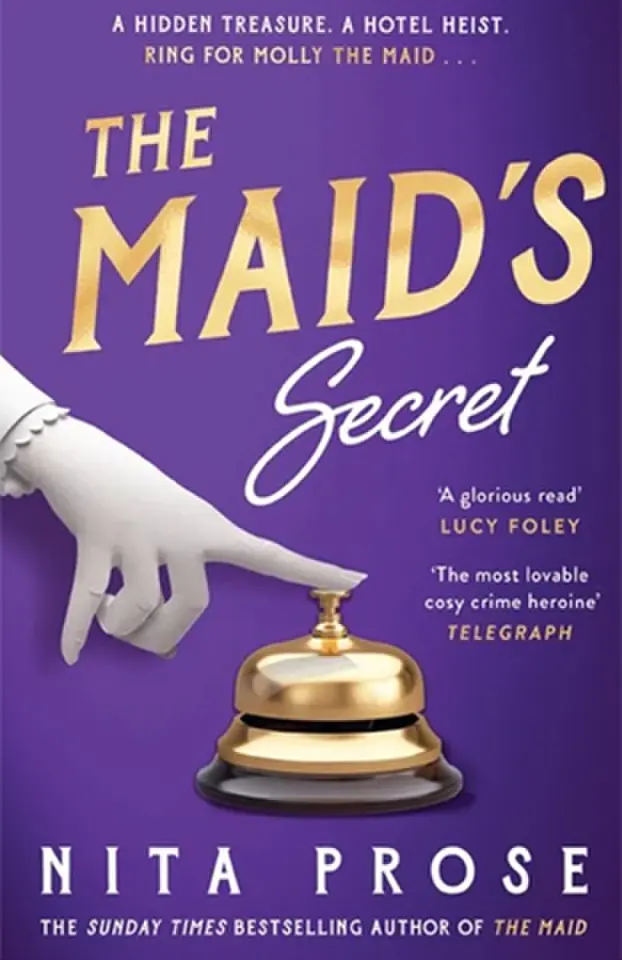
The Maid’s Secret
By Nita Prose
HarperCollins
ISBN: 978-0008708542
403pp.
In 2022, the Canadian-born novelist Nita Prose rocketed to fame with her debut novel, The Maid, which sold over two million copies. She constructed a murder mystery around the character of Molly Gray, a remarkably dedicated and diligent maid at the Regency Grand Hotel (RGH). Molly plays detective when a body is discovered in the hotel’s opulent penthouse suite.
Prose’s debut was followed by The Mystery Guest (2023), and The Maid’s Secret (2025) completes the trilogy. (Incidentally, The Mistletoe Mystery, a novella featuring Molly, was also published in 2024.)
While each novel can be read as a standalone work, readers will be drawn to read all three because Molly’s character and the backstory of her beloved grandmother, Flora Gray, steal the show throughout. Although the first two novels were ostensibly murder mysteries, a large portion of each was committed to underscoring Flora’s story, who basically trained Molly in the arts of housekeeping and housecleaning.
The Maid’s Secret does not contain a murder per se. However, it focuses on a piece of art which Molly inherited from her grandmother, and which she firmly believes is a good imitation of a Fabergé egg. The originals were trinkets (egg-shaped objects made of precious metals and gems) designed by the House of Fabergé, which acquired great value over time, especially due to the patronage of Russian tsars who often presented them to their wives and loved ones.
The third part of a trilogy revisits the main protagonist hotel maid and her beloved late grandmother who trained her, and adds in an inherited multi-million dollar Faberge egg
Excitement builds at the RGH when a pair of very prestigious auctioneers, Thomas Beagle and Baxley Brown, decide to appraise various objects belonging to the hotel staff for an entertaining TV show. Much to the surprise of Molly and her fiancé Juan Manuel (a Mexican-born immigrant who works at the RGH as a pastry chef), they assess that Molly’s trinket is a genuine Fabergé egg, which can potentially be sold for several million dollars.
Molly is overcome with apprehension, but everyone else, ranging from auction groupies to the hotel’s staff, is wildly excited. The hotel manager, Mr Snow, immediately places the egg in the hotel’s office safe, and the doorman, Mr Preston, is particularly thrilled because he loved Molly’s grandmother in their youth and appreciates the fact that Molly will now be able to live a rags-to-riches story.
Ironically, the only one who is less than thrilled is Molly herself, since the televised aspect of the find leaves her with no privacy whatsoever. A truly virtuous and humble young woman, Molly has no desire to be catapulted into the fame of becoming a millionairess. However, Brown and Beagle rightly claim that the find is too major to be ignored, since the egg appears to be the major prototype of several others that were created after it.
Interspersed with the action of Molly’s story, the reader is made privy to the egg’s provenance, which is inextricably linked to Flora’s story. Flora was born and raised in a highly privileged milieu in the earlier half of the 1900s. Intelligent and sensitive, she eventually rebelled against her snobbish parents’ desire to force her into marrying a consummate rake, Algernon Braun.
It turns out that the egg (which ends up being gifted to Flora) was stolen by the Braun family from a noble, rich baron who was a major art collector. Molly only discovers all this by reading her grandmother’s diary during the latter portion of the novel. The reader will find the connections between Beagle, Brown, Braun, and Barons entertaining, albeit somewhat predictable.
Over the course of the novel, the egg gets dramatically stolen during the auction that is set up for it. Much to everyone’s surprise, however, it gets returned to Molly. In a startling plot twist, the thief places it in Molly’s RGH housekeeping trolley, amidst a mound of toilet paper! Given that the auction valued the egg at close to $10 million, this plot twist comes across as highly amusing.
Molly eventually figures out who the thief is and why he took such pains to first steal the egg and then put it back in her belongings. While the mystery is enjoyable, and its solution quite satisfying, only about half the space of the novel is devoted to it — the rest of the novel consists primarily of Flora’s story.
Nita Prose never really manages to make Flora Gray emerge as an authentic character, possibly because too much of her tale involves recounting a plot which tends to become tedious on occasion. Molly comes across as a far more interesting character because one can sympathise with her, thereby experiencing her feelings and sentiments, rather than having them placed mundanely before one in the form of a slightly dull, saccharine diary.
Moreover, the portion of the mystery that focuses on Molly’s friends and acquaintances does tremendous justice to minor characters. Cheryl, a supremely lazy maid, is as well-sketched as a young man named Speedy, whom Mr Preston is training to take over as the hotel’s doorman. Speedy’s speech contains some hilarious malapropisms; for instance, when asked to be discreet, he quips, “Excretion is my middle name!”
Little details, such as the point that Juan Manuel takes great pride in making beautiful animal figures out of marzipan (which he calls “marzipanimals”) make the Molly-segment of the book far more engrossing than the section devoted to her grandmother’s youth.
It is evident that Nita Prose enjoys placing her heroine in predicaments which require Molly to use her own intelligence actively and assiduously. Molly does not disappoint; she approaches every mystery she encounters as if it were a particularly difficult piece of furniture that requires cleaning and polishing.
Naturally, a fair bit of the novel requires a suspension of disbelief — one can understand why Flora eventually found Algernon to be repulsive, but the manner in which she flees from her snooty parents is undeniably far-fetched. Be that as it may, Molly’s relationship with Juan Manuel is based on real love and, although the Fabergé egg ends up causing her no end of trouble, her fiancé admirably sticks by her through thick and thin.
This may be why one simply smiles rather than groans as the novel ends on the maudlin but sweet phrase “love is the greatest gift of all.” The moral of the story is that good-hearted Mexican immigrants can provide one with more satisfaction than glittering Fabergé eggs can!
The reviewer is Associate Professor of Social Sciences and Liberal Arts at the Institute of Business Administration. She has authored two collections of short stories, Timeless College Tales and Perennial College Tales and a play, The Political Chess King
Published in Dawn, Books & Authors, November 1st, 2026