Prophecies, predictions and speculation about humanity’s future have caught the imagination of several scientists, philosophers, prophets, religious leaders, astrologers, soothsayers and literary geniuses. The broad picture about the ultimate fate of humanity and our Earth is possibly this. The Sun, the giver and preserver of life on Earth has already reached half-life, that is, 4.5 billion years out of a total life-span of about 9 billion years. But the next one billion years would be extremely crucial for the earth and humanity as the Sun is likely to lose about 10pc of its luminosity and may also expand in size.
In that event, there will be either a “hot death”, when oceans will boil and dry up or “cold death”, when oceans and the earth will freeze. Or will the atmosphere lose oxygen making it impossible for life to survive? A supercomputer model has predicted that there could be rapid depletion of oxygen in the atmosphere between 1-1.2 billion years from now. In any case, death will be certain and all living species on earth are likely to face extinction. The earth will turn into a dead planet like Venus and Mercury. But for another five centuries, a tiny period of time in the Earth’s life, there appears to be no danger from the Sun’s rotation and it will continue to shower its benevolence on life on Earth.
But because of man’s reckless activities and mindless exploitation of nature, the Earth will surely witness violent volcanic eruptions, earthquakes, tsunamis, floods, desertification and unpredictable climate change causing unprecedented disasters. Modern industrial civilisation entirely depends on power and energy sources. Imagine a situation when a global breakdown in power supply-chains takes place; the whole world will plunge into darkness and everything will come to a standstill. One shudders to think about such an eventuality. But the fact remains that the non-renewable energy resources will run out, today or tomorrow. Estimates vary.
But there is near unanimity among geo-scientists and experts about the probable timelines by which the non-renewable energy resources will run out. Let’s have a look at how long these sources will last globally.
a. Crude oil: The world is left with 1.7 trillion barrels of oil reserves and at the current rate of consumption of 102.8 million barrels a day, the reserves will last for another 57 years. New discoveries and improved technology of extraction may give another few decades and at best another 100 years.
b. Natural Gas: At the current rate of consumption, natural gas reserves may last for another 50 years but new discoveries may extend it to a maximum of 100 years.
c. Coal: Coal reserves are available in abundance and may easily last for 200-300 years.
d. Uranium: Uranium reserves for nuclear power may last for another 150-200 years.
Major minerals critical for our industrial civilisation will also run out within a period of 100-200 years. At the current rate of exploitation, economic reserves of iron ore will last for another 50-100 years. Since iron ore constitutes five per cent of the earth’s crust, the total reserve of 180 billion metric tons should last for a few centuries. Global copper reserves (estimated at 890 million tons) will last for another 40 years.
Aluminium (from bauxite) is the most abundant metal on the planet forming 8 per cent of the earth’s crust and because of its recycling properties, it will perhaps not run out in the coming centuries. Cement (from limestone): Limestone reserves (67.5 quintillion tons) are not likely to run out in the coming centuries. The world’s Rare Earth Oxides (REO) reserves estimated at 75-85 million metric tons are likely to last for roughly 190-200 years.
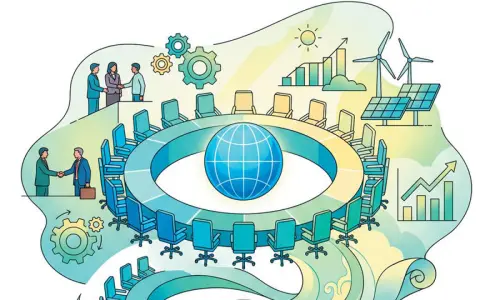
Therefore, much before the world reaches 2500CE, all the non-renewable energy sources will dry up and there will be a complete transition to renewable energy sources, that is sun, wind and water. Humanity will inherit vast reserves of scientific knowledge and technology, which will be put to use for better utilisation of renewable energy including hydrogen power. But because of their inherent limitations and localisation, universal use to propel mega carriers may not be possible. The continents and nations will fall apart and will survive in relative isolation.
Unless scientists are able to make magical power banks during this period, the jumbo-jets and the supersonic fighter aircraft will not fly, the mega-container ships will not sail across the oceans, bullet trains will stop running, space rockets will not boom in the sky, and the Porsches and Lamborghinis will no longer speed down highways. In the absence of megawatts and gigawatts of electricity, mega-cities and skyscrapers would be rendered unsustainable for living and people will have to abandon cities and migrate to rural areas. The common people will perhaps have to live like the peace-loving community of Amish in America, who even today, build their own homes, grow their own food, travel in horse-driven carts and have their own educational system and places of worship.
Circa 2500 CE will mark the end of the modern industrial revolution and herald a new kind of civilisation based on renewable energy, human hands and animal power. During the intervening period of almost five centuries, the world will go through tectonic changes following climate change, natural disasters, pandemics, wars, famines and diseases. It is said history doesn’t repeat itself but sometimes it does so in disguise and in unpredictable forms.
It has been observed that a virulent pandemic of an unknown virus killing millions of people visits us almost every century. History also tells us that there have been deadly wars in each century since the days of the Mahabharata. It is almost certain that there will be wars like WWI and WWII in each of the centuries.
Published in Dawn, October 26th, 2026