Supreme Court questions Sindh govt’s property claim
• Wonders why only litigants have to approach civil courts in cases not disputed by competent authority
• Says oral claim of auction cancellation can’t negate tenancy relationship
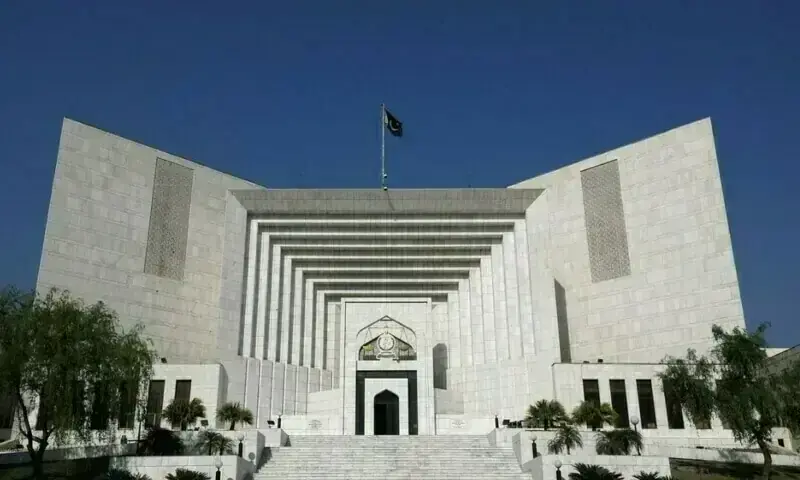
ISLAMABAD: Taking note of the Sindh government’s sudden awakening from a deep slumber in a property dispute, the Supreme Court on Saturday questioned why a litigant alone should have to approach civil courts to seek a declaration of title that had never been disputed by the competent authority.
“Why the tenant/government of Sindh was in deep slumber if at all they have any vested right or title which apparently seems to be in air,” observed Justice Muhammad Ali Mazhar in a judgement authored by him.
The observation came as the SC remanded a protracted landlord-tenant dispute to the Sindh High Court (SHC) for fresh adjudication within six months, setting aside its Dec 5, 2023, judgement.
Justice Mazhar, who headed a three-member Supreme Court bench comprising Justice Irfan Saadat Khan and Justice Aqeel Ahmed Abbasi, was hearing a civil petition filed by Rasheeda Begum, who had purchased Plot No. 4/3, Survey No. 98/101, measuring 1,000 square yards, from Bushra Rahat through two separate registered sale deeds. One deed covered 210 square yards and the other 790 square yards. Both deeds were executed on March 28, 2011.
The property was already under tenancy with the Sindh government, which had been paying monthly rent of Rs50,000 to the previous owner under a tenancy agreement dated Dec 1, 2007.
After purchasing the property, Ms Begum served a notice under Section 18 of the Sindh Rented Premises Ordinance, 1979 (SRPO), informing the Sindh government of the change in ownership.
The dispute subsequently passed through several rounds of litigation over a number of years, involving ejectment proceedings, first rent appeals and constitutional petitions.
During the third round of litigation, the Sindh government challenged the Rent Controller’s jurisdiction under Section 3 of the SRPO, claiming that the property had been requisitioned by the government. It further contended that the auction in favour of the original purchaser had been cancelled in 1974.
During an earlier round of litigation, the Sindh government had acknowledged the previous landlord’s ownership. However, when Ms Begum served the notice under Section 18 of the SRPO and provided documents establishing her title, the government claimed to have discovered that the land had been transferred on the basis of an auction that was subsequently “cancelled” because the auction purchaser had failed to deposit the required amount within the stipulated period.
The tenant’s defence was struck off under Section 16(2) of the SRPO for failure to deposit rent arrears. The Rent Controller’s consolidated order was challenged through First Rent Appeals (FRAs) Nos. 91 and 97 of 2022, but both appeals were dismissed.
The Sindh government subsequently filed a constitutional petition before the SHC, which allowed it, set aside the concurrent findings of the courts below and directed Ms Begum to institute a civil suit to resolve the question of title. “If the government of Sindh really had a vested legal right or title to the property, why did it remain completely inactive for so long and fail to assert that right earlier?” Justice Mazhar questioned.
The SC bench noted that the government’s claimed title appeared vague and unsupported by the record. Merely asserting orally that the auction had been cancelled in 1974 was insufficient to establish a cause of action for disputing the landlord-tenant relationship in ejectment proceedings, which were not the appropriate forum for determining ownership of the property.
“In our considered view,” the judgement observed, if any such notification had been issued in the past, it should have been produced before the Rent Controller before the government acquiesced to the landlord-tenant relationship.
The judgement also referred to the Latin maxim “Allegans contraria non est audiendus”, which embodies the principle that a person should not be permitted to take contradictory positions on the same matter.
Setting aside the SHC’s decision, the apex court remanded the matter to the high court for fresh adjudication through an independent application of mind, preferably within six months of receipt of the SC judgement.
Published in Dawn, October 25th, 2026