Collective deterrence under Makkah pact ‘already in play’
• ISPR chief says Pakistan providing ‘all necessary support’ to Saudis in fight against Houthi threat
• Maintains all efforts directed at ending conflict; calls on Muslim nations to stop attacking each other
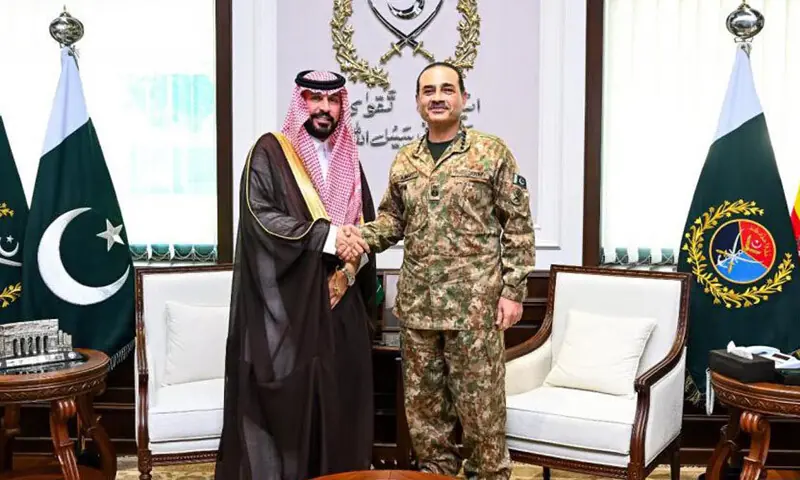
• CDF Munir, Saudi envoy express satisfaction with Makkah pact progress
ISLAMABAD: Pakistan is providing “whatever support is needed” to defend Saudi Arabia amid attacks by Yemen’s Houthi rebels against the kingdom, Inter-Services Public Relations (ISPR) Director General Lt Gen Ahmed Sharif Chaudhry said.
“Pakistan is giving very strong signals that this collective deterrence is at play, has already been actualised and we will take all necessary steps for the security and territorial integrity of the Kingdom of Saudi Arabia and the Haramain Sharifain (The Two Holy Mosques),” he said in an interview with Independent Arabia.
The “message is going to everyone, whether he is in front or he is behind” the escalation, Lt Gen Chaudhry remarked.
Asked about the military support Pakistan is providing to the kingdom amid attacks by Houthis, Lt Gen Chaudhry said Saudi Arabia’s “sovereignty, territorial integrity, and the security, and foremost the security of the Two Holy Mosques, is paramount”.
“It’s non-negotiable; it’s absolute as far as Pakistan is concerned […] So whatever support is needed to do that is being provided and will be provided,” he affirmed, adding that no alliance makes public the specifics and the quantification of the support provided.
Commenting on Pakistan’s reaction to the Houthi attacks against Saudi Arabia, the military spokesman said, “Our reaction in Pakistan… is one of anger… why would anyone in [their] right mind attack or threaten Saudi Arabia or the holy places, or even give an impression of threatening the holy places.”
On whether Pakistan’s support to Saudi Arabia will strictly remain defensive if the Houthi attacks continue, the military spokesperson said all three members of the alliance were “absolutely clear […] that this alliance has no offensive intent; it is purely defensive”.
Citing Article 51 of the United Nations Charter that provides collective deterrence, he said such a mechanism “gives a very strong and clear message to those elements of instability, of chaos, in the region that if you directly or indirectly wage this war against any of these three countries, then the response will be collective”.
“If that deterrence doesn’t work, then that deterrence has to be re-established by all means that are available to the three countries,” he added.
Asked whether Islamabad had issued any “warning” to Tehran regarding Houthis as the Saudi deputy foreign minister linked the two, the DG ISPR stressed that Pakistan had been engaging with all parties involved, including Iran, “with the singular intent of restraint and to reduce the temperatures”.
The military spokesperson reiterated that “all interactions and all conversations with the parties are based on dialling down the escalation”.
“Whether you expand it to Houthis, whether you expand it to other places, it doesn’t serve anything. It only serves those who are interested in chaos in the region.”
Addressing claims linking the alliance’s formation to the need to deter Iran or Israel, Lt Gen Chaudhry said the pact was not “country-specific” and did not have any “offensive intent”.
However, he added: “It is [formed] to have peace, stability and security in the region. So any actor which threatens that peace, stability and security, it automatically interacts with this collective deterrence mechanism.”
Regarding the threats to maritime navigation in the Bab al-Mandeb and the Strait of Hormuz, the ISPR chief noted that Riyadh had established a multinational maritime defence coalition, with a Pakistani naval officer serving as its deputy commander.
He was referring to the Saudi-led Multinational Maritime Defence Coalition, which became operational in September this year. The force is commanded by Saudi Rear Admiral Abdullah bin Salem Al-Shehri, with Pakistan Navy Commodore Rashid Sheikh serving as his deputy.
Asked about his message to Saudi Arabia and the Muslim world, Lt Gen Chaudhry said Muslims “need to unite”. He emphasised that there was no advantage “to these countries, any country, by vertically or horizontally escalating these conflicts”.
“We need to stop attacking each other,” he maintained, highlighting that Pakistan had been trying to convey the same to all parties since the US-Iran war erupted.
“If we are unable to come to a negotiated outcome and we turn into a military conflict, then this instrument of collective deterrence of the Makkah alliance will definitely come into play, as it is coming into play,” Lt Gen Chaudhry said.
Regarding the expansion of the alliance, the military spokesperson maintained that the door remains open to other countries that believe in the principle of collective deterrence and share the member states’ goals related to regional security and stability.
Asked about reports of Egypt and Syria’s interest in joining, he stated such decisions rest with the political, strategic and military leadership of the three countries.
CDF meets Saudi envoy
Lt Gen Chaudhry’s remarks came ahead of a meeting between Chief of Defence Forces Field Marshal Asim Munir and the new Saudi envoy to Islamabad, Dr Rajeh Tami Albugamy, on Monday.
“Both the dignitaries expressed satisfaction over the progress made under the framework of the Makkah Joint Defence Agreement and underscored the importance of strengthening defence collaboration, institutional linkages and strategic coordination,” ISPR said.
CDF Munir congratulated the ambassador on his appointment and expressed confidence that his tenure would further strengthen the longstanding fraternal ties between Islamabad and Riyadh, which are “rooted in shared faith, mutual trust and strategic partnership”.
Last week, Mr Albugamy had met President Asif Ali Zardari, Prime Minister Shehbaz Sharif and Foreign Minister Ishaq Dar.
Published in Dawn, October 20th, 2026