EXHIBITION: RIVER, CITY, COSMOS
What is art for? That is the question ‘The sky held it, the earth remembered’ keeps returning to, although never quite directly.
At Dubai’s Ishara Art Foundation, Shahana Rajani, Rohini Devasher and Sarker Protick approach the question from radically different distances: a village submerged in the Indus Delta, a city changing block by block in Dhaka, and a phenomena unfolding across the surface of the sun. What connects them is not immediately obvious — the exhibition asks you to work it out.
Presented by Ishara in collaboration with the Han Nefkens Foundation, the exhibition brings together artists from Pakistan, India and Bangladesh around the idea of land, water and cosmos as “living archives of memory and history.” Its curatorial premise is that environments bear “material traces” of ecological change across deep time — traces that can be obscured, submerged or simply beyond human perception.
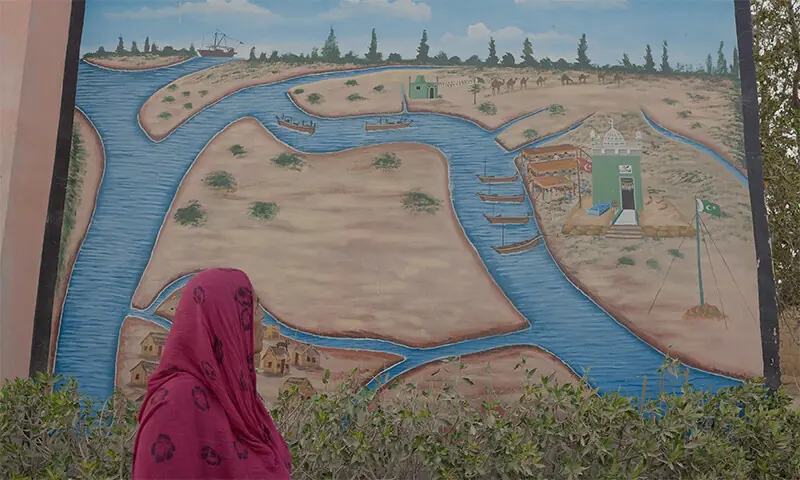
At the centre of this is Lines That World a River by the Karachi-based artist Shahana Rajani, the recipient of the inaugural Han Nefkens Foundation South Asian Video Art Production Grant. The three-channel film is an expanded iteration of Four Acts of Recovery, produced through the grant, where communities of the Indus Delta, displaced by dams and barrages reconstruct their submerged villages through painting. Houses, boats, winding creeks and dargahs [shrines] appear as remembered landscapes — images of places that can no longer be inhabited as they once were.
Three artists from Pakistan, India and Bangladesh use art as a living archive of memory and change at a newly opened exhibition in Dubai
In the video, a villager remarks, “When I see these murals… I feel as if we are living inside the paintings. The land is alive again.” That moment changes the way one might think about the paintings and art itself. For the people who make them, the murals become a place of return, a way of making a submerged landscape present, when it can no longer be reached.
We are accustomed to thinking of paintings as representations, objects that refer to something beyond themselves. Here, the distance between image and lived reality becomes much harder to maintain. The question of what art is capable of doing suddenly feels considerably larger than the walls of the gallery.
The work’s formal construction reinforces this. At the centre of the three screens is an enclosure evoking a dargah, referencing shrines that remain standing when surrounding settlements are inundated. In the gallery, the visitor is invited inside. The dargah becomes both architectural reference and absence, a structure that survives while the world around it does not.
Rohini Devasher’s Latent Fields takes us almost impossibly far away. Three monumental silk panels carry images inspired by sunspots and other solar phenomena, developed through drawing, acid washing, embossing, fumage, photography and digital printing. Devasher’s practice moves between art and astronomy, asking how we observe phenomena that cannot be encountered directly. Here, what is being recorded exists at a scale beyond unaided human perception.
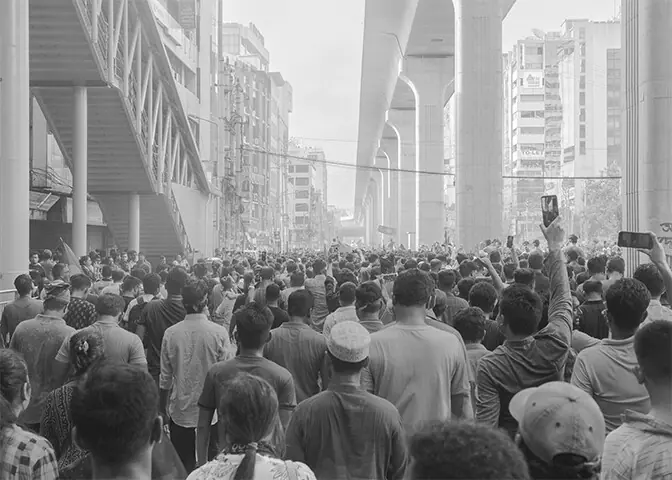
Sarker Protick’s Dhaka 1217 series brings the gaze back to the city in a deeply personal way. The series draws from 135 black-and-white photographs taken between 2011 and 2026 in the neighbourhood where Protick was born and continues to live. Construction encroaches on parks, lakes and vegetation as railway infrastructure gradually obscures the landscape. Alongside these larger transformations are smaller traces of personal life: fallen hair, an old photograph, dusty books.
The relationship between the three bodies of work lies in the question of what change leaves behind and how we recognise it. A submerged village survives through painted memory. A changing neighbourhood is registered photograph by photograph. Phenomena invisible to the naked eye become images through scientific and artistic processes.
The exhibition gives us traces without always telling us exactly what to do with them. We are asked to notice what is absent, what has changed and what has survived — to move between personal memory, ecological transformation and scales of time that exceed ordinary experience. The viewer performs an act of archival work, gathering fragments and trying to understand what they tell us.
Which brings us back to the question: what is art for?
At face value, ‘The sky held it, the earth remembered’ could seem like another exhibition in a sea of narratives about environmental degradation and ecological destruction. Its deeper proposition emerges slowly, in the act of looking: what survives change, what becomes invisible and how do we know what was there?
‘The sky held it, the earth remembered’ is on display at the Ishara Art Foundation in Dubai from September 11-Decemebr 15, 2026
The reviewer is a Dubai-based writer and communications strategist. Her writing explores identity, art and cultural shifts. She has written for Newsweek Middle East and Wired, and has been featured by AJ+, BBC and
Arab News. Instagram: @arfashahid
Published in Dawn, EOS, October 18th, 2026