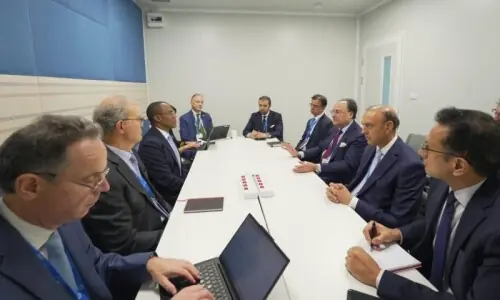
PAKISTAN has reached a staff-level agreement with the IMF after completing the fourth review under its programme. Implementation of the Extended Fund Facility is on track, with progress on macroeconomic stability. The challenge is to translate the gains into sustained growth.
Political and administrative disruptions that can derail this difficult transition must be avoided. The fiscal deficit has been contained at 2.6 per cent of GDP. The primary surplus has strengthened, supported by provincial cash surpluses and exceptional grants to the federal budget. Revenue targets have been met, though raising petroleum levies amid rising global prices adds to inflationary pressure. The external current account has been broadly balanced, largely because of stronger-than-expected workers’ remittances, despite declining merchandise exports.
Sovereign credit ratings have improved, though remaining below 2006-07 levels. Access to global capital markets for long-term financing stands restored, and diversification into instruments like Panda bonds has begun. Foreign portfolio inflows have recovered, but FDI remains disappointing. Talks with the US Treasury on a proposed 10-year Exchange Stabilisation Facility continue, while tariff reduction discussions with the US Trade Representative remain inconclusive.
Foreign exchange reserves accumulated by purchasing dollars from the intermarket rather than borrowing now cover three months of imports, up from a trough of $4.3 billion in FY2023, helping stabilise the exchange rate and strengthen the balance of payments.
External public debt has declined to 25pc of GDP; the share of short-term debt has fallen from 24 to 16pc, partly after a Saudi deposit was converted into a three-year facility.
Yet ordinary citizens see little improvement. Poverty, joblessness, poor public services, unfair taxation, intrusive regulation, and high energy prices constrain households and businesses. Savings and investment are weak, and exports lack the dynamism to sustain growth. We must expand productive capacity, employment, and exports without reigniting inflation or destabilising the external account. This requires completing the structural reform agenda. Federal and provincial governments must be right-sized, civil services professionalised through specialist recruitment and better incentives, and public administration digitised. The FBR must broaden the tax base instead of burdening compliant taxpayers; provinces must effectively implement agriculture income and property taxes. Energy and wheat markets must be made more competitive, with BISP protection for poor households.
Restructuring and privatising SOEs, reforming the Export Facilitation Scheme, implementing the National Tariff Policy, and expanding financial access for small businesses, farmers, women entrepreneurs, and housing are equally important. Export financing and insurance must reach new exporters. Delays or reversals will weaken investment, employment, and competitiveness, undermining the stability painstakingly achieved. Long-delayed infrastructure projects must advance — the Karachi-Peshawar ML-1 railway, the Sukkur-Hyderabad motorway, oil pipeline extensions, oil refinery upgrades, the Quetta-Zhob highway, five special industrial zones, and revamping the Karachi Circular Railway. Skills upgrading must complement these investments.
Pakistan is midway from crisis management to sustainable growth.
Industrial, automobile, and strategic trade policies must be harmonised in consultation with the private sector and announced without delay. A credible implementation framework with clear milestones, assigned duties, and firm timelines is needed. Regular monitoring, inter-agency coordination, and timely bottleneck removal must replace announcements without execution. External risks make the transition more urgent.
The US-Iran war, disruptions to energy flows through the Strait of Hormuz, and instability in Bab el-Mandeb can sharply raise import costs, intensifying uncertainty over inflation, the current account and exchange rate. Suspension of the Indus Waters Treaty compounds water insecurity. Meanwhile, AI is transforming labour markets, creating uncertainty about job opportunities.
Against this backdrop, three domestic sources of disruption demand particular attention. First, security in KP and Balochistan must be restored through dialogue and an effective counterterrorism strategy. Poverty and conflict reinforce each other. Reversals in poverty reduction are linked to conflict-affected districts, where social indicators are among the weakest nationally. The NFC framework should give greater weight to disadvantaged districts, alongside empowered local governments (LGs). Federal and provincial governments must jointly own a practical CT plan. The apex committees set up after 2014 showed the value of coordinated action in restoring peace. Imposing emergency and governor’s rule in KP could, instead, intensify political tensions and worsen law and order amid terrorist attacks. Economic relief, jobs, and better public services must complement security operations.
Second, the movement of goods and services across the country must be uninterrupted. LEAs requisitioning containers, trucks, and oil tankers disrupt trade. Imports must reach factories on schedule, exporters must honour delivery commitments, and farmers must transport perishable produce to urban markets without delay. Supply disruptions raise prices and create household shortages.
Internet shutdowns are equally damaging, disrupting payments, business transactions, logistics, information flows, and the work of freelancers and firms exporting IT and IT-enabled services. Economic activity requires predictable rules and uninterrupted movement of goods, people, and information. Administrative measures intended to address immediate security concerns must not impose disproportionate costs on the economy.
Third, the debate over new provinces/ administrative units shouldn’t become another source of instability. It’s a contentious proposal; the Sindh Assembly has opposed dividing the province. Administrative reorganisation requires constitutional clarity, fiscal assessment, and political consensus. Failing to do so would divert scarce resources to new bureaucracies, increase administrative expenditure, and weaken provincial cash surpluses transferred to the centre. Fiscal consolidation will then suffer, jeopardising macroeconomic stability. Strengthening LGs and improving service delivery within existing arrangements should take precedence.
Pakistan is midway through a demanding transition from crisis management to sustainable growth. Political leaders hope that the present IMF programme will be the country’s last. Fulfilling that aim needs continuity, discipline, and determined implementation. External shocks can’t be controlled, but their impact can be mitigated through sound policies and domestic consensus. The priority is clear: restore peace through dialogue, keep goods and services moving, complete reforms already initiated, and avoid divisive experiments. Pakistan can’t afford to squander its hard-won stability through preventable disruptions. The transition to growth must be protected, not derailed.
The writer is a former State Bank governor.
Published in Dawn, October 15th, 2026