Parliament nod not mandatory for Makkah pact deployments: FO

• Says pact, military commitments fall within executive authority under existing laws
• Insists troops in Saudi Arabia will be used for defence, not attacks inside Yemen
• Stresses diplomacy remains preferred route, but questions talks amid Houthi attacks
• PM condemns Houthi attacks, reiterates Pakistan’s support for Saudi security
ISLAMABAD: The Foreign Office on Friday emphasised that signing the Makkah Joint Defence Agreement and committing military capabilities under it were executive functions under Pakistan’s national laws and Rules of Business and did not necessarily require parliamentary approval.
Speaking at the weekly media briefing, Foreign Office spokesperson Sajjad Haider Khan said the agreement had been signed and Pakistani personnel were already deployed in Saudi Arabia under previous arrangements, adding that relevant decisions had been taken in accordance with the applicable legal framework.
“Governments make decisions in accordance with their own rules of business. The agreement has been signed, and the deployment is already in place, based on our previous agreements as well. Pakistan will follow its own rules of business, and that decision has already been taken,” he said.
On parliamentary approval, Mr Khan said: “If there is a need to take the matter to parliament, that would be a different matter. However, as of now, the decisions are fully covered under the law and the applicable rules of business.”
The government’s position rests on the executive’s authority over foreign relations and international agreements. Articles 90 and 99 of the Constitution, read with Rule 16(1h) of the Rules of Business, 1973, place the conduct of foreign policy and the signing and ratification of international agreements within the domain of the executive and federal cabinet. Parliamentary approval is not required unless implementation of an agreement entails changes to domestic law.
Successive attempts by parliamentarians to establish a formal legislative role in the ratification of international agreements, including bills moved by Dr Shireen Mazari in 2013 and Senator Raza Rabbani in 2018, did not succeed.
However, governments have turned to parliament when political circumstances warranted backing. In 2012, the government sought parliamentary support for terms governing the reopening of Nato supply routes following the Salala incident.
A similar course was followed in 2015, when the government took the Yemen crisis to a joint sitting of parliament and secured a unanimous resolution supporting Saudi Arabia in the event of a threat to its territorial integrity or the two holy mosques, while declining to commit Pakistani forces to combat in Yemen and urging neutrality.
Mr Khan rejected the impression that the agreement had been pursued without political consultation, stressing that the arrangement reflected a “whole-of-government approach”.
He cited meetings chaired by the prime minister and participation in the Strategic Political and Defence Committee by Deputy Prime Minister and Foreign Minister Ishaq Dar and Defence Minister Khawaja Asif, both members of parliament and the federal cabinet.
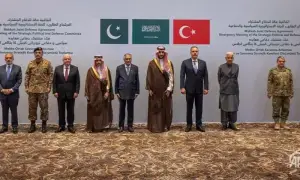
The Oct 5 meeting of the Makkah alliance’s Strategic Political and Defence Committee in Riyadh called for immediate implementation of collective defence commitments and rapid deployment in Saudi Arabia of military forces and capabilities already agreed upon, subject to each member’s national legislation. The statement did not authorise operations inside Yemen.
The spokesperson recalled that Pakistan’s armed forces had maintained a presence in the kingdom since 1982 under different arrangements and said any further mobilisation would depend on the alliance’s requirements.
“At the recent SPDC meeting, the three countries decided that appropriate mobilisation would take place according to requirements. It is for the organisation and the alliance’s headquarters to decide how much deployment is required, when and where it should take place, and the countries that are part of the alliance will make the necessary contributions accordingly,” Mr Khan said.
He said Pakistan understood that troops deployed to Saudi Arabia would not be used for operations inside Yemen.
“These forces would not cross the border into Yemen to launch attacks against the Houthis. However, they would, of course, be utilised to defend the country’s [Saudi Arabia’s] territory and safeguard its sovereignty,” he said.
Turkiye, the alliance’s third member, is following a different legal route. Article 92 of the Turkish Constitution gives parliament authority over the deployment of Turkish armed forces abroad, subject to specified exceptions.
The issue has since moved towards parliamentary consideration in Ankara. Ruling AK Party spokesman Omer Celik said on Oct 7 that the agreement was expected to be sent to parliament within days, while Foreign Minister Hakan Fidan said on Oct 8 that the necessary work for its submission had been completed.
Mr Fidan described the agreement as defensive, saying Turkiye would not send troops to another country to carry out attacks on its territory. He said military delegations would assess Saudi Arabia’s operational requirements, including air defence and technical support, while Ankara was also pursuing a diplomatic track.
Mr Khan said Turkiye had committed itself under the agreement to providing the support needed to strengthen the alliance’s defensive capabilities, adding that each country had its own procedures.
He cited the participation of the Turkish foreign minister, defence minister and chief of defence forces in the Oct 5 meeting as evidence of Ankara’s commitment.
Pakistan remained in favour of political dialogue and de-escalation, the spokesperson said, but argued that prospects for talks depended on the Houthis’ willingness to change their conduct.
“We are not saying that diplomacy is not a solution or that we should only fight a war. We fully agree that peace can only be achieved through diplomatic means. However, this also depends on whether the other side is willing to pursue peace. If they are ready, we can consider the next steps,” he said.
He questioned whether talks could be productive while the Houthis continued attacks on infrastructure and maritime routes, saying the group appeared to believe such actions would give it leverage.
“In such a situation, I do not think talks would be fruitful; they would simply be futile. Therefore, the parties must first come to terms with the situation before moving forward diplomatically,” Mr Khan said.
PM condemns Houthi attacks
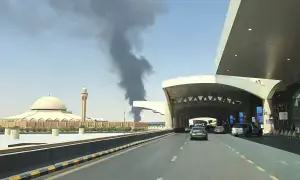
Prime Minister Shehbaz Sharif on Friday strongly condemned repeated attacks by the Houthi militia against Saudi Arabia, including the targeting of King Khalid International Airport in Riyadh and Abha International Airport, which resulted in civilian deaths and injuries.
In a post on X, the prime minister commended the vigilance and professionalism of the Saudi armed forces and the Islamic Military Counter Terrorism Coalition in intercepting multiple ballistic missiles and protecting civilian lives and critical infrastructure.
“Pakistan stands in unwavering solidarity with the leadership and people of our brotherly Kingdom of Saudi Arabia,” he said.
PM Shehbaz said that in line with the Makkah Joint Defence Agreement and recent decisions of its Strategic Political and Defence Committee, Pakistan’s commitment to the kingdom’s sovereignty, territorial integrity and security remained resolute.
He said Pakistan fully supported Saudi Arabia’s legitimate right to defend its people and protect its cities and vital infrastructure.
“The Houthi militia must immediately cease these attacks. We will continue to stand shoulder to shoulder with Saudi Arabia in the face of these threats,” the prime minister said.
Syed Irfan Raza also contributed to this report
Published in Dawn, October 10th, 2026