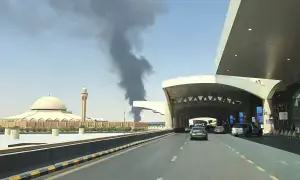
RIYADH: Three people, including a pilot, were killed in Houthi attacks on Riyadh’s international airport a day earlier, Saudi authorities said on Friday, as Saudi-backed Yemeni forces launched a major operation to recapture a strategic Red Sea shipping strait from the group.
The war has quickly become the fiercest front in a wider regional conflict triggered by the US and Israeli attack on Iran, which began on Feb 28. It has brought intense fighting back to Yemen and to the Saudi capital.
Explosions echoed across Riyadh on Thursday, forcing diplomats stationed in the city to shelter in place and international schools to take safety measures.
The kingdom’s civil defence agency said missile interception debris had damaged a kindergarten and a medical complex. The strikes also damaged a Saudia Airlines plane and disrupted air traffic, days before Riyadh is due to host a major meeting of global oil chiefs.
The Saudi civil aviation authority said the attacks had resulted in the “martyrdom of three citizens”. The national flag carrier confirmed that one of its captains had died, expressing “profound sadness”.
Admissions by Saudi authorities that civilian targets have been hit are relatively rare. The Houthis had already killed three people in strikes on airports in the kingdom earlier this week.
Battle for Bab al-Mandab
The attacks came as Saudi Arabia stepped up its military campaign against the Houthis, aimed at reversing their recent territorial gains, threats to international shipping and attacks on the kingdom.
The Houthis have made major gains in recent weeks, including along the Red Sea coast near the Bab al-Mandab strait. The government forces backed by Saudi air power are trying to retake Bab al-Mandab.
The chokepoint is critical to global energy markets and has become vital to Saudi oil exports as Iran partly blockades the Strait of Hormuz.
Saudi Arabia’s ambassador to Yemen, Mohammed al-Jaber, wrote on X that the strait had been liberated from the last Houthi elements.
A military source on the ground contradicted that account, confirming that government forces had launched a “major operation” in the area on Monday but saying “fighting is fierce and advances are limited”. Houthi-affiliated media said an attack by government forces south of the strait had been repelled.
Although the government claims to have pushed fighters out of strategic areas on the coast, the Houthis remain in the port city of Mocha, and government forces are now focused on a battle in nearby hills overlooking it.
Further inland, the Houthis have cut a key mountain road to Taiz, encircling the city of more than half a million people and its garrison of thousands of pro-government fighters.
Meanwhile, a regional source briefed on Saudi government policy told AFP that Riyadh was ruling out negotiations on “any truce or ceasefire before the Yemeni government regains the territory it lost last month”.
The source added that the kingdom would not bow to Houthi “military blackmail” and was seeking help from Pakistan and Turkiye, its partners in a mutual defence pact, to ward off the attacks.
Houthi media reported on Friday that Saudi strikes on the airport in the capital Sanaa killed two people, a day after the group launched deadly strikes against Riyadh’s own air hub.
Separately, the civil defence agency in the Yemeni capital reported extinguishing four fires caused by Saudi strikes, including one it said destroyed a factory.
Overnight on Thursday, the Saudi-led coalition launched intense air strikes on Houthi targets, saying it had destroyed three missile launch platforms.
The raids hit military positions in Sanaa, away from residential neighbourhoods, shortly after a large demonstration in support of the group in the city centre. Houthi media reported strikes on two factories in the capital and in Saada governorate, the group’s stronghold.
Published in Dawn, October 10th, 2026