Peshawar High Court acquits police official in evidence fabrication case
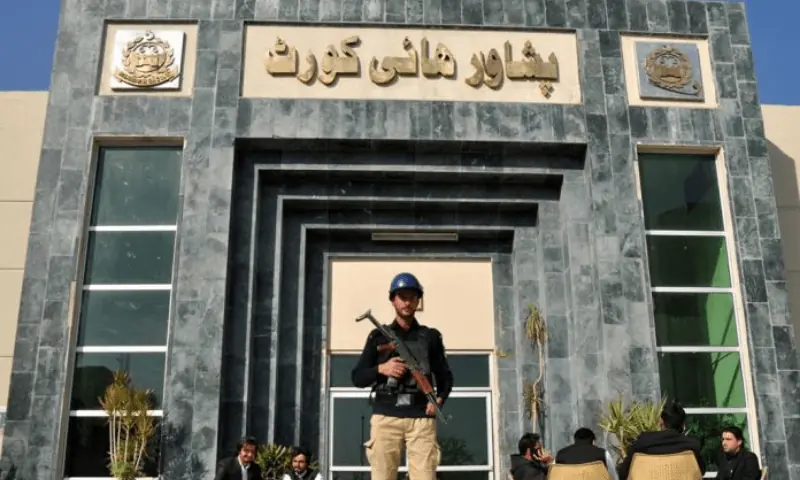
PESHAWAR: Peshawar High Court has set aside the conviction and sentence of 10 years’ imprisonment awarded by a trial court to a police inspector for ‘fabricating evidence’ in a murder case.
A bench consisting of Justice Sahibzada Asadullah and Justice Farah Jamshed accepted an appeal filed by the inspector, Hidayatullah, and ordered his acquittal.
An additional sessions judge, Imtiaz Ali, had in June this year pronounced that Hidayatullah was found guilty of offences under sections 186 (2) (hampering investigation) and 193 (fabricating false evidence) of Pakistan Penal Code.
The judge had convicted him on both the counts and sentenced him to seven years imprisonment under Section 193 and three years imprisonment under Section 186 (2) of PPC.
The officer was sentenced to 10 years’ imprisonment by trial court
The appellant was investigating officer (IO) in a murder case of a woman Mehfooza Bibi, who was killed at a bus stand in Peshawar. The FIR of the occurrence was registered at Pahari Pura police station on July 4, 2024, under sections 302, 324 and 34 of PPC.
The appellant had appeared as prosecution witness during trial of the occurrence and his cross-examination took place on Jan 7, 2026.
Advocate Shabbir Hussain Gigyani appeared for the appellant and contended that the primary role of a court was that of an impartial and fair adjudicator. He argued that under the law, a conviction could only stand if the proceedings complied with the Constitution, law and prescribed procedures.
The bench held that the appellant was deprived of his fundamental legal and constitutional rights.
It ruled that the appellant was not provided with a proper opportunity to present an effective defence, which violated the fundamental right to a fair trial and due process under Article 10-A of the Constitution.
The bench observed that the appellant was not granted an adequate opportunity to engage a counsel of his choice to defend him, whereas effective legal assistance was an essential element of a fair trial in criminal proceedings.
The court observed that during the proceedings, the trial judge’s role was not restricted to that of an impartial judicial forum; prima facie, the judge acted as complainant, prosecutor, and adjudicator simultaneously, which contradicted the fundamental requirements of justice and judicial impartiality.
The bench noted that if the matter pertained to a breach of a legal order or investigative duty by a police officer, following the procedure prescribed by law was mandatory. It added that merely exercising powers to directly impose punishment couldn’t substitute the settled procedure of law.
The trial court had pointed out that during cross-examination, the IO stated that he had not recorded the statement of the manager or any other person of the bus stand and had also not cited any of them as witness on the recovery memo.
It said that he had also not recorded the statement of the CCTV camera operator nor was there any reference on the record as to who transferred the recording of the occurrence to a USB.
Moreover, the IO had admitted that he had not dispatched the subject USB to forensic science laboratory or Punjab Forensic Science Agency (PFSA), Lahore, or cybercrime agency to ascertain its genuineness or otherwise.
Published in Dawn, October 8th, 2026