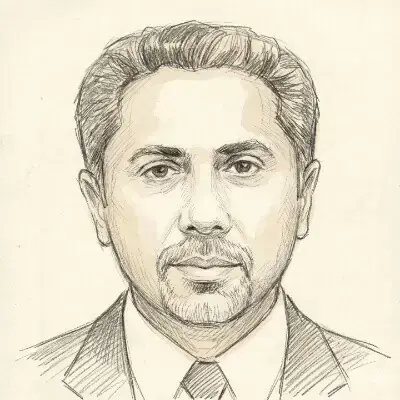
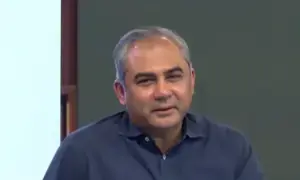
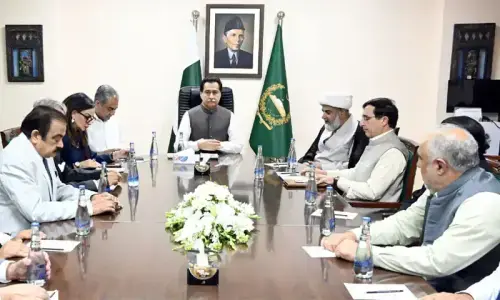
KARACHI: A book titled The Fractured World and the Promise of Peace by former ambassador G.R Baluch was launched at an event organised by Rotary Club.
Speaking to the attendees, the author said he had highlighted “six fault lines” in the world economic and political order in his book.
One such fault line or a fracture was “asymmetric warfare and maritime chokepoints”.
“Drones, precision missiles, naval blockades and maritime chokepoints now enable states and non-state actors to impose strategic costs disproportionate to their conventional military strength,” said the former diplomat.
Former diplomat’s book The Fractured World and the Promise of Peace launched
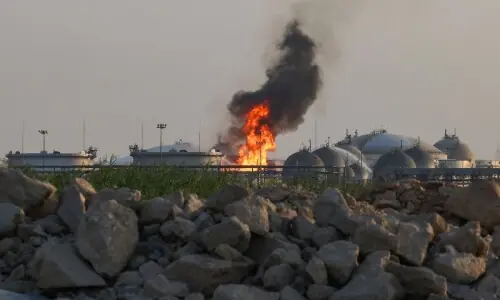
Citing the cases of the Strait of Hormuz and Bab al-Mandeb, the envoy said disruption in Hormuz had exposed the vulnerability of global energy markets, while threats around Bab al-Mandeb have placed additional pressure on the Red Sea trade corridor.
“Two narrow straits now possess extraordinary leverage over the economic security of the wider world,” said the author.
Mr Baluch said relatively inexpensive drones can threaten costly military assets and critical infrastructure.
Naval blockades and threats to commercial shipping have become instruments of warfare and diplomatic coercion.
“Prolonged disruption of both waterways could increase energy prices, freight and insurance costs, intensify inflation and threaten industrial production,” he said, adding that developing, energy-importing countries such as Pakistan would be particularly vulnerable.
“A regional war can become a global economic crisis without becoming a global military war.”
He believed conventional military superiority alone cannot guarantee security under these conditions.
“Freedom of navigation, maritime security must become integral components of diplomatic settlements.”
Another fracture or fault line pertained to “Artificial Intelligence (AI) without adequate governance”.
“AI promises extraordinary advances in medicine, education, scientific discovery and productivity. Yet its development is increasingly concentrated among a relatively small number of corporations, states and technology leaders — the new techno-barons.
“Humanity has never possessed greater technological intelligence, yet we remain desperately short of political wisdom.”
Other fault lines highlighted by the author pertained to “the crisis of the United Nations”, “populism and the personalisation of power”, “the weaponisation of trade” and “ethno-nationalism”.
The diplomat said the other part of his book also talked about “promise of peace”.
He suggested that the rise of “middle powers” like Pakistan, Turkiye, Saudi Arabia, Indonesia, Brazil, Egypt and other countries was one of such “promise of peace” as these countries possessed growing opportunities to exercise diplomatic agency.
He said the future international order will not be shaped exclusively in Washington, Beijing, Moscow or Brussels. “Their historic responsibility is not to imitate great powers but to bridge rather than dominate.”
Citing Pakistan’s involvement in efforts to facilitate Iran-US negotiation, the envoy said it showed the diplomatic role a middle power can seek to perform.
“Our strength should not only be measured by the weapons we possess. It should also be measured by the conflicts we can help prevent.”
He opined that the rise of Generation Z, who questions the inherited order, is another promise of peace.
Youth-led mobilisation in Bangladesh and Nepal illustrates this changing political consciousness.
He said “cooperative multi-polarity” like the international organizations BRICS and the Shanghai Cooperation Organisation and other emerging platforms were other promises of peace.
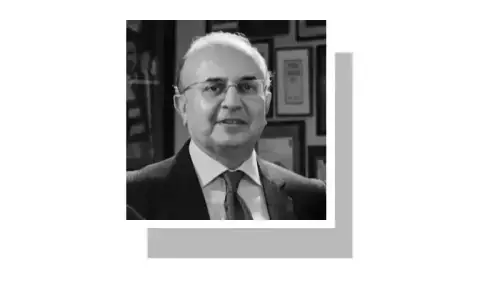
Dr Javed Laghari, former senator and chairperson of the Higher Education Commission, said AI was having impact on education as popularity of online courses was increasing, leading to decline in enrolment of world universities.
“They [developed world] talk about skills as skills are taking front seat while degrees are taking back seat.”
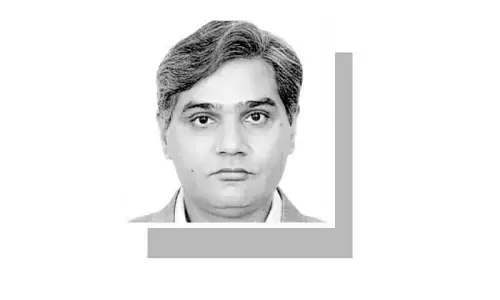
Former envoy Mustafa Kamal Kazi said Pakistan was playing the role of mediation between Iran and the US.
“But amid war, Pakistan’s joining of the Makkah defence alliance may raise questions as it ‘compromised’ Islamabad’s position and narrowed its options.”
He said Houthis were a “Lashkar” and only a “Lashkar” can fight with them.
Prof Huma Baqai, Dr Jamshed Adil, dean of SMIU, Zulfiqar Halepota and others also spoke.
Published in Dawn, October 4th, 2026