Tracing Salima Hashmi’s artistic practice from 1964 to the present is, in many ways, to trace the evolution of an artistic consciousness shaped by the shifting contours of personal experience, society and history. Her practice unfolds alongside a life encompassing multiple and interconnected roles as an artist, educationist, actor, writer, political activist and as the daughter of the renowned poet Faiz Ahmed Faiz.
Her artistic journey cannot be separated entirely from these intersecting dimensions, which have informed the circumstances in which her work has been produced and understood. It is within this broader trajectory of an extraordinary and multifaceted career that Lahore’s COMO Museum of Art is currently hosting a retrospective exhibition of her work, titled ‘Dast-i-Tah-i-Sang’ [Hand Under the Stone], curated by Asad Hayee.
Hashmi’s artistic journey began in 1964 when, as a young student, she was still searching for a visual language through which to articulate her perceptions and experiences. What began as an exploration of form and expression gradually developed into a sustained and deeply reflective engagement with the social and political realities of her time. Over the decades, her experiences — joyful and painful, private and public — have found their way into her work, leaving visible traces upon its imagery, symbolism and emotional register.
The exhibited work is the record of a life lived through and in dialogue with the cultural, political and historical complexities of Pakistan. Hashmi’s retrospective thus brings together the accumulated traces of a consciousness continually responding to a changing world.
A major retrospective in Lahore brings together six decades of Salima Hashmi’s work, shaped by memory, history, politics and personal experiences
She tells me that this artistic journey has unfolded against some of the most significant and turbulent moments in Pakistan’s history. The trauma and rupture of 1971, followed by the political upheavals of 1977 and the years of military dictatorship that followed, formed a complex backdrop for the lives of artists, particularly female artists whose creative and personal freedoms were often shaped by the restrictive social and political climate.
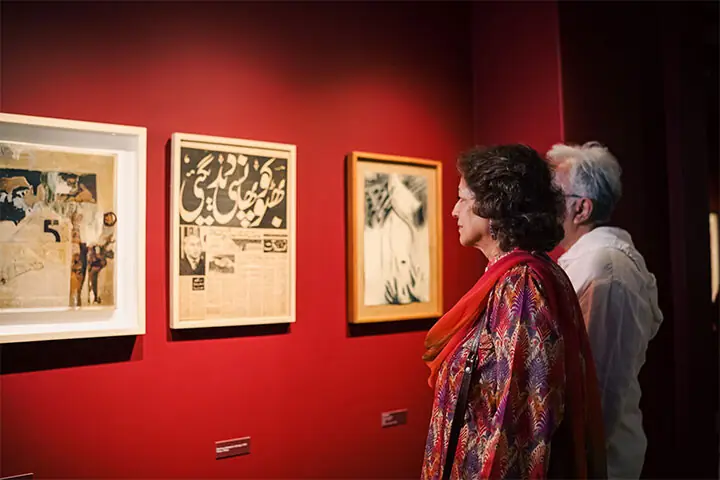
This retrospective, therefore, offers more than a chronological survey of an artist’s oeuvre. It becomes a visual account of how one individual has negotiated the passage of time, responding to personal joys and sorrows while remaining alert to the larger political and social realities surrounding her. Seen across six decades, the work reveals an artist continually absorbing, questioning and reinterpreting the world.
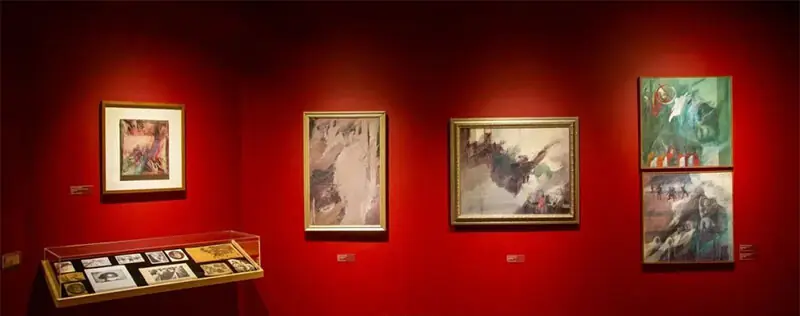
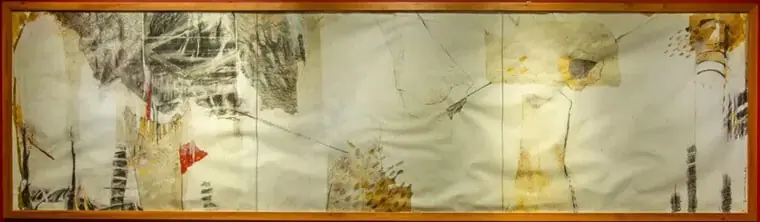
Moving through the exhibition, one is immediately struck by the consistency of the artist’s palette. Earthy tones, ochres, browns, muted pinks and subdued neutrals recur throughout the works, creating an atmosphere that is contemplative rather than flamboyant. There is zero reliance on shimmering hues or sharply contrasting colours.
Equally significant is the artist’s sustained engagement with collages. Fragments, layers and juxtapositions become an important part of her visual vocabulary, suggesting a process of assembling and reassembling. The collage can be read as a metaphor for memory itself — fragmented, layered and constantly open to reinterpretation. The human figure, particularly female nudes, also occupies a notable place in the exhibition. Yet, these works resist conventional representations of the body. Rendered through abstraction, fragmentation and suggestive forms, these figures are less concerned with anatomical description than with conveying presence, vulnerability and psychological states.
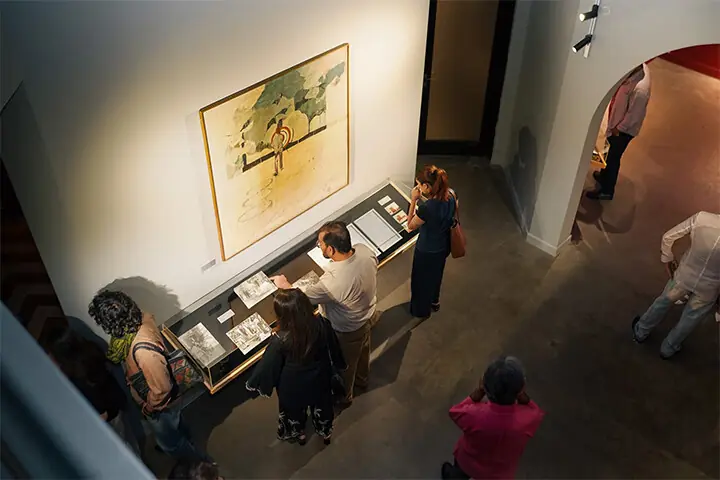
Photographs from Hashmi’s college years, moments shared with co-actors during her years in television and images of eminent figures from the worlds of theatre and academia are thoughtfully incorporated into the exhibition. Video footage of Hashmi’s television performances and other aspects of her artistic practice further enrich this visual narrative, offering viewers glimpses into the diverse facets of her creative journey beyond her work as a visual artist. Also displayed is a small self-portrait Hashmi made at around nine or 10, depicting herself with her sister.
In White Bowl (1971), thick, scraped and layered passages are visible across the canvas. Marks accumulate, overlap and occasionally appear to have been removed or painted over. One feels that the image has been constructed through the process of addition and erasure rather than simply painted from observation. The bowl catches the attention against the predominantly earthen palette of rust, burgundy, dusty pink ochre, blue and charcoal. The bowl is not represented as a conventional still-life object, rather it is abstracted and flattened, making it more of a symbolic representation.
Viewed against the upheavals of 1971, the painting’s fractured composition can be read as an evocation of a society undergoing rupture and divisions. The separation visible within the picture plane may, therefore, invite an association with separation on a national scale. The white bowl can also be read as a quiet witness to a fractured historical moment, marked by the political and territorial rupture that divided the country and profoundly affected many lives across the region.
In Hashmi’s work, the physical act of layering of materials, colours, textures and fragments of collage often takes precedence over recognisable imagery. Meaning is not immediately revealed, rather it remains embedded beneath these accumulated layers. One such example is her painting Heart Still. It invites viewers to look closely and dig deep to uncover the personal, historical and emotional associations within the work. Works such as 32 Church Crescent Series and Absent God also fall into the same category.
Some of the works, such as Friday Morning III are more restrained, graphic and painterly, with a strong sense of composition and tension. The deep rust and burgundy mass is particularly provocative. Punctuated by layers of red, it suggests rupture, pain and something wounded or compressed beneath the surface.
Hashmi has had a remarkable artistic journey spanning six decades, encompassing the many ebbs and flows of life — its laughter and sorrows, as well as its political and historical upheavals. In this retrospective, the works become traces of lived experience, revealing how memory, history and changing circumstances gradually find their way into art, transforming private moments into a visual record of a life and its times.
‘Dast-i-Tah-i-Sang’ is on display at the COMO Museum of Art, Lahore from September 12, 2026-January 31, 2027
The writer is an art critic, fine artist and educationist based in Lahore. She can be reached at ayeshamajeed2015@gmail.com
Published in Dawn, EOS, October 4th, 2026