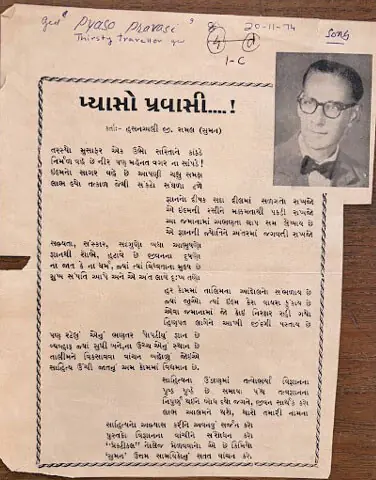
In the quiet of a Karachi evening in November 1974, my father, Hassan Ali G. Rammal, wrote a Gujarati poem that still speaks to me across five decades. He signed it, as he almost always did, with his chosen pen name, Suman — a word associated with “flower” and, figuratively, with a noble mind.
The poem is called Pyaso Pravasi — or The Thirsty Traveller.
But first, a little about the man who wrote it.
Hassanali G. Rammal was born on May 16, 1906, in Karachi, then a cosmopolitan port city of British India. He grew up among Gujarati, Sindhi, Urdu, Hindi and English speakers, and he conversed and wrote fluently in all of them.
His artistic life reflected the cultural and religious diversity of Karachi at the time.
In 1974, Hassan Ali G. Rammal wrote Pyaso Pravasi, a Gujarati poem about the pursuit of knowledge. Decades later, his son looks back at the poem — and the pluralistic Karachi that was the author’s milieu
A PLURALISTIC WORLD
Over his long creative life, my father composed more than 150 geets [lyrical songs] that were sung in Ismaili jamaatkhanas [community centres] and living rooms from Karachi to London, Toronto and Vancouver.
The most famous of them, Prem Sandesh, recorded by the legendary Khursheed Nurali with the Prince Aly Khan Orchestra in 1968, remains a classic of Ismaili devotional music. In 1970, a selection of his work appeared in the Gujarati-language anthology Suman Sangraah.
He was also a prolific playwright. He was a member of the Shankar Vijay Sangeet Samaj, a prominent music and theatre institution located at Gordhandas Market in pre-Partition Karachi. Most of its members were Hindu businessmen or professionals; my father was the sole Muslim among them. Yet he was welcomed as an honorary drama and song writer. My sister and I would accompany him to their performances, to bhajan [devotional music] evenings, to gatherings of the Theosophical Society, and to classical music parties.
He also wrote Jeevan Leela for them. The play was performed twelve times by different theatre groups across the city — and every rupee from ticket sales was donated to charity.
My father also belonged to the Rajdeep Sangeet Samaj, a local cultural hub promoting music. For them, he wrote a Hindi play titled Doosri Shaadi [Second Marriage]. It was staged at the Khaliqdina Hall on August 10, 1947 — five days before Partition.
The cosmopolitan ease with which he moved among Hindu, Parsi, Gujarati and Muslim circles was not an intellectual posture. It was simply how he lived.
When the riots of Partition broke out, our family remained safe. But my father’s first concern was for his Hindu friends. They stayed indoors until the streets quietened; we carried food to their homes. That quiet act of friendship has stayed with me longer than any formal lesson in pluralism.
He passed away in 1990, but his songs have never fallen silent. Among his writings, that one poem continues to speak to me in a particularly personal way.
THE CONTEXT OF THE POEM
Pyaso Pravasi was written at a pivotal moment in the educational history of the Ismaili community in Pakistan.
Sir Sultan Muhammad Shah, Aga Khan III, had laid the foundations decades earlier, through the Diamond Jubilee Schools, established from 1946 onwards. By the early 1970s, under the leadership of Prince Karim Aga Khan, those grassroots institutions were being reorganised and expanded. Regional education boards were formed, curricula modernised, and a clear message was being sent: education must move beyond rote memorisation towards critical thinking, science and practical application.
My father heard that message clearly. His poem makes a sharp distinction between popatiyu gyaan — parroting characterised by repetition or the mechanical repetition of facts — and true “practical” knowledge. It directly responds to the educational challenges of the time. The “winds of knowledge” he describes were not poetic licence; they were the real currents of community mobilisation, adult literacy drives and the rapid expansion of Aga Khan schools across Sindh and the Northern Areas.
Here is a translation of Pyaso Pravasi — or The Thirsty Traveller:
A thirsty traveller stands on the bank of a river,
The pure water flows, but cannot be reached without effort!
An ocean of knowledge flows right before our eyes,
Take advantage of it immediately, so all miseries are dispelled.
Keep the lamp of knowledge always burning in your heart,
Hold on to the rope of that knowledge with firm determination;
In this era, ignorance is considered equivalent to a curse,
Keep that flame of knowledge awakened deep within your conscience.
Civility, culture and virtues are all ornaments,
They shine through knowledge and remove the vices of life;
No matter the caste or religion, wisdom is valued everywhere,
It brings happiness and wealth and ends sorrow.
In every community, the echoes of education movements are heard,
Wherever you look, the winds of knowledge are blowing;
In such an era, if anyone remains illiterate,
They feel inferior and regret it for the rest of their lives.
But education that is just rote learning is parroting,
A person’s position is not high until knowledge becomes practical;
To develop knowledge, extensive reading is required,
High-quality literature is present in our community.
In the depths of literature, philosophical paths of science
Every page contains the path to philosophy (wisdom);
Be proficient and give teachings to the world, make life meaningful;
The world will benefit, and it will bring glory to your name.
As a result of studying literature, create something new,
By reading books of science, conduct research;
To gain “practical” knowledge, this is the technique,
“Suman” says, continuously read excellent magazines.
THE POETRY ITSELF
Like the best of the Indo-Islamic tradition, the verse is both simple and layered. The central metaphor of the thirsty traveller standing on the riverbank is classical: opportunity is abundant, but it demands effort. The lamp of knowledge is also an image familiar from Sufi and Bhakti traditions.
Yet the language is never archaic. In the final stanza, my father inserts the English word “practical” directly into the Gujarati text — a small but telling act of linguistic openness that mirrors the plural society he inhabited.
The poem is structured in rhyming couplets that lend themselves to memorisation and, potentially, to musical setting. The verbs are almost all imperative: rakhjo, karjo — keep, do. This is not contemplative poetry; it is a call to action.
A SON’S REFLECTIONS
I have spent my working life in advertising and public relations, fields that also deal in the power of words and images. My father encouraged my interest in drawing and painting from an early age. At his gentle urging, I studied art while teaching drawing and mathematics for two years in Karachi and, eventually, entered the world of commercial art and advertising.
The evenings spent watching actors rehearse his plays, the bhajans and classical concerts he took us to, the quiet determination with which he moved among communities that others treated as separate — all of it formed a living education far more powerful than any textbook.
In an age when information is more abundant than ever, yet genuine understanding often feels scarce, Pyaso Pravasi retains its force. The river of knowledge still flows. The question my father posed in 1974 remains urgent: will we make the effort to drink from it, or will we stand forever on the bank, thirsty?
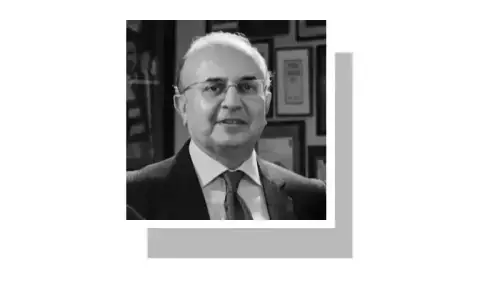
The writer is chairman of Asiatic Public
Relations Network and the eldest son
of the poet and playwright Hassan Ali
G. Rammal, who used the pen name Suman
Published in Dawn, EOS, October 4th, 2026