• Riyadh schools shift to remote learning
• France calls its military support to S. Arabia ‘strictly defensive’
SANAA: Saudi Arabia’s air strikes on a market in the outskirts of Taiz city caused dozens of casualties, a spokesman for Yemen’s Houthis-led Ansarallah forces said in a statement on Sunday, as fighting escalated further after a truce broke down months ago.
Yahya Saree said Saudi Arabia launched two air raids that hit a market on the outskirts of the city, killing and wounding nearly 50 people without giving the exact breakdown.
“The blood was unjustly and aggressively spilled,” the spokesman said in a statement posted online, vowing there would be consequences for the attack.
In a subsequent statement, the TV channel, citing the Ansarallah Houthis’ health ministry, said that five children were among those wounded.
The city itself remains under the control of Saudi-backed government forces but has long been besieged by Houthi fighters and remains one of the main fronts in Yemen’s civil war.
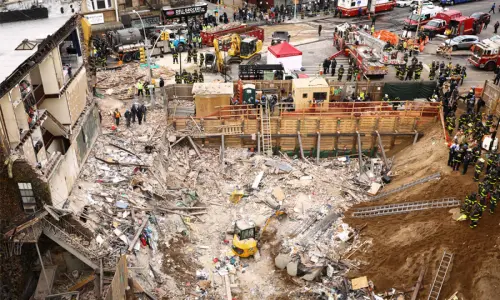
Images broadcast by Al-Masirah showed vehicles with blown-out windows as well as damaged warehouses, where goods were covered in a thick layer of dust.
Following several years of relative calm, Yemen’s war reignited in July, against the backdrop of the widening Middle East war.
The country is one of the poorest in the world and remains gripped by a vast humanitarian crisis.
Fighting intensified in September as the Houthi-led Ansarallah forces launched a lightning offensive that saw them seize Yemen’s entire Red Sea coast, including the Bab al-Mandab Strait, a vital shipping lane.
The Ansarallah forces have in parallel launched a blockade on Saudi energy exports, already choked off by Iran’s closure of the Strait of Hormuz.
On Saturday, Saudi Arabia said it intercepted two Houthis’ drones that were heading in the direction of the capital Riyadh.
Schools in Riyadh announced on Sunday that they would be shifting to remote learning for a week, without giving the reason, according to messages sent to parents.
“We have just been informed by Saudi authorities that schools must remain closed all week,” one parent living in Riyadh said.
There was no official reason given but the move comes amid heightened tensions in the Gulf and near-daily attacks aimed at Saudi Arabia by Houthi fighters.
“When a decision affects an entire school community for a full week, families deserve clear communication and transparency about the reasons behind it,” he said.
“It’s a last-minute decision. We have no clue what’s happening,” a Lebanese expatriate living in Riyadh said.
Yemen’s war erupted in 2014, when the Houthis-led Ansarallah forces seized the capital Sanaa from the Saudi-backed government, before going on to take control of vast swaths of the country’s north.
Riyadh intervened in the war the following year at the head of an international coalition.
Despite massive Saudi backing, Yemen’s government forces have been unable to repel the latest Houthis-led Ansarallah forces.
France says its military is helping Saudi Arabia
French Foreign Minister Jean-Noel Barrot said on Sunday the French military support being given to Saudi Arabia to help it confront attacks from Yemen’s Houthis is “strictly defensive”.
His comment, made on state television network France 2, follows President Emmanuel Macron’s announcement of French troops, radar units and “defence systems” being sent to Saudi Arabia.
Asked whether France’s aid meant that Paris had become a partner in Saudi Arabia’s war against the Houthis-led Ansarallah forces, Barrot said: “Absolutely not… This is strictly defensive.” He said that “since the start of the [US-Israeli] war against Iran, we have deployed military assets to protect our allies, our partners”.
“Does that mean at any time we can be considered co-belligerents? Never.”
Barrot said the scale of the French deployment to Saudi Arabia would depend on what Riyadh requested, as well as “our own capacities and how the situation develops”.
Published in Dawn, September 28th, 2026