Gunmen kill 27 in 2 separate shootings in South Africa
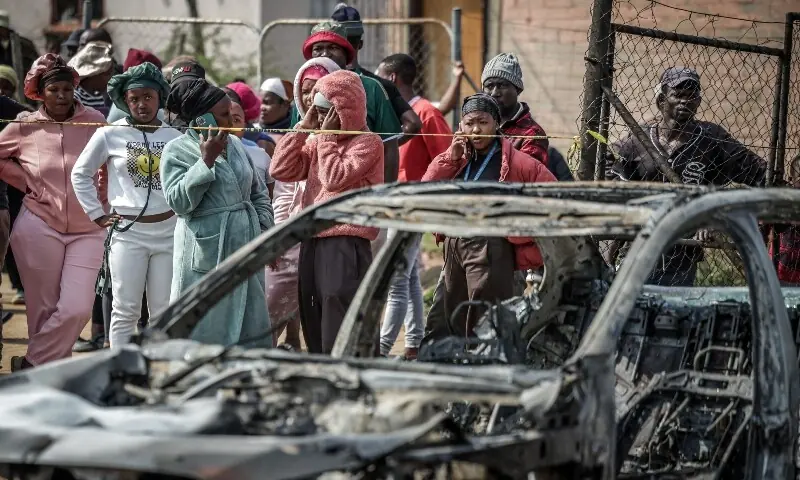
Gunmen killed at least 27 people in two mass shootings in South Africa’s two main cities, police said on Sunday, in the latest violence to hit the crime-weary country.
Eight gunmen armed with assault rifles stormed a bar west of Johannesburg at around 1930 GMT (12:30am) on Saturday, killing 17 people and wounding 15 others.
The victims included 13 males and four females.
The suspects opened fire on customers drinking outside and then moved inside to continue shooting, police said.
The shooting took place in Wedela, a semi-rural township of brick houses and small businesses, surrounded by wide expanses of land scarred by mining.
The area has also been a focus of a government crackdown on illegal mining, with soldiers deployed alongside police to tackle criminal networks operating around abandoned mine shafts.
“The criminals think it’s a fashion. They want to make it something which we need to get used to, but that cannot be allowed and tolerated,” deputy provincial police commissioner Major General Fred Kekana said at the scene.
“We managed to get clear pictures of the suspects and we will get them,” he said, adding that the attack appeared to have been retaliation for an incident last month.
The motive was still unknown, and the suspects torched two vehicles before fleeing.
One of the victims was being sought by police in connection with an incident at the same tavern last month in which one person was killed and another wounded, Kekana said.
In a separate shooting at an entertainment venue in a township outside Cape Town early on Sunday, gunmen killed 10 people and wounded 11 more.
In video clips shared on social media, revellers can be seen dancing and drinking before a burst of gunfire rings out, sending people scrambling for cover.
Five of the victims were declared dead at the scene, while the others succumbed to their injuries while being taken to hospital.
No suspect has been arrested in either case, police said.
Army deployed
The attacks come as South Africa, awash with legal and illegal firearms, grapples with persistent gun violence often linked to gang rivalries and competition among informal businesses.
The country of about 62 million people records roughly 60 murders a day, among the highest rates globally.
Last week, gunmen stormed a house party in a township in South Africa’s eastern port city of Durban and killed 11 people.
South Africa has repeatedly turned to the military to reinforce police efforts against violent crime.
In March, President Cyril Ramaphosa deployed soldiers to violence hotspots in Johannesburg, describing rampant crime as one of the biggest threats facing the country.
Troops were also deployed to enforce strict Covid‑19 lockdowns in 2020 and during the deadly riots sparked by the jailing of ex‑president Jacob Zuma in 2021.
They were also sent into the streets in 2023 after a wave of truck burnings raised fears of wider unrest.
In 2019, around 1,300 soldiers were deployed to back up police in the gang-afflicted Cape Flats areas surrounding Cape Town.
Yet shootings and other violent crime remain a persistent threat.
In Johannesburg, 10 women have been killed in a single municipality in two months, the latest found on Saturday semi-naked and stoned to death.
A suspect has been taken into custody, police said on Sunday.
The nine other victims were mostly in their 20s and 30s, with some found stripped of their clothes and showing signs of sexual assault.
Police have offered a 400,000 rand ($25,000) reward for information leading to the arrest of the killer or killers, while the Democratic Alliance, South Africa’s second-largest political party, has put up a further $31,000.