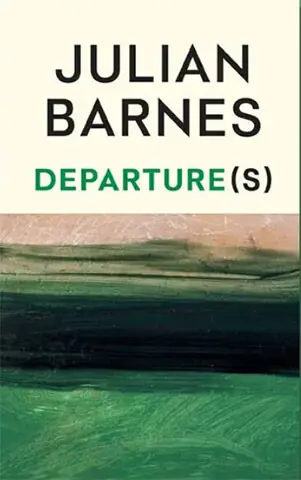
Departure(s)
By Julian Barnes
Vintage, Penguin Random House, UK
ISBN: 978-1-787-33572-1
158pp.
How should a fiction writer bid farewell to writing, his readers and his life?
Julian Barnes, a Booker Prize winner and now the author of 14 novels and three short story collections, does so with his latest novel, Departure(s), published to coincide with his 80th birthday. The book blurs fiction and reality, making one wonder whether it is a novel, the author’s memoirs or a collection of long essays strung together.
It was in 2018 that a close friend of mine introduced me to Barnes with a gift — his then new novel The Only Story — which started my journey of reading Barnes. It was followed by The Sense of an Ending, which had won the 2011 Booker Prize, Elizabeth Finch (2022), his debut novel Metroland (1980), Talking It Over (1991) and its sequel Love, etc (2000).
What’s common in all these novels, except for the last two, is that the author’s memory holds them together, and this necessitates their mention here. It is a flawed, problematic, pinching, edited and fragmented memory, through which the characters and the novelist view the past while attempting to understand it. You can call it Barnes’ fixation, and he continues to write in the same vein in his last novel.
Once again, memory is the linchpin of Departure(s). It reminded me of The Sense of an Ending, which also looks back at youth through its protagonist, Tony Webster, a retiree who revisits his past. A similar phenomenon takes place in Departure(s). Stephen and Jean, two lovers and friends of the narrator — Julian or JB — during his Oxford years, are remembered by him.
Celebrated author Julian Barnes bids farewell to his readers with a genre-bending novel about memory, love, ageing and the moral complications of writing about real lives
Though memory is a strong element in his other works, Barnes’ latest novel comes closest to The Sense of an Ending: in both novels, the lovers separate when they are young and meet again in old age. In both books, reconnecting raises many questions.
The novelist narrator, JB, discusses the possibilities of involuntary autobiographical memory (IAM) and his own fears of it, since our voluntary memories are heavily censored by us, and his hope about IAM helps him in writing his biography. There is a whole chapter dedicated to this discussion. JB’s memory is juxtaposed with the theme of love, and he remembers the couple following different paths in life after they separate and he helps them get together again after a gap of 40 years.
Speaking of memory, in one of his old interviews, Barnes had said, “I have a brother who’s a philosopher. He maintains that almost all memories are false, all fallible and that memory is the act of imagination, rather than the act of a lucid remembering machine somewhere up in our brains. I have a more sort of old-fashioned, pragmatic view of memory. But I certainly increasingly think that it’s not only faulty but sometimes over-reliant on the imagination.” This may make readers wonder how much of Departure(s) is real and how much of it is fiction.
In the novel, Barnes also raises the moral question of whether a writer should write about their friends or not, since his narrator had promised Stephen and Jean that he would not write about them. In fact, he swore on the Bible that he would not make them the subject of any of his books, but decided to break that promise. The oath did not carry much weight because it was an atheist who had given his word to another atheist and there was no chance of condemnation by the Divine.
Barnes also resorts to the “compost theory of writing” — a creative and psychological process in which the writer gathers together life’s experiences, half-cooked ideas, reading notes and rejected drafts into a mental or physical compost heap, to let them decompose slowly before making up stories. The narrator also mentions he wrote about his friends after their deaths.
Departure(s) has been called a hybrid work of fiction and a memoir. At times, it reads like a long essay, in which Barnes indulges his musings and deliberations about things such as ageing, memory, death and morality. We can safely say that Barnes’ novel is one of the best examples of hybridity in his work.
While reading it, the reader sometimes feels as if they are reading a personal essay instead of a novel. The characters speak of childhood, parents and past life and JB of his mother making sandwiches during his childhood, the future of the world, life in general, the lack of money and the end of altruism. When asked about autobiographical elements in Departure(s) in a recent interview with the BBC, Barnes said, “I don’t think it’s my most autobiographical work… but it’s obviously a personal book.”
However, there are many similarities between the protagonist and Julian Barnes, including his vocation as a novelist, a person suffering from blood cancer — which has been described as manageable — the death of his wife and a publisher friend.
At the beginning of the novel, the narrator appears as Julian Barnes and reading the first chapters does not feel like one is reading a work of fiction. He also declares, “This will be my last book.” He leaves little to the imagination when he puts his full name at the end, Julian Barnes, as if he were penning a last letter to his readers or making his last speech without doing so.
The last few pages, if not the whole chapter, are very readable when he bids farewell, saying, “I shall ‘miss’ ‘you’ — whatever that means.” He imagines sitting with his readers in an unidentified town in an unidentified country, in warm weather with cold drinks in front of them, watching the many expressions of life pass by. His last words are, “I hope you have enjoyed our relationship over the years. I certainly have. Your presence has delighted me.”
However, in his last passage too, he doesn’t forget to mention the role of a novelist, saying that “novelists should not speak down to the readers from an assumption of greater wisdom.”
The title of the novel seems odd, with the addition of an ‘s’ in parentheses. In the BBC interview, Barnes explained this by stating, “Because there’s one main departure, which is our departure from life and then there are several others referred to in the books, which are departures from love and so on.”
The writer is a member of staff.
X: @IrfaanAslam
Published in Dawn, Books & Authors, September 20th, 2026