Large-scale industry rebounds 3.03pc in July
ISLAMABAD: The Large-Scale Manufacturing (LSM) sector posted a modest year-on-year growth of 3.03 per cent and a sharper 9.5pc month-on-month in the first month of 2026-27.
Industrial activity rebounded in July after a 3.48pc contraction in June.
The Quantum Index of Manufacturing (QIM) stood at 119.13 in July FY27, up from 115.62 in the corresponding month of the last year, the Pakistan Bureau of Statistics said on Wednesday.
In FY26, the LSM posted year-on-year growth of 4.98pc. The full-year improvement suggests that industrial production regained some ground in the outgoing fiscal year.
LSM growth remains uneven despite recovery
The main contributors to overall LSM growth in July were tobacco (0.55pc), garments (3.87pc), petroleum products (0.11pc), cement (0.36pc), electrical equipment (0.21pc), automobiles (1.91pc), other transport equipment (0.27pc), and furniture (0.18pc).
However, the recovery was uneven, with food dragging LSM growth by 0.45pc, followed by beverages (0.45pc), textiles (0.53pc), chemicals (0.50pc), pharmaceuticals (1.24pc), iron and steel products (0.47pc), and machinery and equipment (0.03pc).
The weakness in textiles is particularly significant given the sector’s weight in Pakistan’s manufacturing and export base, suggesting that the improvement in headline LSM growth did not extend evenly to some of the country’s major industrial activities.
Negative contributions from textiles, pharmaceuticals, chemicals, and iron and steel suggest that while industrial production recovered in July FY27 as a whole, momentum remained fragile and concentrated in a relatively small group of industries.
The food group dipped 6.39pc year-on-year in July. Wheat and rice milling declined 0.99pc. Cooking oil and vegetable ghee production fell 19.22pc and 11.81pc, respectively. However, tea blended production grew 0.52pc.
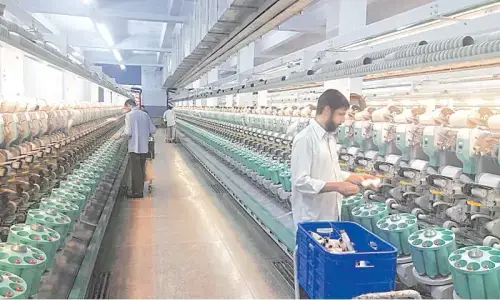
The overall textile sector production shrank 3.09pc year-on-year in July. However, cotton yarn rose 2.73pc, while cotton cloth fell 0.09pc, accounting for more than 80pc of the textile sector. Garment exports grew 22.03pc year-on-year in 1MFY27.
Coke and petroleum products rose 1.34pc in 1MFY27. Most petroleum products posted positive production growth, except high-speed diesel (HSD) in July. Petrol production rose 11.56pc, while high-speed diesel declined 7.26pc. LPG production rose 9.86pc and kerosene 43.10pc during the month under review. However, furnace oil output dipped 13.28pc year-on-year in July.
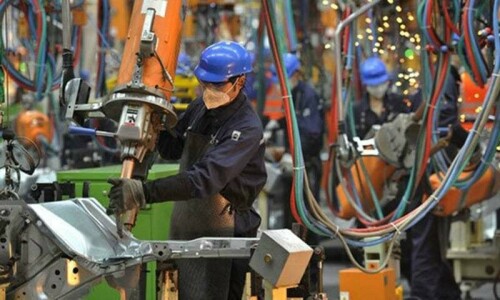
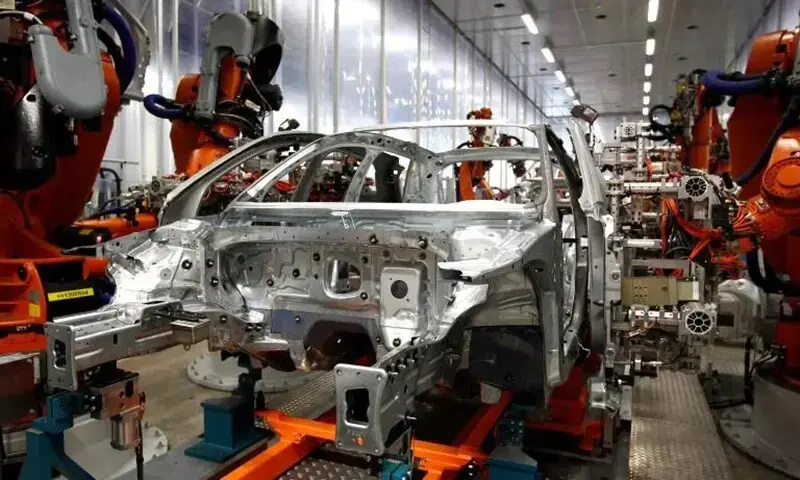
The automobile sector grew 57.01pc YoY in 1MFY27. This growth was mainly contributed by a 57.19pc surge in jeeps and cars, followed by trucks up 94.35pc, and LCVs up 12.54pc. However, bus production declined 3.85pc.
Pharmaceutical production dipped 20.79pc, and fertiliser production fell 4.71pc.
Iron and steel production declined 11.40pc in 1MFY27. Rubber products production rose 1.75pc, non-metallic minerals 4.25pc, and electrical equipment 7.88pc.
Published in Dawn, September 17th, 2026