Indian delegates attempt to interrupt Ayaz Sadiq’s address at Commonwealth conference

ISLAMABAD: Indian delegates reportedly attempted to interrupt National Assembly Speaker Ayaz Sadiq’s address at the 69th Commonwealth Parliamentary Conference in Cape Town, South Africa, as he spoke about climate adaptation and climate justice.
According to information available, the Indian delegates repeatedly sought to intervene during Sadiq’s speech, with footage showing attempts to get hold of the microphone and disrupt the proceedings.
Sadiq had raised the issue of “water terrorism” during his address without naming any country, in the context of broader concerns over climate change, water resources and climate justice.
The Indian delegates’ attempts to seize the microphone affected the atmosphere of the session, prompting direct intervention by the host and the Jamaican speaker, who asked them either to remain silent or leave the hall. Meanwhile, other participants advised the Indian delegates to listen patiently to Speaker Sadiq’s address.
Despite the disruption, the discussion on climate adaptation and climate justice continued.
In his address, Speaker Sadiq, without naming any country or delegation, presented a principled position on tackling climate change and stressed the responsibilities of the international community.
He raised issues, including the sudden surge of water in rivers and the withholding of water, without naming any country.
Speaker Sadiq said climate adaptation policies should be formulated with effective public participation, adding that oversight by democratic institutions was indispensable to policies aimed at addressing climate change.
He added that climate change was affecting various spheres of life, including food, water and health, noting that Pakistan was among the countries most affected by climate change.
“Tackling climate change requires climate justice and the inclusion of democratic institutions,” he said, adding that parliamentary dialogue on global challenges such as climate change should be serious, purposeful and constructive.
He said the role of parliaments was important in the practical implementation of climate policies and that international climate finance should come under parliamentary oversight.
“The Parliament of Pakistan is playing an important role in climate adaptation through legislation, budgetary oversight and committees,” he said, adding that the inclusion of women, youth and other segments of society was indispensable to addressing climate change.
“To deal with climate risks, parliaments should benefit from mutual experiences,” he said, adding that to meet the challenges of climate change, parliaments should promote cooperation and meaningful dialogue rather than differences.
“Strong democratic institutions are indispensable for strong and vibrant societies,” Speaker Sadiq said, adding that climate adaptation could be effective only with fair financial assistance and democratic accountability.
The Indus Water Treaty (IWT) remains a contentious issue between Pakistan and India, following New Delhi’s unilateral abeyance of the accord in April last year — a move that was followed by a brief military conflict between the two sides in May 2025.
Following India’s move, Pakistan termed any attempt to suspend its water share an “act of war”, noting the IWT had no provision for unilateral suspension. It later argued that Delhi’s action was a violation of the 1969 Vienna Convention on the Law of Treaties.
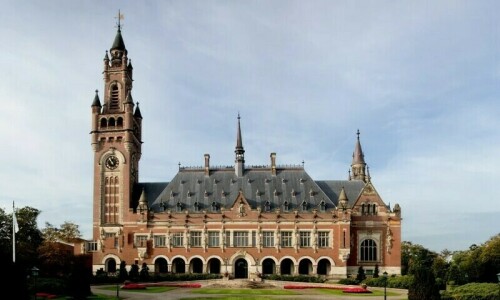
In August, the Permanent Court of Arbitration (PCA) in the Hague also ordered India to uphold the IWT with Pakistan and suspend work on a hydro project in occupied Kashmir.