ISLAMABAD: In a controversial decision, the National Electric Power Regulatory Authority (Nepra) on Friday approved the contentious Integrated System Plan (ISP) 2025, entailing a total investment of about $58 billion in the power generation and transmission sectors over 11 years.
In a 45-page decision conditionally approving the 11-year (2025-35) planning document, all three members, including the Nepra chairman, wrote more than 12 pages of dissenting or separate advisory notes while questioning the grounds for the exclusion and inclusion of major projects and bypassing the Council of Common Interests (CCI) — the constitutional forum dealing with such matters, including the national energy policy and plan.
“The Authority hereby approves the ISP-2025, to the extent of Revised Base/Recommended Case of IGCEP-2025 (excluding Battery Energy Storage System-BESS and K-Electric Ltd-KEL transmission line in 2028) together with the revised scope of Transmission System Expansion Plan (TSEP-2025), subject to redressal of the observations of the Authority,” the Nepra decision said.
It also placed on record contradictory statements by two related organisations — the Independent System and Market Operator (ISMO) and Power Planning and Monitoring Company (PPMC) — under the power division.
Members question project changes, CCI bypass
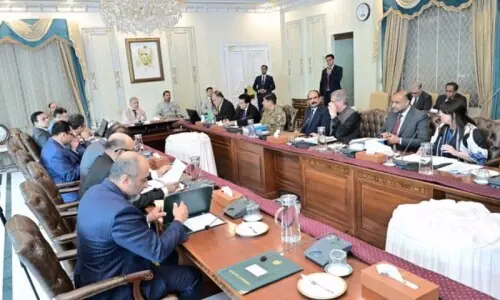
Nepra also expressed displeasure over changes to the 10-year investment plan on the advice of a technical committee constituted by the power division, noting that changes to the National Electricity Policy or National Electricity Plan could not be dictated by a technical committee or the power division without going back to the CCI.
Nepra noted that ISP-2025 superseded earlier Integrated Generation Capacity Expansion Plans and considered three principal demand forecast scenarios — high growth, medium growth and low growth — one of which was treated as the business-as-usual (BAU) scenario. The corresponding cumulative average GDP growth assumptions are 6.37pc, 4.95pc and 3.52pc.
The low-growth, or business-as-usual, scenario based on the Rationalised Capacity Addition (RCA) assumption was adopted as the reference case for generation expansion planning. It envisages capacity addition of 26,045MW — 17,485MW committed and 8,560MW optimised — along with the retirement of 2,577MW of existing capacity, resulting in total installed capacity of 62,657MW.
This also includes 8,120MW of net metering. The total projected cost of the additional capacity is $47.08bn.
Alongside this, ongoing or committed transmission projects entail an estimated investment requirement of $4.6bn, while newly proposed transmission expansion projects require an additional investment of approximately $6.05bn, “resulting in a cumulative transmission investment requirement of approximately $10.65bn over the planning horizon”, the decision said.
The proposed investments include power evacuation schemes, transmission system reinforcements, construction of new extra high voltage substations, transformer augmentations and voltage control facilities.
In view of the geopolitical conflict between Iran and the US disrupting electricity imports from Iran, the plan provides for the lateral entry of a 40MW on-site power plant for the Gwadar and Makran region, where extension of the national grid is currently considered neither technically nor economically feasible.
Nepra noted that K-Electric’s highly competitive renewable energy projects had originally been excluded from the ISP by ISMO, but a 269MW JCM Wind-Solar Hybrid Project at Dhabeji was later incorporated for induction in the current fiscal year.
Nepra expressed displeasure over ISMO’s disclaimer of responsibility for the integrity, accuracy, correctness, authenticity or completeness of the data, projections and information used for the plan, as well as for any consequences arising from them.
The regulator did not allow $900m investment for Battery Energy Storage Systems (BESS) until a comprehensive technical and economic study was provided to establish their requirement, optimal capacity, operational application and cost-effectiveness. Nepra also highlighted contradictory positions of ISMO and PPMC regarding the impact of ISP-2025 on consumer-end tariffs.
It therefore directed that the impact of the proposed plan on consumer-end tariffs be appropriately quantified and incorporated in the main ISP report. PPMC projected the consumer-end base tariff to increase to Rs37.28 per unit by 2035 from Rs34 in 2024-25.
Published in Dawn, September 12th, 2026