Indus erosion endangering dozens of settlements near Layyah
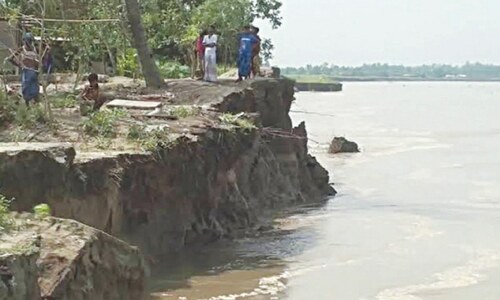
DERA GHAZI KHAN: The erosion of the Indus riverbank has claimed dozens of settlements and thousands of acres of fertile agricultural land as well as standing crops leaving people homeless along with their livestock near the Layyah city.
The low-lying settlements near Layyah city that have been severely affected by river erosion over the past few days include Kanjal, Alyani, Maken, Baloch, Khokhar, Jawand, Joni, Noon, Sonra and Kalhora.
On Thursday, the affected people staged a protest outside the Layyah Press Club where Seraiki Lok Saanjh activist Safdar Kalasra said that the excessive silt discharged into the River Indus from the Chashma Canal over the past 20 years had contributed to the worsening situation near Layyah city.
He said that before the construction of the Chashma Canal, silt carried by hill torrents from the Koh-i-Sulaiman range was distributed across the entire riverine belt through an arid zone irrigation system.
Afterwards, people used turbines to irrigate land instead of using the hill torrent water through the north-east waterways. This resulted in the hill torrent silt being discharged in the river instead of spreading into the belt. After the canal was built, large quantities of silt were discharged directly into the River Indus and its accumulation had created large obstructions in the riverbed, forcing the river to change its course and intensifying erosion along its eastern bank.
Low-lying settlements near Layyah city worst affected with river now coming dangerously close to the city itself, says activist
He said the river had now come dangerously close to the Layyah city, with only a few hundred feet separating the river from the city near the Lala area. Layyah, Jaman Shah, Kot Sultan and Paharpur cities, along with hundreds of surrounding settlements, were now facing a serious threat.
Irfan Kanjal, an affected resident of Wasti Kanjal, said the district administration had remained a mere spectator to the situation and had taken no effective measures to protect the settlements.
Ramazan Gormani, another affected resident of Wasti Gormani, said the “Lahore-based Punjab government” was consuming the funds of the Seraiki Wasaib. He alleged that instead of spending billions of rupees to protect riverine areas, including spurs and protective embankments along the River Indus in the region, huge amounts were being spent on projects in central Punjab and Lahore.
Meanwhile, several low-lying settlements near Paharpur have also been washed away by the river over the past year.
These include Mada, Dadan, Sheikh, Karlo, Machhi, Natkani, Kalati, Chandharar, Qureshi, Gormani, Jhabil, Darakhan, Jallo, Sanghri, Handrani, Chaki, Mullan, Manjotha, Malla, Mashori and Mula.
Published in Dawn, September 11th, 2026