Indonesia conducts water bombing near future capital to curb wildfires
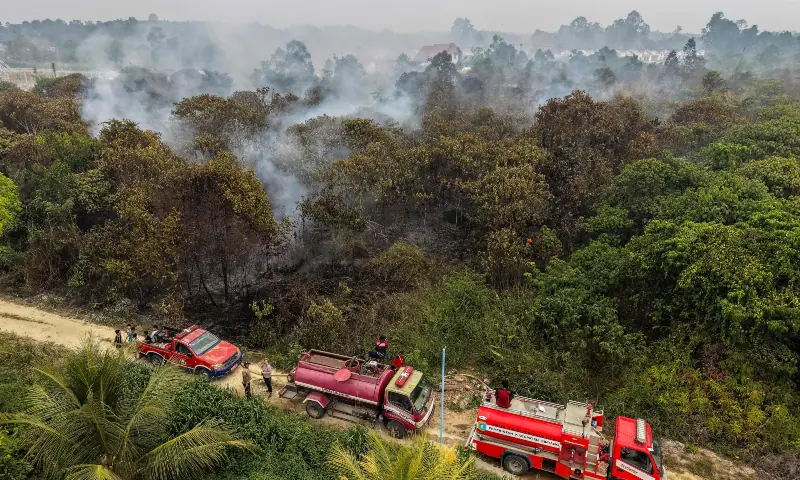
JAKARTA: Indonesian authorities carried out a water bombing operation on Saturday to prevent wildfires from spreading in the future capital city Nusantara, a city official told AFP.
The archipelago is constructing a new capital city in Borneo, home to vast tropical jungle, to replace sinking and traffic-clogged Jakarta.
The country is also fighting to contain wildfires that have burned large swathes of Sumatra and Borneo, which caused choking haze that has drifted across the border to Malaysia, Singapore and the Philippines.
Fires have been intensifying since mid-August in buffer areas outside the core area in Nusantara, where the city’s development is concentrated, Nusantara authority environment and natural resources deputy Myrna Asnawati Safitri said.
It prompted authorities to carry out a water bombing operation to complement on-the-ground firefighting efforts, she added.
Authorities step up efforts to douse blazes in Nusantara’s buffer areas
“The function of water bombing is not only to extinguish fires but also to accelerate cooling in areas that have been extinguished by ground firefighters,” Myrna said.
The operation will last until Sunday, but Myrna said it can be extended if necessary.
So far, Nusantara’s construction has not been hampered by wildfires or haze, she said.
Drifting smoke
The hazardous smoke has led to an increase in respiratory problems, forced schools to close and has been drifting to Malaysia, Singapore and the Philippines.
Most of the fires are concentrated on Borneo island, home to a vast tropical jungle that Indonesia shares with Brunei and Malaysia, as well as Sumatra.
So far this year, nearly 300,000 hectares of land have burned in Indonesia.
Indonesia has seen an uptick in carbon emissions since late July, and by the end of last month the levels were comparable to previous El Nino years of 2015 and 2019.
“We’re seeing already now… really extreme fire emissions comparable to those previous strong El Nino years, and also the extent of the smoke and the haze and the air quality impact,” Parrington said.
Fires in the archipelago have released more than 23 million metric tons of carbon emissions between Aug 28 and Sept 3, according to the Fire Emissions Watch portal.
It was higher than 20.7m metric tons of emissions from fires over the same period in 2015, which was a strong El Nino year.
What causes the fires?
Analysts said that the El Nino weather phenomenon, which the United Nations said this week could turn out to be the strongest in four decades, has contributed to creating drier conditions in Indonesia and made it easier for fires to spread.
But slash-and-burn land-clearing practices also contributed to the damage, said David Gaveau, founder of the Nusantara Atlas.
“El Nino does not ignite fires. It creates the dry conditions that allow human-started fires to escape and become very large,” he said.
The fires are difficult to extinguish because many occurred on peatlands, a wetland ecosystem with layers of partially decomposed organic materials that become flammable when dry.
“Peat is a naturally wet ecosystem and stores large amounts of organic material. When peat is drained, this organic material is converted into fuel,” Pantau Gambut spokesman Wahyu Perdana said.
Published in Dawn, September 6th, 2026