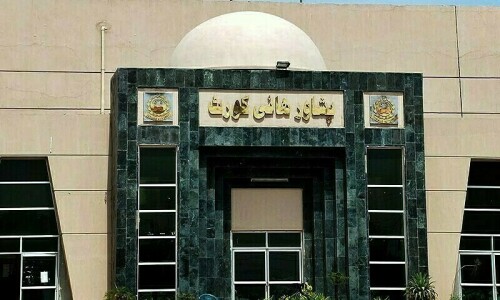
PESHAWAR: A senior lawyer on Friday moved the Peshawar High Court, seeking orders for the provision of “appropriate” health facilities to prisoners and the holding of a medical audit of all prisons in Khyber Pakhtunkhwa.
In the petition, advocate Shabbir Hussain Gigyani requested the high court to declare that everyone kept in the prisons of Khyber Pakhtunkhwa was constitutionally entitled to timely, adequate and medically appropriate healthcare in accordance with provisions of the Constitution.
The petitioner said that the petition had been necessitated by the grave and alarming situation prevailing in the province’s jails regarding the provision of timely and adequate medical care to prisoners.
He claimed that two prisoners, including Fazalur Rehman and Zahir Shah, reportedly died in Peshawar Central Prison lately as they, despite being seriously ill, didn’t receive timely and adequate treatment and necessary services.
Lawyer seeks orders for ‘medical audit’ of prisons, preparation of medical referral protocol
The petitioner said that such incidents demonstrated the urgent need for effective judicial intervention to ensure that every prisoner is provided with proper, timely and adequate healthcare to prevent the loss of human lives due to neglect or unavailability of medical care in jail.
He requested the court to order the provincial government and other respondents to conduct a comprehensive independent medical audit of all central and district prisons in the province, including the staffing, medicines, laboratories, diagnostic equipment, emergency facilities, specialist availability, ambulance services and referral mechanisms.
The petitioner also sought orders for the respondents to prepare and notify, within a reasonable period fixed by the court, a comprehensive Prison Medical Referral Protocol for serious and emergency cases; establish, wherever feasible, secure prison wards in the nearest suitable government teaching hospital, DHQ hospital or other public sector health facilities for admission and treatment of seriously ill prisoners. He requested the court to ensure that appropriate police or jail security is provided to prisoners admitted to outside government hospitals so that security concerns didn’t become a ground for denial or delay of life-saving treatment.
The petitioner, known for public interest litigations, sought directives for the provincial health and prison departments to prepare a specialist roster under which specialists from nearby government or teaching hospitals periodically visit major prisons for consultation, diagnosis, review and treatment of prisoners; that specialist services, including but not limited to nephrology, cardiology, pulmonology, oncology, psychiatry, infectious diseases, surgery and other specialties, be made available according to the actual medical needs and disease burden of each prison; and, that every prisoner diagnosed with a serious disease be assigned a documented treatment plan, including diagnosis, prescribed medicines, investigations, specialist opinion, referral and follow-up.
He also said that the respondents should be directed to maintain a centralised digital or physical Prison Medical Record for every prisoner, including medical history, investigations, prescriptions, referrals, outside hospital visits and treatment outcomes; and, every request by a prisoner for medical attention be recorded with date and time and that emergency requests be attended to without delay.
The petitioner contended that every death occurring in prison from illness or suspected medical neglect be subjected to an independent medical review or inquiry in accordance with the law and that a report identifying the cause of death, treatment provided, referral history and any administrative lapse be maintained.
He said that a prisoner didn’t lose his status as a human being merely because his liberty or freedom of movement had been curtailed pursuant to the law.
The petitioner said that the sentence of imprisonment didn’t extinguish the fundamental rights guaranteed by the Constitution, particularly the right to life under Article 9 of the Constitution and the inviolability of dignity under Article 14.
He claimed that he had reason to believe that in Peshawar Central Prison and other major jails of the province, serious medical cases requiring specialist consultation, diagnostic facilities, surgery, dialysis, respiratory treatment, cardiology, nephrology, oncology or other specialised treatment were not always being dealt with through an effective, prompt and institutionalised referral mechanism.
The petitioner claimed that serious allegations and reports had emerged from time to time regarding deaths of prisoners allegedly after delay or inadequacy in providing appropriate medical treatment.
He also referred to relevant superior court judgements declaring that a prisoner, whether convicted or under trial, is entirely dependent upon the state for safeguarding his right to life and for medical attention and that such dependence created a positive duty of care upon the state and its functionaries.
Published in Dawn, September 5th, 2026