Malnutrition an ‘emergency’, needs integrated solutions

• Experts call for food and nutritional security to be recognised as ‘fundamental rights’
• Tarar insists malnutrition not simply a health issue, but moral challenge and economic imperative
• Punjab official says stunting among children under five down to 27pc from 36pc
ISLAMABAD: The two-day DawnMedia international conference on malnutrition came to a conclusion on Thursday, with experts calling for food and nutritional security to be recognised as fundamental rights and for an integrated approach to address this “national emergency”.
Speakers at the ‘Act For Nutrition: The Emergency We Can No Longer Ignore’ conference, which was aimed at addressing Pakistan’s persistent nutrition and stunting crisis, reflected that the issue could be addressed, given that there was a will to overcome this crisis.
The conference brought together policymakers, international development leaders, health professionals and nutrition experts to confront the burgeoning crisis and build momentum for urgent, coordinated action.
Speaking at the concluding session, World Health Organisation (WHO) Pakistan Representative Dr Dapeng Luo stressed that malnutrition remained the “greatest barrier” to health, development, and opportunities. He noted that nutrition was “much more than access to food” and further stated that “predictable and solid regulation” was needed as a way forward.
World Food Programme’s (WFP) Country Director for Pakistan Anita Hirsch praised the progress of the Benazir Nashonuma Programme (BNP), which showed that nutrition could be integrated into national social protection.
“As we look ahead, one priority is to sustain those gains, continue to scale up and integrate services for millions of Pakistani women and children,” Ms Hirsch said, adding that many countries were following Pakistan’s approach.
“Pakistan continues to face a high level of malnutrition. More than 40pc of children under five are stunted. This means children whose growth and cognitive development are compromised,” she added.
“Second takeaway was that timing matters; the first 1,000 days represent a critical window that will have lifelong implications for the potential for children and potential for Pakistan, and that adolescence also matters,” she added.
Ms Hirsch noted the economic cost of malnutrition, remarking that it remained a barrier to national growth and prosperity. “[A total of] $17 billion are lost every year to malnutrition and stunting,” she added. She said malnutrition was not just about food alone; it was about health, education, women’s empowerment, and behaviour change.
Scaling Up Nutrition Movement Chairperson Dr Irshad Danish recommended that the government should recognise food and nutritional security as a fundamental right in the Constitution. “There are some provisions, but nutrition and food security are not fundamental rights,” he said.
He said the federal and provincial governments must appoint dedicated nutrition coordinators to give priority to the malnutrition problem, adding that the scale and severity of Pakistan’s malnutrition burden must be treated as a national emergency.
Action plan for nutrition
In his address at a separate session, Information Minister Attaullah Tarar also called it a national emergency. “Malnutrition was not simply a health issue, it is a moral challenge, an economic imperative and a national emergency,” the information minister said.
He said fathers must recognise a child’s nutrition as their responsibility too, as the whole family needed to address the nutrition issue, not just the mother. “Too often, we place the entire burden of a child’s nutrition on women, while decisions about food purchases, healthcare and women’s workloads may be taken by other members of the family, a mother cannot carry this responsibility alone,” he said.
“Fathers must understand that nutrition is also their responsibility,” he said.
The minister said there was an action plan to be implemented throughout the year, which also raised awareness about nutritional deficiencies. He suggested that public service messaging must move beyond telling people that malnutrition is a serious problem, and every message must give families practical steps they can take. Every message should have a result-oriented approach, he said.
After Mr Tarar, Dr Usman Ali Khan, programme director of Punjab Family Planning Programme, said that stunting among children under five has fallen from 36 per cent in 2018 to 27pc now. “However, despite this improvement, there were 5.5m malnourished children in the province,” he said, and acknowledged that one in four children in the province suffered from stunted growth.
He said the province was actively screening women and children who could be suffering from malnutrition and stunting.
During the discussion, Punjab government’s special secretary Aurangzaib Haider Khan said that nutritional financing was predominantly a provincial budgetary question. He also said that birth spacing also belonged within the nutritional agenda rather than beside it.
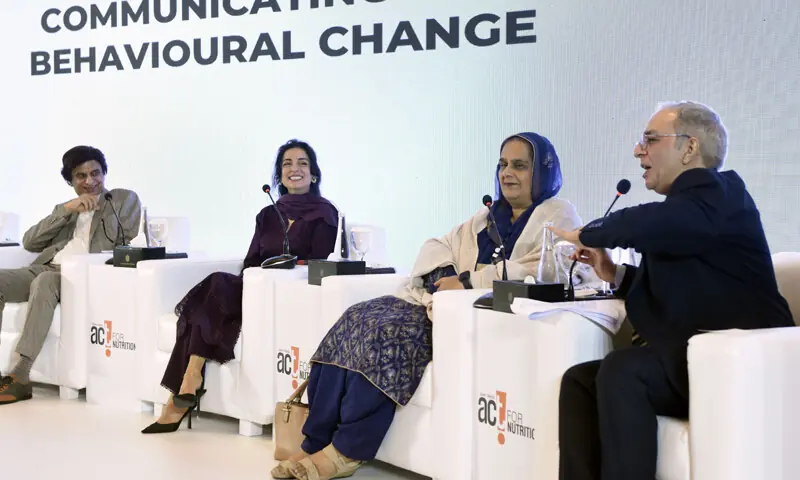
In a different session, actress and activist Sarwat Gillani said that addressing malnutrition was a collective responsibility because only then could it be resolved. Ms Gillani, who is also an ambassador for Special Olympics Pakistan and the Indus Hospital and Health Network, emphasised the use of “intelligent marketing” in addressing societal issues, including malnutrition.
Satish Anand, chairman of EverReady Pictures, highlighted the importance of radio and PTV for reaching the masses, but cautioned that the language and the mindset of the current generation cannot be ignored in the efforts to create awareness regarding malnutrition.
Published in Dawn, September 4th, 2026