KARACHI: The Pakistan Stock Exchange (PSX) remained volatile amid persistent geopolitical and political uncertainty, with value hunting helping the benchmark KSE-100 index close the shortened week marginally higher. However, investor sentiment remained bearish as rising inflation fuelled concerns about the economic outlook.
The KSE-100 index gained 530 points, or 0.3 per cent, week-on-week to close at 177,697 points.
Topline Securities Ltd said the market remained broadly flat as a lack of fresh triggers prompted investors to adopt a wait-and-see approach, particularly amid uncertainty over the progress of US-Iran peace talks.
Trading activity remained subdued despite an improvement in volumes. Average daily traded volume was reported at 713 million shares, while average daily traded value stood at Rs35 billion.
Moody’s upgrade and value buying offset bearish sentiment
Arif Habib Ltd (AHL) said a key development in the outgoing week was Moody’s one-notch upgrade of Pakistan’s sovereign credit rating to B3 from Caa1, with a stable outlook. The upgrade took the rating to a four-year high, with Pakistan last holding a B3 rating in June 2022. The rating upgrade provided a modest boost to investor sentiment.
Foreign investors remained net sellers, while local participation provided some support. Individuals, local companies and mutual funds were net buyers of equities worth $7.3 million, $2.8m and $2.7m, respectively. Foreign corporates and banks were the major sellers, offloading shares worth $8.3m and $1.9m, respectively.
The IMF’s fourth review mission under the Extended Fund Facility is scheduled to visit Pakistan in September to assess progress on structural reforms. These include legislation concerning the Sovereign Wealth Fund, state-owned enterprise governance and anti-corruption measures, said the AHL.
The State Bank of Pakistan’s net profit fell 20pc year-on-year to Rs1.99 trillion in FY26, from Rs2.499tr in FY25. The central bank transferred Rs1.932tr to the federal government, Rs496bn above the budgeted amount.
Pakistan’s five major refineries are expected to sign agreements under the Brownfield Refinery Upgradation Policy early next month. The deals could unlock around $6bn in investment, enabling greater domestic production of Euro-5-compliant fuels and reducing dependence on imported petrol and diesel.
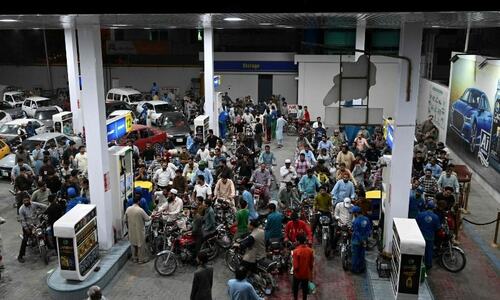
Petroleum prices increased under the new daily pricing mechanism. The price of petrol rose Rs4.82 per litre to Rs342.60, while high-speed diesel increased Rs6.91 to Rs371.61. The adjustments tracked the seven-day average of Platts prices, while petroleum levy, inland freight equalisation margin and oil marketing company margins remained unchanged.
Foreign exchange reserves rose to $22.6bn as of Aug 27. SBP reserves increased to $17.1bn, while commercial banks’ reserves reached $5.5bn, taking total import cover to 2.56 months. The rupee appreciated marginally by 0.02pc to Rs277.50 against the dollar from Rs277.56.
Banking stocks provided the strongest support to the index, contributing 491 points, followed by power with 124 points, cement 107, fertiliser 101 and textile composite 70 points. These gains were partly offset by leather and tanneries, which deducted 207 points, followed by oil marketing companies at 100, exploration and production companies at 88, investment banks at 72 and miscellaneous companies at 29 points.
Among individual stocks, United Bank Ltd contributed 381 points, Habib Bank Ltd 188, Fauji Fertilizer Company 162, Hub Power Company 131 and Bank of Punjab 105 points. National Bank of Pakistan was the largest drag, reducing the index by 246 points, followed by Service Industries Ltd, Pakistan State Oil, Mari Petroleum Company and Pakistan Petroleum Ltd.
Other notable developments included Saudi discussions on investment in agriculture, real estate, energy, and information technology; plans to establish a special-purpose vehicle for the privatisation of three power distribution companies; $763m in loans and grants received in July; and a performance-based rebate for incremental exports.
Analysts expect the market to remain sensitive to geopolitical developments, while the ongoing earnings season could provide support. They noted that the KSE-100 was trading at a price-to-earnings ratio of 8 times, with a dividend yield of 6.2pc.
AKD said easing geopolitical tensions and improving economic indicators could help the market advance. A potential US-Iran agreement could also bring international oil prices closer to pre-conflict levels.
Published in Dawn, August 30th, 2026