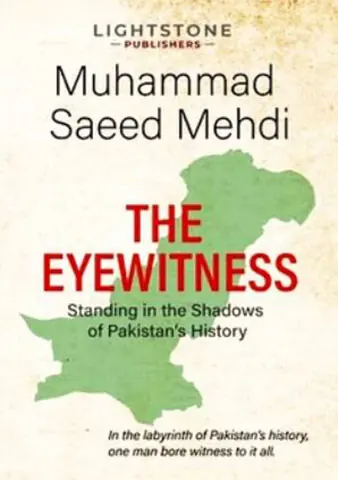
The Eyewitness: Standing in the Shadows of Pakistan’s History
By Muhammad Saeed Mehdi
Lightstone Publishers
ISBN: 978-969-716-309-0
344pp.
History told through quotes’ is how Muhammad Saeed Mehdi’s memoirs, The Eyewitness: Standing in the Shadows of Pakistan’s History, can best be described. A Civil Services of Pakistan czar and a commissioned army officer, the author takes the reader along a journey that begins with the “blood and iron” of Partition, the memories of which have stayed with him.
Mehdi was a commissioned officer in the army who later joined the civil service, where he served as a commissioner of both Rawalpindi and Islamabad and retired from the Government of Pakistan as a federal secretary. During his extensive career in the civil service, he remained associated with the government at several key decision-making roles that included Chief Secretary of Sindh and Principal Secretary of the Prime Minister Secretariat.
Mehdi’s history is rarely an opinion. It is, instead, a compendium of the utterances by those who made and destroyed Pakistan. Their names include — hold your breath — Gen Ayub Khan, Gen Yahya Khan, Z.A. Bhutto (ZAB), Gen Ziaul Haq, former Punjab Chief Minister Hanif Ramay, former PM Mohammad Khan Junejo, former Chief Justice Anwarul Haq — the man who signed ZAB’s death warrant, Mian Nawaz Sharif, Gen Pervez Musharraf, Benazir Bhutto, Shehbaz Sharif and many more names, some preceded by ‘Mr Justice.’ Being ‘Mr Justice’ meant nothing to them, however, because many of them behaved as vindictive scoundrels.
Mehdi is neutral in his opinion and, where necessary, praises as well as lampoons. Bhutto, says the author, chose his own hangman by appointing Lt Gen Ziaul Haq as Chief of Army Staff. Zia was promoted above six other, more senior lieutenant generals by Bhutto.
Bhutto’s enemies pretended to believe that they were going by the law but, in the heart of their hearts, they knew they were out there only to murder Bhutto. One significant piece of dialogue between the author and Gen Zia deserves to be reproduced here.
The memoirs of a powerful former civil servant take the reader on a journey through Pakistan’s turbulent political history, exposing many in the top echelons of power through their own words
The author was deputy commissioner in Mianwali and Zia met him there on a jail visit after he took power. The two discussed official matters, during which Zia turned his attention to the prisoners’ cells. There were cells of different categories, and the prisoners were lodged there according to their crimes. Looking at the cells must have made Zia uncomfortable, so he chose to talk it out.
“Commissioner Sahib,” he said, “there should also be an ‘A’ class, as who knows someday, God forbid, you or I may be sent to this jail. Instead of being in ‘B’ class, let us have the privilege and comfort of being in ‘A’ class.” The man didn’t know, of course, that the wreckage of a plane would end up being his ‘prison cell.’
Zia violated the constitution, went back on his word to hold the general elections that were due, remained the army chief and head of state till the end, held a bogus referendum, promised the ‘Islamisation’ of laws, used Saudi and American money to organise anti-Soviet resistance in Afghanistan, and crushed Bhutto’s PPP and all political opposition. He had both admirers and sworn enemies.
Mehdi deserves praise for reproducing a significant part of ZAB’s highly emotional historic speech in the Lahore High Court. According to the author, the bench was so constituted as to ensure a guilty verdict, a fact borne out by the recent declaration of the Supreme Court that the decision to condemn ZAB to death was indeed a “judicial murder.” Bhutto, according to the author, had decided to keep his head high and refused to seek Zia’s pardon until the end.
The enmity Zia had toward the Bhutto family and the meanness in his behaviour have been adequately covered in the book. For instance, Benazir Bhutto’s request to enter her father’s cell so he could embrace her before his execution was denied. Says the author: “How sad and how unfortunate! Bhutto’s family were not given his dead body, though it is laid down in the rules and practice that, after execution, the dead body is handed over to the family…”
He says that he wondered under what law Begum Nusrat Bhutto and Benazir were arrested. No case was registered against them. Their only “crime”, according to him, was that one was ZAB’s wife and the other his daughter. The judiciary, to which the author himself belonged for a brief time, comes under harsh criticism in the book for giving one man (Zia) the power to amend the constitution.
The book obviously inflicts us with the wounds of history, especially when the author dwells on the 1971 tragedy. The book reminds us that these wounds still pain our friends in Bangladesh. During a courtesy call on Sheikh Hasina, then Bangladesh prime minister, then PM Nawaz Sharif told her, “Madam Prime Minister, it is time to forget the past and heal the wounds.”
Sheikh Hasina remarked quickly, “No, Mr Prime Minister, that is not possible. The wounds are far too deep and too sharp to be forgotten. If you are not aware of that period, do kindly read the Hamoodur Rahman Commission report if you have not done that so far.” This meant, as the author remarks, that the wounds, deep in the minds and hearts of the Bangladesh prime minister and perhaps many others, still seemed fresh even after the passage of more than a quarter century.
It is ironic that Sheikh Hasina, herself now in exile in Delhi and under a death sentence in her homeland, must contend with crimes committed by her party’s goons and the wounds that those who suffered under her are unwilling to forgive.
Some of the book’s revelations about the politicians of the pre-1973 era might seem unbelievable to younger readers today. For instance, ‘Field Marshal’ Ayub Khan’s alleged remarks about Fatima Jinnah during the presidential election appear implausible. Fatima Jinnah was a nationally respected personality. Besides being Quaid-i-Azam Mohammad Ali Jinnah’s sister, she played a valuable role as an opposition leader, criticising what to her appeared to be the Ayub government’s policies and dictatorial tendencies.
During the presidential election, she secured a majority of seats in East Pakistan and Karachi. Ayub won the election that many thought was rigged but was bitter against her. According to the book, Ayub called her and her supporter, East Pakistan’s Sheikh Mujibur Rahman, “ghaddars, traitors and Indian agents.” While anyone can fall victim to political tensions and perceived hurts to their ego, it seems unbelievable that these words would come from Ayub, who was recognised internationally as an officer and a gentleman, with a Sandhurst touch to his personality. Mehdi wasn’t there but, then, no historian is there when history is being made.
On the whole, this is a valuable book that gives us an insight into the quality of our political leadership, which ranges from brilliant to worse than mediocre. A minor correction: it should be the 1965 war and not 1955, as printed on page 77.
The writer is Dawn’s External Ombudsman and an author
Published in Dawn, Books & Authors, August 30th, 2026