Infant deaths at Pims prompt Sindh govt to renew fire safety directives
• PMA warns health facilities in the province remain vulnerable to fires; urges concrete steps to improve safety measures for patients and staff
• Chief Secy orders review of fire safety measures at all public places, buildings
• KMC, SESSI-run hospitals told to ensure installation of extinguishers, alarm and fire detection systems
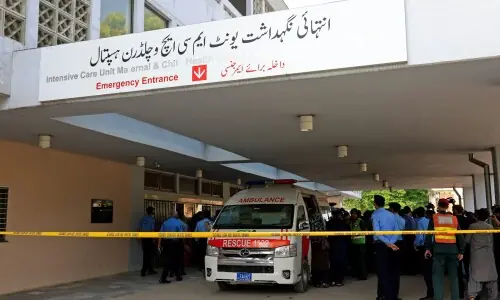
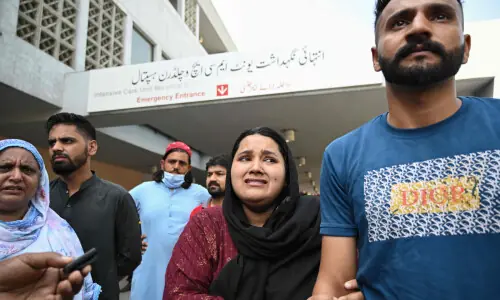
KARACHI: The tragic loss of 14 infants in a fire at the Pakistan Institute of Medical Sciences (Pims) in the heart of the federal capital has also brought to light the highly risky conditions prevailing at health facilities across Sindh, prompting authorities to issue directives to review and strengthen fire safety measures at all health facilities, public places and buildings.
The issue was also taken up by the Pakistan Medical Association (PMA), whose representatives warned at a press conference on Thursday that health facilities in Sindh were no less vulnerable to such an incident, while calling for concrete steps to make hospitals safe for both staff and patients.
Thursday also saw a high-level meeting chaired by Sindh Chief Secretary Asif Hyder Shah, who issued directives to all provincial departments to complete reviews of fire safety arrangements at all public places, buildings and institutions under their administrative control and submit signed compliance certificates within 15 days.
‘A predictable outcome of criminal negligence’
Speaking at the press conference, PMA’s Dr Abdul Ghafoor Shoro said the fire at Pims was a predictable outcome of criminal negligence, complete administrative breakdown and structural failure.
“If a flagship institution operating directly under federal oversight lacks functional emergency exits, maintained fire suppression systems and basic safety protocols, we must confront an uncomfortable truth: our healthcare system is in crisis from the top down,” he said.
Pointing to the state of health facilities in Sindh’s rural and underprivileged areas, he said their conditions were far worse. “Millions of vulnerable citizens are forced to seek care in dangerous, crumbling facilities that lack basic fire protection, functional equipment and physical security for patients and medical staff alike.”
Recalling some fire incidents at Sindh’s hospitals — the National Institute of Child Health (June 2026), Syed Abdullah Shah Institute of Medical Sciences (November 2025) and Sindh Government Hospital Liaquatabad (February 2024) — that resulted in the death of four health staffers, the PMA representative emphasised that these tragedies indicated structural failures across the country’s healthcare system.
“Hospitals must be sanctuaries of healing — not places where infants and patients pay for administrative failure with their lives,” he said.
The association demanded immediate resignation and removal of the entire Pims executive administration and the senior officials directly tasked with facility management and regulatory oversight.
It also called for an immediate, third-party safety and security audit of every public and private healthcare facility across Pakistan, prioritising high-risk rural and district hospitals, and Rs100m compensation to each aggrieved family.
‘Over 3,300 buildings audited for fire safety in Sindh’
At the meeting chaired by the CS, Provincial Disaster Management Authority (PDMA) officials said that a total of 3,354 buildings had been identified and audited for fire safety across the province.
They said 798 buildings were inspected in Karachi Division, 1,287 in Hyderabad Division, 420 in Larkana Division, 129 in Mirpurkhas Division, 418 in Shaheed Benazirabad Division and 302 in Sukkur Division.
Referring to past fire incidents, the chief secretary said that timely safety measures, trained staff and well-organised evacuation plans could significantly reduce loss of life and property. “Fire safety is an ongoing responsibility and cannot be limited to a one-time inspection,” he said.
The CS directed all administrative departments and divisional commissioners to ensure full compliance in every facility, with special priority for public places, government buildings, commercial centres, shopping malls, markets, prisons, hospitals, teaching hospitals, industrial facilities, schools, colleges, hostels, child protection institutions, Dar-ul-Amans, orphanages and bus terminals.
He said special safety measures and workable emergency evacuation arrangements must be ensured in institutions housing children, women, patients, students, prisoners and other vulnerable groups.
Healthcare body to conduct surprise inspection
The Sindh Health Care Commission (SHCC) has directed healthcare establishments across the province to ensure full compliance with the commission’s prescribed standards for fire safety, emergency preparedness and disaster readiness.
“The SHCC will now conduct surprise inspections and monitoring visits across Sindh, without prior notification, to assess the actual level of compliance with the prescribed safety standards,” a spokesperson of the commission said.
During these visits, he added, SHCC inspection teams would not only physically assess fire safety and emergency arrangements but would also verify relevant records and documentary evidence.
KMC, SESSI intensify fire safety measures at hospitals
The Karachi Metropolitan Corporation and the Sindh Employees Social Security Institution (SESSI) have also issued fire safety directives to all health facilities operating under their administrative control.
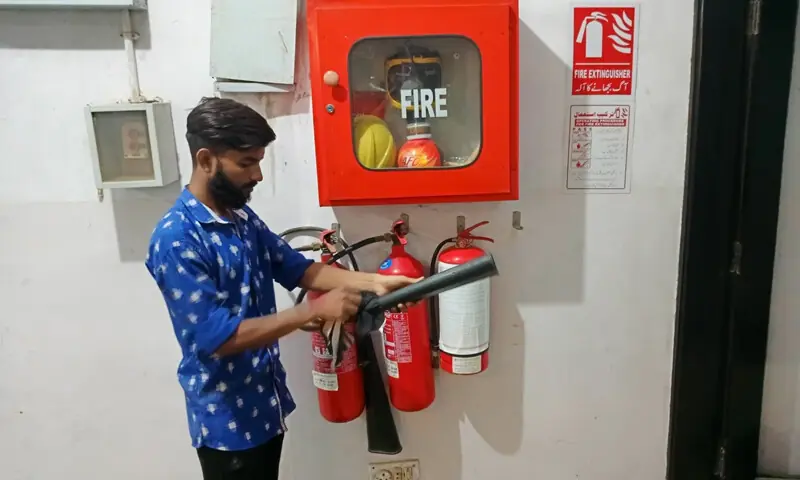
The KMC directed heads of all its health facilities to review and strengthen the fire safety measures; ensure installation and availability of adequate fire extinguishers at all appropriate and easily accessible locations, including wards, operation theatres, laboratory, store, kitchens, electric rooms and other high-risk areas.
The hospitals were asked to ensure installation and functional maintenance of fire alarm and detection systems, provision and maintenance of clearly marked and unobstructed emergency fire exits with appropriate lighting and display of emergency evacuation plans and fire safety instructions at prominent locations for the guidance of patients, attendants and hospital staff.
Also, SESSI Commissioner Hadi Bakhsh Kalhoro directed the relevant authorities to inspect fire alarms, fire extinguishers and emergency evacuation routes in all hospitals.
Published in Dawn, August 28th, 2026