• Holds first parliamentary meeting, announces strategy against violence, economic crisis and political repression
• Barrister Gohar says his party has assured JUI-F chief of complete support
ISLAMABAD: The joint opposition on Monday held its first parliamentary meeting and announced a collective strategy against violence, the economic crisis and political repression.
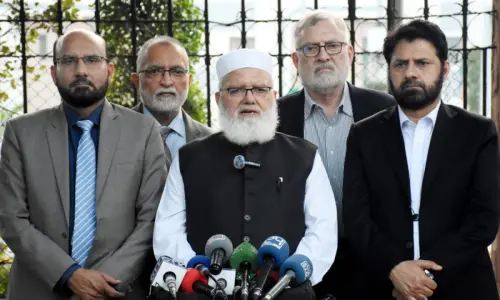
The meeting, held at Parliament House, was attended by prominent opposition leaders, including JUI-F chief Maulana Fazlur Rehman, Pakhtunkhwa Milli Awami Party (PkMAP) leader Mehmood Khan Achakzai, Majlis Wahdat-i-Muslimeen (MWM) head Allama Raja Nasir Abbas and interim PTI Chairman Barrister Gohar Ali Khan.
Speaking to the media after the meeting, the JUI-F chief said the opposition parties had agreed to play a joint role in parliament, stressing that the prevailing situation demanded political consensus, the release of political prisoners and an end to violence.
He said it was not the time to divide the provinces, warning that such a move would only deepen mistrust among the federating units.
“Provincial division will increase disturbance,” he said, and claimed that the 18th Amendment had become a “thorn in the throat” of the establishment. He said all opposition parties agreed that Pakistan, as a state, could not afford the prevailing situation.
“People are also on the streets in Kashmir,” he said, alleging that violence was being used instead of resolving public grievances.
The JUI-F chief called for the release of prisoners and the creation of a positive political environment. Describing the day as “blessed”, he said lawmakers sitting on the opposition benches had decided to join forces.
“We are together today in view of the law and order situation in the country,” he said. “On one side, our land is red with blood, while on the other, our rulers are walking on red carpets.”
He said the deteriorating law and order situation was also severely affecting the national economy.
Referring to Pakistan’s rivalry with India, he said the two countries had often talked about war and competition, while New Delhi had now become the world’s fourth-largest economy.
He also questioned Pakistan’s standing in judicial rankings.
‘Suffocating atmosphere’
Mr Achakzai, who is also the leader of the opposition in the National Assembly and head of the Tehreek-i-Tahaffuz Ayeen-i-Pakistan (TTAP) alliance, said opposition members had reached an agreement despite the “suffocating atmosphere” in parliament.
“It is a day of happiness and congratulations,” he said, expressing hope that the alliance would play an important role in restoring Pakistan’s lost glory.
Mr Abbas, who is also the leader of the opposition in the Senate, said the opposition’s unity during the month marking the birth of the Holy Prophet (PBUH) was a good sign.
He expressed concern over the deteriorating law and order situation, referring to recent incidents of violence and saying that bodies of people with their throats slit were being recovered.
“We are cultivating enmities instead of friendships,” he alleged, adding that the lives of citizens were not secure.
He also alleged that the sanctity of homes and the privacy of families were being violated, say-ing that the honour and dignity of citizens were not protected.
Referring to the condition of PTI leader Dr Yasmin Rashid, he said her situation was there for everyone to see.
He also claimed that the Supreme Court had ordered the transfer of PTI founder Imran Khan to Shifa International Hospital, but alleged that the law and judicial decisions were being ignored.
‘PTI to fully back Fazl’
PTI Chairman Barrister Gohar said leaders of opposition parties had met and agreed to remain united.
“All opposition parties will adopt a common position inside parliament,” he said, adding that they would speak with one voice on law and order, inflation and Pakistan’s relations with other countries. Mr Gohar said the PTI had assured the JUI-F chief that it would fully support him.
On the question of provincial restructuring, he said no constitutional amendment concerning the provinces could be made overnight, stressing the need for consultation and consensus.
Published in Dawn, August 25th, 2026