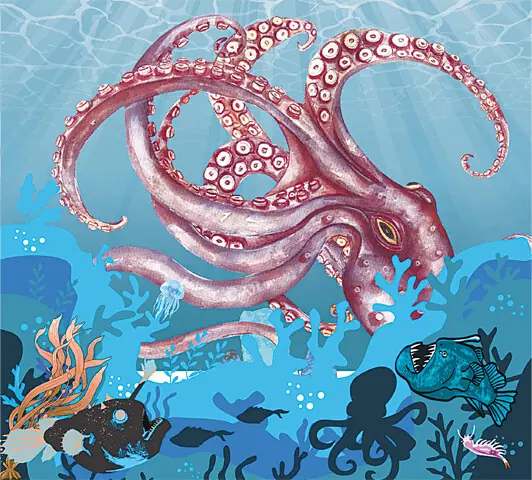
Now and then, we hear about a new planet, a distant moon or some weird signal coming from deep space. Scientists are keeping their eyes on Mars in the search for water and alien life, studying Jupiter’s moon Europa and sending robots to comets millions of miles away.
And this is what humanity needs: research, curiosity and the courage to dig deeper. But there’s something huge we usually forget: a similarly mysterious alien world right here on our own planet — but hidden deep beneath the ocean waves.
There is no doubt that the ocean deep down is dark, freezing and full of creatures that look like nothing on land.
But scientists have explored only a tiny part of it. Humans have directly seen less than 0.001 percent of the deep seafloor — an area roughly the size of Rhode Island. So what exactly is down there that we have not seen?
From glowing creatures and hydrothermal vents to bizarre ecosystems, deep ocean depths hold a world we are only beginning to understand
A world hidden beneath us
On the shore, the ocean feels familiar. You can see the sand, the fish, and the waves. But go deeper and everything changes. It’s a mysterious world we hardly know anything about. The deeper you go, the stranger and more challenging it gets.
At 200 metres, sunlight starts to fade. At 1,000 metres, the temperature drops to just above freezing. The pressure builds until it would crush a human body instantly without a submarine to protect it.
The deepest point we’ve found in any ocean so far is the Mariana Trench. There, scientists have compared the pressure to having enormous weights stacked on top of you. Only a handful of people have ever gone to its deepest point. More people have climbed Mount Everest than have reached the bottom of the Mariana Trench.
Life where the sun never reaches
In 1977, a team exploring the seafloor more than 2,500 metres down near the Galápagos Islands, in a submersible called Alvin, found something nobody expected: colonies of clams, strange tube worms and other creatures clustered around cracks in the ocean floor, where sunlight never reached.
These cracks are called hydrothermal vents. They release scalding, mineral-rich water heated by volcanic activity beneath the seafloor. And this entire ecosystem survives on a process called chemosynthesis, where bacteria turn chemicals from the vent water into food, instead of relying on sunlight the way plants do.
This discovery didn’t just surprise biologists. It changed how scientists think about where life could exist elsewhere in the universe — because if life can survive without sunlight here on Earth, maybe it can survive the same way under the icy oceans of distant moons like Europa or Enceladus.
A world that glows
With advances in technology, we now know a lot more about one of the strangest, most beautiful things in the depths of the ocean: bioluminescence. Scientists estimate that around three-quarters of the animals observed in the ocean can produce their own light. Some fish flash light patterns to attract other fish. Some shoot out glowing clouds to confuse a predator and slip away. Some use it as camouflage.
Almost all jellyfish-like animals can glow, and by some estimates, up to 90 percent of fish living below 500 metres can too. Turn the lights off on a research submersible down there, and instead of total blackness, you get flashes and sparks of blue-green light coming from every direction — like a galaxy or a light show.
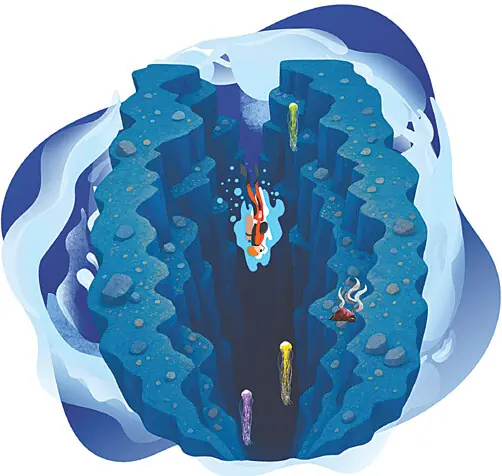
Robots become the explorers
A few years ago, the Titan submersible tragedy made the whole world suddenly aware of just how brutal ocean pressure really is. It’s exactly why, just like in space, most deep-sea exploration today is left to machines instead of people.
Remotely operated vehicles, or ROVs, are robots connected to a ship above by a long cable. Scientists sitting safely on deck steer them, watch live video feeds and use robotic arms to collect samples. Other robots, called autonomous underwater vehicles, work without a cable at all — exploring on their own and reporting back once they resurface.
Sending a robot is actually doable because robots don’t need oxygen, don’t get crushed by pressure the way a human body would and can stay down far longer than any diver could.
New faces from the deep
Every year, expeditions using these underwater robots bring back footage of animals nobody has ever recorded before.
In July and August 2025, off the coast of Argentina, a robot exploring a canyon nearly twice as deep as the Grand Canyon filmed shimmering squids, pink lobsters and a variety of other deep-sea creatures. Scientists documented more than 40 suspected new species during the expedition, although confirming whether they are truly new species will take further study.
Off the coast of Brazil, researchers have also been exploring the ocean’s “midwater” — the vast, barely explored layer between the sunlit surface and the seafloor — revealing species and ecosystems that are still poorly understood.
The parts we still haven’t seen
According to the National Oceanic and Atmospheric Administration (NOAA), only 28.7 percent of the global seafloor had been mapped using modern, high-resolution technology as of April 2026. And when it comes to actually seeing the deep seafloor, humans have observed less than 0.001 percent.
It’s not that scientists haven’t tried. It’s just that the deep ocean is one of the toughest places on Earth to reach. It’s dark, freezing and the pressure down there can crush equipment that isn’t built to handle it. But almost every time researchers manage to get down there, they find something nobody has ever seen before, such as a new species, a strange ecosystem or even a landscape no one knew existed.
Most scientists believe that we’ve barely scratched the surface of what’s actually living in the deep sea, simply because we haven’t been able to look closely enough.
The same question, asked twice
We spend a lot of time imagining what’s out there on other planets — strange chemistry, extreme cold, creatures that survive without sunlight, animals that glow in the dark. Turns out, all of that already exists here, just a few thousand metres under the ocean’s surface.
Travelling millions of kilometres into space is one of the most incredible things we’ve ever attempted. So is dropping a submersible into total darkness and crushing pressure, just a few kilometres beneath a fishing boat. Both take extraordinary machines, extraordinary courage and years of patient work. And both are still, mostly, a mystery to us.
With the same curiosity that sends rovers to Mars, we send robots to the Mariana Trench as well. The same excitement about life on Europa is why scientists still get goosebumps over a hydrothermal vent. Space and the ocean are asking us the same question — and we get to go looking for the answer in both.
Published in Dawn, Young World, August 22nd, 2026