NA speaker calls for national consensus on water crisis, sustainable recycling systems
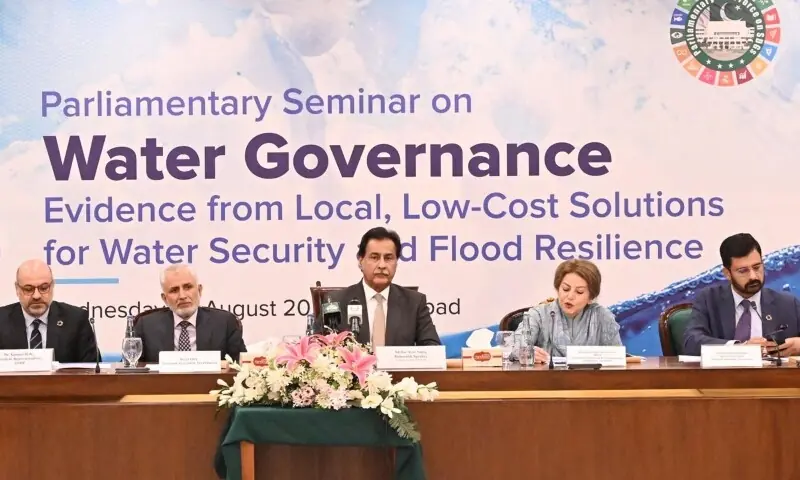
ISLAMABAD: National Assembly Speaker Sardar Ayaz Sadiq highlighted the critical need for a nationwide consensus and enduring policies to resolve Pakistan’s water crisis, emphasising sustainable development over provisional measures.
The speaker called for making water harvesting a priority for both the federal and provincial governments.
He further stressed the need to introduce sustainable water recycling systems at the federal and provincial levels to improve groundwater levels and conserve precious water resources.
He stressed that political differences must be set aside to develop a national consensus on the water issue.
“Water security is human security, economic security and national security,” he said.
He was speaking at a parliamentary seminar on water governance, “Evidence from Local, Low-Cost Solutions for Water Security and Flood Resilience.” Parliamentary Task Force on Sustainable Development Goals (SDGs) had organised it.
Mr Sadiq emphasised that water conservation is intrinsically linked to Pakistan’s food security, economic stability, and national security.
He added that the federal and provincial governments should accord special attention to the construction of water reservoirs and small dams.
He emphasised that close cooperation between the federal and provinces was essential for effective management of water resources.
He stressed that effective implementation of the National Water Policy and institutional coordination are essential for sustainable water management.
He called for ensuring transparent utilisation of funds allocated for water-related projects and said that Parliament’s responsibility extends beyond legislation to effective oversight of public policies.
NA speaker said that responsible investment, modern technology, reduction of water wastage and restoration of groundwater resources are essential components of a comprehensive water-security strategy. Speaker Sardar Ayaz Sadiq has also said that water is no longer merely a sectoral issue but has emerged as a critical matter of national security, stressing that ensuring access to clean water is a shared national responsibility. India’s suspension of the Indus Water Treaty was a clear violation of international law, he said.
Federal Minister for Planning, Development & Special Initiatives Ahsan Iqbal Chaudhary said that Pakistan had not built a new water reservoir in the last 50 years, stressing the need to increase the storage capacity of existing reservoirs and construct new ones to address the country’s limited and increasingly scarce water resources amid the adverse impacts of climate change.
He stressed that Pakistan needed additional water reservoirs to strengthen its capacity to withstand such threats and ensure water security.
The federal minister also expressed concern over the decline in development financing, noting that the PSDP had fallen from 2.6 per cent of GDP in 2018 to 0.6 per cent in 2026.
He said the PSDP allocation remained at around Rs1 trillion in both 2018 and 2026, which, after accounting for inflation, represented only about Rs250-300 billion in real terms.
He stressed the need for effective utilisation of the PSDP, stronger local government financing and robust disaster-risk financing to scale up proven local solutions across the country.
Convenor of the Parliamentary Task Force on SDGs, Ms Shaista Pervaiz said that water security is not merely an issue of water scarcity but also involves the sustainable use and management of water resources.
She said that improving Pakistan’s water resources is a shared responsibility and stressed the need to protect and further strengthen the country’s abundant water resources.
The seminar was attended by MNAs as well as administrative officers and representatives of UNDP, World Bank, WaterAid, and Unicef.
Published in Dawn, August 20th, 2026