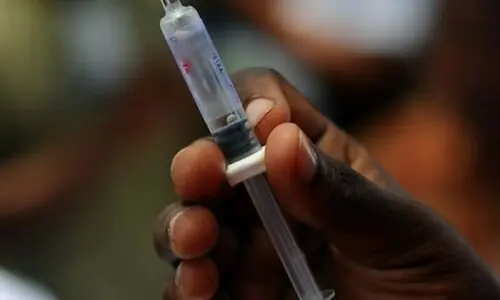
PESHAWAR: The Khyber Pakhtunkhwa government is incorporating amendments to Drug Act, 1976, to regulate import, export, manufacturing, storage, distribution and sale of drugs to ensure public safety through availability of quality drugs and fast-track cases in the court.
The proposed amendments also seek to enhance punishments for sellers and manufacturers of substandard medicines and medical devices. In this connection, a bill has been tabled in the provincial assembly.
The Drug Act, 1976, is meant to regulate import, export, manufacturing, storage, distribution and sale of drugs to ensure public safety and quality.
It empowers the federal government under sections 4, 5, 7, 12 and 43 to grant manufacturing licence and register medicines, regulate import and export of drugs, fix maximum retail prices (MRP) and other quality standards in addition to making rules pertaining to drug registration, drug licensing, drug labelling and packing etc.
Amendments will also help to fast-track court cases
Sections 6, 11, 15, 17 and 44 of the Act empower the provincial government to grant licences for drug sale, establish provincial quality control boards (PQCBs) and drug testing laboratories (DTLs). Under Section 18 of the law, provinces are authorised to carry out inspections and enforce provisions aiming to regulate quality parameters of drugs in market through sampling and conduct investigation in case of adverse reports.
In addition, provinces are also required to frame rules for drug sale licences and establishment of laboratories etc.
Presently, provincial governments are authorised to set up a PQCB consisting of such members including a chairman as government may appoint from time to time.
The proposed amendment seeks in sub-section (3), the word “provincial government”, occurring for the first time, words “chief minister of the province” shall be substituted and for words “provincial government” occurring for the second time, words “with the approval of provincial government” shall be deleted to authorise the chief minister to establish/constitute PQCB to avoid delay in finalisation of the constitution and other matters of PQCB and to ensure quick disposal of cases submitted to it.
Other proposed amendment is regarding DTLs, which currently says that provincial government shall set up a provincial DTL under which health department will get the power to establish one or more laboratories.
Sections 16, 17 and 18 of the Act, regarding appointment of analysts, inspectors and assigning powers, say that federal or a provincial government may appoint qualified drug analysts through official notification for specified areas and categories of drugs.
The amendment will replace words “provincial government” with “health department” in Section 16 in case of analysts, Section 17 in case of inspectors and section 18 regarding powers of inspectors to make the posting notification in consonance with appointment under the relevant section of law to avoid delay in investigation, prosecution and to cover legal lacunas.
Currently, penalties for spurious/unregistered drug, unlicensed manufacture/import are up to 10 years imprisonment and fine up to Rs500,000 that will be enhanced to 10 years and not less than Rs1 million, respectively.
The penalties for imitation, false warranty, wrong name and adulteration will rise to seven years imprisonment and up to Rs5 million fine.
The existing Section 31 of the Act, regarding drug court, says that federal government may, by notification in the official gazette, establish as many drug courts as it considers necessary. The amendment, to be incorporated, seeks to replace “federal government” with “government” for transfer of authority to provincial government to take over drug court and to ensure swift decision.
Another section inserted in the proposed bill authorises drugs inspector and accused to file appeal before Peshawar High Court against an order of acquittal and sentenced passed by drug court to enhance judicial transparency and to provide aggrieved parties with a clear appellate process with timeline, which has not been defined in the existing law.
Published in Dawn, August 18th, 2026