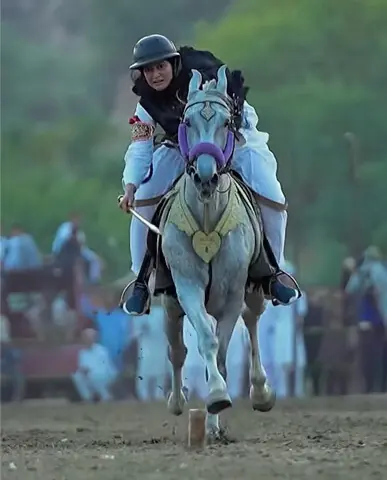
“It’s like you’re on a dragon,” is how tent-pegger Ayesha Ahmed describes the feeling of charging at top speed on her stallion, lance in one hand and reins in the other, as she gallops towards the peg.
The 21-year-old Islamabad-based rider, who started riding at five, is currently the youngest captain of Pakistan’s national women’s tent-pegging team. “Nothing matches the adrenaline rush of those few seconds,” she tells Eos.
Ahmed has played badminton, netball and basketball, and taken up swimming, polo and squash, but says nothing compares to tent-pegging, which she took up at 17. “It demands impeccable hand-eye coordination and precise control of the lance and horse,” says Ahmed, who is also studying public policy.
Raja Zarar Sajjad, president of the Equestrian Federation of Pakistan (EFP) and a keen rider, says the 2024-25 livestock census puts Pakistan’s horse population at 552,000. Of the nearly 70,000 horses used in equestrian sports, he estimates almost half are used for tent-pegging, with some 15,000 riders.
In a sport long ruled by men, a growing number of Pakistani women are galloping into tent-pegging — lance in hand and, increasingly, a seat on the federation’s saddle
“Some have three or four horses, or even more, just for this sport.” He estimates that the rest are used for polo and leisure riding.
FREEDOM IN THE SADDLE
Ahmed shares four horses with her father but has a soft spot for five-year-old Khan, an Anglo-Arab chestnut, for his feistiness. “I love his nakhras [antics]. He refuses to gallop or even canter for anyone else,” she says.
Artist Maryam Mohsin, 25, is only beginning to understand her special bond with horses. “A horse canters or gallops through the mind. Only a rider can understand that connection,” she tells Eos.
For Anum Shakoor, founder of Binte Zahra, Pakistan’s first women’s EFP-registered tent-pegging club, desi [indigenous or locally bred] horses outperform crossbred thoroughbreds.
“They’re spirited and hot-blooded,” says the 32-year-old financial analyst, who took up riding two years ago and has since competed in about 15 privately organised melas [tent-pegging events] across Punjab.
Shakoor is fluent in tent-pegging lingo. Mela doraya means galloping to pick the peg. Pegs are named by size: qilla (2-2½ inches), aari (1-1½ inches) and partari (½ inch). “I’ve done them all,” she tells Eos.
Last year was a defining moment. After defeating 40-45 men — including her ustad [teacher] — in the partari round at a mela in Gujjar Khan, her ustad gifted Shakoor his prized horse, Shehzada. “Imagine beating your own ustad!” Shakoor recalls. “He knew which horse I’d set my eyes on!”
BONDING WITH THE BEAST
For Ahmed and Shakoor, the horses Khan and Shehzada are more than prized possessions; they are part of the bond that makes riding so compelling.
That connection is what drew Maryam to exclusively paint horses. The young artist always felt disconnected from her work — until she mounted a horse two years back.
“That feeling of emptiness suddenly dissipated,” she tells Eos. A year later, she started tent-pegging. “They understand your heartbeat and your emotions — if you’re nervous, they react the same way,” says Mohsin.
“They’re incredibly sensitive,” agrees Arooj Kayani, 37, who refers to herself as a horse mum. “They read your body, your mind, your energy — even from six feet away,” she tells Eos.
Kayani started riding at 12 but took it up seriously two decades later, at 32. “It felt like receiving a divine gift,” she says, adding that she shares a “spiritual bond” with horses. For Kayani, that connection has taken a more physical form.
Five years ago, she took up tent-pegging in Lahore, spending long hours with horses and in the stables. She soon led Pakistan’s national women’s team to South Africa.
Her passion for horses has since extended beyond sport. At her farmhouse near Rohtas Fort in Jhelum district, Kayani runs a niche horse-tourism venture, offering day-long equestrian experiences designed to foster a deeper appreciation of the animals.
“In Pakistan, horses don’t get the love or respect they deserve,” says Kayani. “They’re not dungar [beasts of burden]. They are noble creatures and I want my clients to change their outlook when they leave the farm,” she says.
FROM TROT TO CANTER
Globally, women outnumber men in many equestrian disciplines. In Pakistan, however, tent-pegging remains overwhelmingly male-dominated, says Sajjad. Yet all the women interviewed say their male counterparts treat them with respect, even admiration. “Even at melas, one feels safe,” says Shakoor.
“The systems have not been developed to include women,” admits Sajjad. Kayani is currently the first and only elected woman on the 13-member EFP board, most of whose positions, she says, are “generational posts” passed down through families.
But the hierarchical set-up is about to change. “As a first step, the word ‘woman’ has been included in the constitution,” Kayani says.
“We are also working on a four-year roadmap, with a calendar of events,” says Sajjad, who has represented Pakistan internationally in tent-pegging.
Aligned with this year’s women’s empowerment and horse welfare agendas of international and Asian equestrian bodies, the EFP is forming three-member committees for each discipline, with at least one woman on each.
SEPARATE OR TOGETHER?
With more women taking up tent-pegging, the EFP is considering separate men’s and women’s competitions. “Men have competed for decades and have an edge. We don’t want to discourage women by pitting them against men,” says Sajjad. Until now, women have competed alongside men in mixed competitions and teams.
“Men have far more experience and their skills are more refined,” admits Kayani, “but we’ve seen women challenge them.” Having competed against men herself, she acknowledges that male riders generally have a better understanding of the sport, positioning and technique, but competing alongside them has shown her what it takes to excel. “The best grooming comes from training and competing with the best.”
While she supports women-only events, Kayani believes they should run alongside, and complement rather than replace, mixed competitions. “Keeping women out of that space will limit their exposure, ambition and experience.”
“I would prefer mixed competition because it builds confidence and the urge to prove yourself,” says Shakoor. Mohsin agrees: “I think it would be less fun if men and women competed separately.”
Whether women will eventually compete separately or alongside men, one thing is clear: they are taking the reins — and making their presence felt in a sport long dominated by men.
Corrigendum: The print version of this article stated that Arooj Kayani captained Pakistan’s national women’s team at two international competitions. In fact, she led the team only on one occasion, in South Africa. The online version has been corrected.
The writer is a freelance journalist
based in Karachi. X: @zofeen28
Published in Dawn, EOS, August 16th, 2026