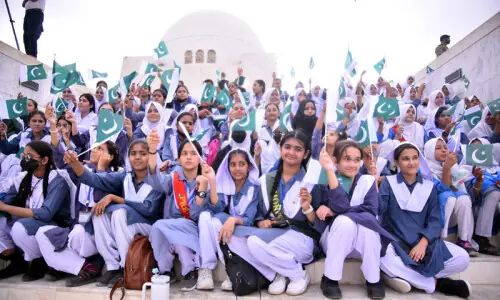
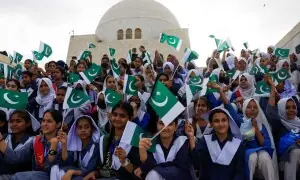
KARACHI: Women of all ages from diverse backgrounds and communities came together on the call of the Pakistan Women’s Foundation for Peace (PWFFP) on Thursday to celebrate the 79th Independence Day of the country on the theme of ‘Hamara Pakistan, Quaid Ka Pakistan, Aik Qaum, Aik Mustaqbil’.
In her heartfelt introduction to the programme, Nargis Rahman, the founder and chairperson of PWFFP, said that in the current air of hopelessness, people wonder about Pakistan’s future. “But the birth of this country was a miracle and it is the goodwill of its citizens that will let more miracles happen for Pakistan,” she said, adding that the Quaid-i-Azam Mohammad Ali Jinnah was a strong advocate of active participation of women in the country’s progress.
“Still, women in Pakistan face cultural barriers keeping them from stepping out of the house or entering the mainstream. The women here are rarely given decision-making roles. Further adverse conditions hinder education and youth participation. With their wings clipped, our youth sit on roadsides protesting for lack of job opportunities. It all impacts social mobility in Pakistan,” she said.
“We need a cohesive national identity to focus on the Quaid-i-Azam’s vision of ‘work, work and work’ to build the nation that was created for us,” she concluded.
PWFFP celebrates Independence Day with women from diverse backgrounds
CEO of Lightstone Publishers Pakistan Ameena Saiyid said it is sad that millions of children in this country are out of school. “And those in government schools are so far behind in education. We really need to increase our education standard,” she said.
Vice Provost of Aga Khan University Dr Anjum Halai said that five per cent of the country’s GDP must be spent on education, though less than one per cent is spent.
Writer and educationist Amina Azfar said that the Quaid-i-Azam wanted equality for women. “Fatima Jinnah was never seen standing behind her brother. She would always stand by his side. It was also the Quaid’s encouragement, which brought forward so many notable women during Partition and the years that followed,” she pointed out.
Archaeologist and museologist Dr Asma Ibrahim said that the best way to implement education and bring it to the next generation was to understand the significance of museums. “Museums can be an indirect education,” she said.
President of the Working Women Welfare Trust Humaira Qureshi said that people have lost faith in government institutions, which is regrettable.
Breast cancer specialist Dr Rufina Soomro said that health and education are very important for every country. “Rich or poor, all people deserve the best health and education facilities,” she said. She also spoke about the change in the ratio in medical colleges, where 70pc admissions are bagged by women while the boys amount to 20pc. “And service delivery of women is far better than men as women are good at multitasking,” she said.
Vice President of All Pakistan Women’s Association and actor Jehanara Hai said that those who came to Pakistan from India left behind their homes and their ancestors’ graves. “But over time, divisions were created in the name of ethnicities. But we are all one people; we are all Pakistanis,” she said.
Philanthropist and founder of Khana Ghar Parveen Saeed said that people do not need to go to bed hungry.
Pastor Ghazala Shafique reminded of another very important event which took place a little before August 14 on August 11. “When the Quaid-i-Azam delivered his speech to the Constituent Assembly of Pakistan in Karachi, he outlined a progressive vision for the new state, emphasising equal citizenship, religious freedom and the separation of religion from state business,” she reminded, while also adding that it was a Christian politician S.P. Singha’s vote that won Punjab for Pakistan in 1947.
Social development entrepreneur Qurratulain Bakhteari spoke about the trauma that one feels when one leaves his or her home. “Partition saw a lot of that. It was a traumatised nation, which made Pakistan. But look at the wonders that those people of yore achieved for their country. And they helped the country stand on its legs while making an effort to not transfer their trauma to us,” she said.
Artist, author and educator Rumana Husain spoke about the environment and climate change. “Health, education, the environment, climate change and the population explosion are all important subjects, which deserve our attention. In fact, no subject should be taboo in Pakistan,” she said.
Justice (retd) Majida Razvi, the first woman judge of a high court in Pakistan, said that amendments to the 1973 Constitution of Pakistan have hurt an independent judiciary. “When you lose the framework of ‘Unity, faith and discipline’, you kill merit, law and order,” she said.
Educationist and founder of the Kiran Foundation, Sabina Khatri, said that it is customary to make big statements and promises about what you will start doing from August 14. “But let’s do it differently this time by saying what you will not do: things that hurt your country,” she said.
CEO of Now Communities Farhat Parveen talked about migration being an issue in Pakistan. “Karachi has so many Seraikis, Pakhtoons and other ethnicities because of the lack of development in their areas of origin. There is also out-migration here which forces our people to leave this country in search of greener pastures,” she said.
Human rights activist Safina Javed, young artist and researcher representing the Parsi community Veera Rustomjee, boxer Marya Rind and footballer Zunaira from Lyari, Ayesha Islam, Michiko Adil, Sufia Ashfaq and Aliya Rahman of PWFFP also spoke.
Published in Dawn, August 15th, 2026