ISLAMABAD: A group exhibition at Gallery 6 brings together seven practitioners of the Indo-Persian miniature tradition redefining its boundaries. Though they share a 16th-century hereditary craft, each artist follows divergent paths towards confronting the anxieties of the 21st century.
“Miniature painting has always been a discipline of restraint before it is one of detail,” observed Saadia Gul who has curated the show. The inherited elements—wasli paper, hashiya borders, fine kalam lines—are precisely what each artist has chosen to honour, subvert, or reimagine, she added.
Together, these seven artists demonstrate how an archaic vocabulary can feel relevant, addressing ecological crisis, psychological conflict, feminist resistance, urban alienation, and the fragile bonds connecting us all, stated Dr Arjumand Faisel, an established artist and director of the gallery.
Samreen Asghar transforms traditional techniques into tools for ecological witness. Her herbal pigments and opaque watercolours on wasli create textural fragility mirroring her subjects’ precariousness.
In ‘Oracle’, surreal elements, dripping black tendrils, a blood-red sun, two lions in an arid expanse, function as prophecy of displacement. ‘Confluence’ depicts five female figures in suspended animation, dissolving human and nature boundaries. ‘Commons’ documents the destruction of nature. “It’s a depiction of chopping of thousands of Jacaranda trees in Islamabad. The painting transforms a travesty into a profound visual elegy,” commented rights defender Tahira Abdullah while talking to Dawn.
Ali Gillani masterfully employs gold leaf and gouache, using fine hatching lines to fill figure silhouettes with dense, quilt-like texture. His Blind Faith series explores conflict between Nafs (ego) and Ruh (soul) through Abraham’s story, presenting faith not as literal truth but as practical guide to resilience. ‘Furnace of Faith’ depicts a meditative figure surrounded by golden flames; ‘Vessel of Salvation’ shows figures navigating stylized waters; ‘The Red Sea’ features geometric complexity with six-pointed stars and chaotic forms.
Hifza Khan maps women’s emotional landscapes through nature and birds. ‘Shelter Was Never Promised’ features a luminous oval with organic pillar, braided hair motifs, pomegranates, and sentinel birds, the absent female figure allowing these elements to embody emotional endurance. Anatomy of Home centres a glowing halved pomegranate, presenting home as complex ecosystem of fertility and survival.
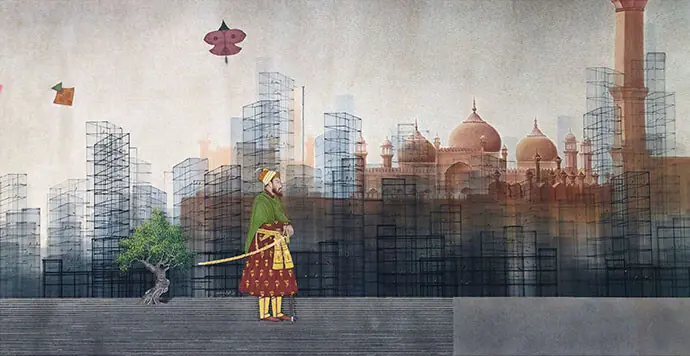
Safwan Bashir translates urban alienation into Mughal miniature language. In ‘Where Birds Once Flew’, historic domes of Badshahi Mosque are encroached by skeletal scaffolding, with a traditional figure standing impassively while a kite and gnarled tree represent nature’s persistence. His protagonists often hold white blossoms, creating counter-narrative to environmental loss. ‘A Tree Nearby’ shows a figure on floating grass observing a single surviving tree against a starry expanse and distant city silhouettes.
Onaiz Taji creates tension between macroscopic and microscopic. From distance, his compositions resemble topographic maps; details reveal distinct human postures, turning pattern back into people. ‘Emptiness’ presents staggering density, countless tiny lines forming landscape ground with a single prone figure, suggesting solitude within crowded existence. ‘Khuzdar’ applies delicate kalam technique to landscape, with tiny figures humanizing vast nature. His work blends traditional training with contemporary conceptualism.
Bakhtawar Naqvi transforms the traditional hasiya border into conceptual framework examining enclosure and intimacy. In her two untitled paintings, thick green lines frame subjects like literal barriers. ‘Desi Ghulab’ uses delicate patterned tape as border, while ‘Dholak’ features dense lattice engulfing the central void.
Her subjects engage in quiet domestic acts, tucking flowers, chatting, blowing candles, rendered with delicate, transparent touch. Naqvi creates studies on how we are simultaneously shielded and restricted by social and domestic borders.
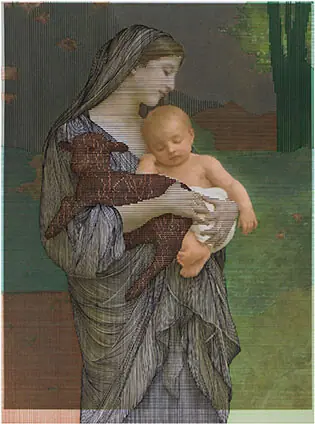
Ramsha Rubbani’s ‘A Timeless Thread’ explores fragility and inevitability of change. Her mixed-media technique employs precise ink and gouache or woven threads, representing life’s fragile strings and time’s passage.
The thread-like textures show women’s biological and emotional changes as its foremost inspiration, balancing chaos and order in a body of work that often settles on the bond between mother and child, highlighting that while life’s connections bind us, they remain subject to time’s passage and modern fragmentation. The show will continue through August 17.
Published in Dawn, August 15th, 2026