International standards are often assumed to be a modern invention. They are not. Many predate the United Nations itself; the International Labour Organization (ILO), for instance, was established under the League of Nations and only later folded into the UN system. Countries have long used such standards to strengthen governance, build credibility, and integrate into the global economy.
Pakistan has been one of them.
Over the decades, it has voluntarily become a party to numerous international treaties and conventions, incorporating many of their provisions into its Constitution, national legislation, and regulatory framework, including constitutional guarantees relating to fundamental rights, labour protections and environmental governance.
It is, however, worth remembering that joining an international treaty is a sovereign, voluntary decision. Pakistan took on these obligations because they were seen as consistent with its long-term development goals, not because it was compelled to.
Today, the country is party to well over 150 major international treaties, conventions, and protocols spanning governance, trade, labour, human rights, environmental protection, maritime affairs, and more.
Far from being symbolic, these commitments strengthen market access, attract international investment, support development cooperation and trade negotiations, and reassure global buyers about the credibility of Pakistan’s regulatory framework. Many of them, notably, were undertaken decades before concepts like ESG, carbon border measures, and supply-chain due diligence became central to global trade.
The labour record: ahead of the pack
Pakistan’s commitment to international labour standards illustrates this long-standing pattern well. The country has ratified 38 ILO conventions and one protocol, including eight of the 10 Fundamental Conventions — covering the abolition of forced labour, minimum working age, freedom of association, collective bargaining, equal remuneration, non-discrimination, and the elimination of child labour.
The remaining two — Convention No. 155 on Occupational Safety and Health and Convention No. 187 on the Promotional Framework for Occupational Safety and Health — are currently under active consideration for ratification. Pakistan has also ratified two of the four ILO Governance (Priority) Conventions, on labour inspection and tripartite consultation.
Why does this matter? Because labour standards increasingly determine market access, particularly for export-oriented economies in Asia.
Pakistan has also ratified the Protocol of 2014 to the Forced Labour Convention, signalling its commitment to global best practices and reassuring international buyers that its exports meet internationally recognised labour standards. Tellingly, India has not yet ratified this protocol, despite its labour-related commitments under its free trade agreement with the European Union. Several major Asian textile and apparel exporters — including China, Vietnam, and Cambodia — have not ratified it either, despite being far more deeply integrated into global value chains than Pakistan.
Beyond labour: environment and the wider picture
Labour is only one part of Pakistan’s broader compliance landscape. The country is also party to 15 major Multilateral Environmental Agreements (MEAs), covering climate change, biodiversity conservation, hazardous chemicals and waste management, ozone layer protection, desertification, and cultural and natural heritage.
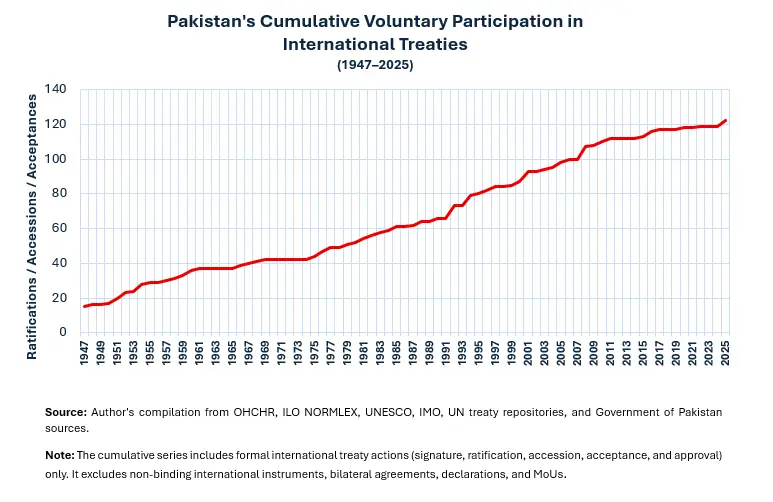
The scale of this engagement becomes clearer when viewed over time. The chart below traces the cumulative growth of Pakistan’s international commitments since independence and it shows a country that has, year after year, steadily expanded its participation in international legal frameworks.
Committing to international standards is no simple undertaking. Ratifying a treaty is only the beginning; it requires governments to review their domestic legal framework and, where necessary, amend legislation, strengthen institutions, and align national policies with international obligations.
Pakistan’s 18th Constitutional Amendment, for example, devolved many environmental and labour-related responsibilities to the provinces, creating an extensive compliance architecture that runs from federal ministries down to provincial departments and, ultimately, local governments.
The challenges are real
None of this has been easy, and challenges remain. Even the world’s most advanced economies have yet to achieve the Sustainable Development Goals; Pakistan is no exception.
Part of the reason is that many international standards are negotiated and implemented within sophisticated legal and regulatory systems that are more readily supported by advanced economies. Less developed economies, by contrast, often face additional implementation hurdles owing to resource constraints and competing development priorities.
These challenges are compounded by Pakistan’s geopolitical environment. Sharing borders with India and Afghanistan, the country continues to contend with persistent security concerns and regional instability, adding further pressure on its institutions.
Despite these constraints, Pakistan has repeatedly shown a willingness to update its compliance frameworks in line with emerging global expectations.
International law keeps evolving in response to new global challenges, geopolitical developments, increasingly stringent trade rules, and more complex global value chains.
Most recently, in response to concerns raised by the United States over the risk of forced labour in global supply chains, Pakistan promptly amended its Import Policy Order to prohibit the import of goods produced wholly or partly using forced labour, well before India or Bangladesh adopted comparable measures. As a result, imported products containing inputs produced through forced labour at any stage of the value chain are now barred from entering Pakistan’s market.
The story behind the numbers
The graph above tells only part of the story. Behind every point on it lie years of negotiations, legal reforms, institutional strengthening, and policy decisions. Their impact is rarely visible overnight, but none of that work has gone to waste.
Perhaps it is time to recognise that Pakistan’s engagement with international standards is not a recent phenomenon. It has been quietly laying the foundations for sustainable development for decades.
And this is the Pakistan we must not overlook.