President Zardari approves additional judges' appointments to high courts after days-long delay
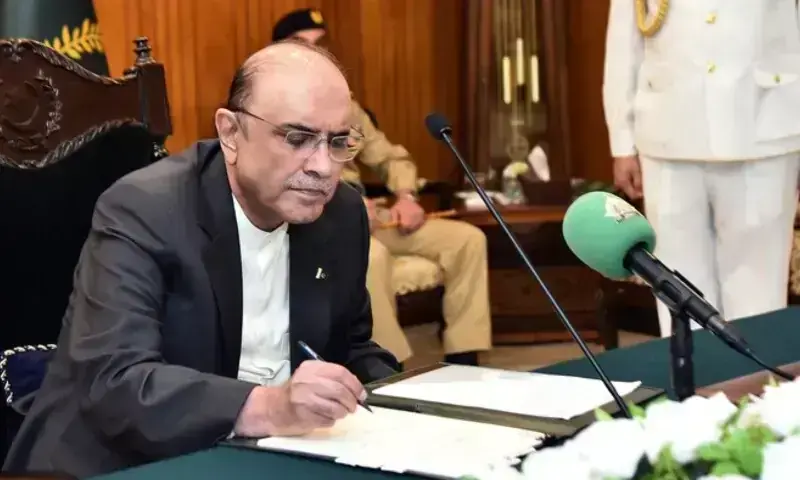


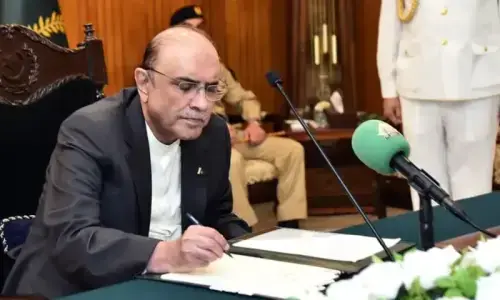
After a days-long delay, President Asif Ali Zardari gave his assent to the appointment and confirmation of additional judges for various high courts on Tuesday.
“The president has approved the appointment of additional judges in the Lahore High Court (LHC), Sindh High Court (SHC), Peshawar High Court, Islamabad High Court, and Balochistan High Court,” the Presidency said in a statement, adding that he had also given his assent to the confirmation of certain additional judges of the SHC and LHC as permanent judges.
The appointments and confirmations were pending since July 20 and 21, when the Judicial Commission of Pakistan (JCP) — the body responsible for appointing judges to the superior judiciary — recommended them.
The JCP had recommended the confirmation of four additional judges of the Peshawar High Court, a six-month extension for an additional judge of the SHC, and the appointment of 19 additional judges to the Lahore, Islamabad, Sindh and Balochistan high courts.
Under Clause 8 of Article 175-A of the Constitution, the recommendations were forwarded to the prime minister, who then sent the summary to the president. However, the summary had remained pending with the president since then.
The president’s legal team had raised certain objections to the JCP proceedings, noting that nearly all nominees proposed by the PPP were rejected. They had also conveyed that some candidates recommended for appointment had criminal records.
Meanwhile, the delay in the presidential assent had begun to affect the functioning of the superior judiciary and created practical complications. Four additional judges of the PHC, whose confirmations were recommended by the JCP, ceased to hold office after their tenure expired on August 4 due to the absence of formal notifications. Similarly, an additional judge of the SHC, whose term was extended by six months, relinquished office after his tenure expired on July 29.
Amid the stalemate, the government had also been examining the possibility of invoking Article 48(1) of the Constitution to issue the notifications through the law ministry, arguing that the president was required to act on the summary within a fortnight of its submission — a period that has since expired.
However, government functionaries later maintained that with the matter now sub judice, notifications could be issued at this stage. Sources had said the government’s legal team planned to pursue an “out-of-court” settlement with its counterparts at the Presidency.
For its part, the Presidency’s legal team had contended that Article 175-A did not prescribe a specific timeframe for the president’s action and that the provision could not be overridden by Article 48(1) to bypass the Presidency.
They had also referred to Article 48(2), which empowered the president “to act in his discretion in respect of any matter in respect of which he is empowered by the Constitution to do so” and states that the validity of anything done by the president shall not be called into question on any ground whatsoever.
On the other hand, government sources had maintained that judicial appointments were governed by constitutional provisions and that any deadlock must be resolved strictly in accordance with the Constitution.
Meanwhile, a plea challenging the delay in the president’s approval had also been filed in the IHC.
The IHC reserved its verdict on the maintainability of a petition filed by advocate Luqman Chaudhary through his counsel Zahid Chaudhry on Monday, seeking a direction to the president to approve the summary.
More to follow