Delay in judicial appointments: IHC tells govt to explain consequences of keeping PM's advice pending

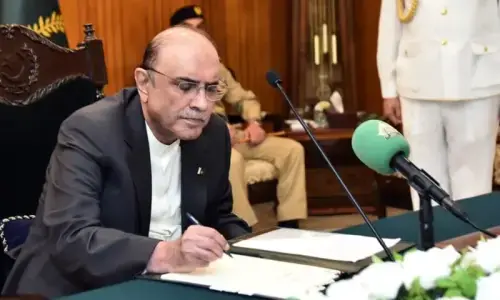
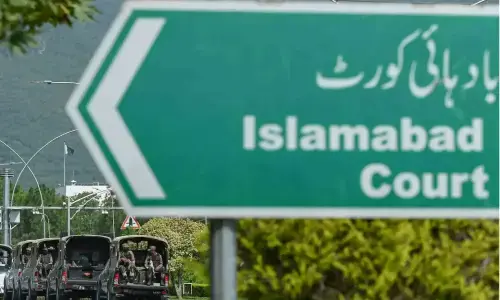
ISLAMABAD: The Islamabad High Court (IHC) on Monday issued a ruling on a public interest petition challenging President Asif Ali Zardari’s delay in approving judicial appointments, directing the government to explain the constitutional consequences of keeping the premier’s advice pending for an indefinite period.
Justice Arbab Muhammad Tahir, who had reserved the order on the maintainability of the petition on August 6, issued notices to the president, the federation of Pakistan and the attorney general. He directed them to file separate concise reports explaining the timeline and status of the summary forwarded by Prime Minister Shehbaz Sharif for judicial appointments.
The petition was filed by advocate Luqman Zafar through his counsel Zahid Asif Chaudhry amid a presidential delay in approving the judicial appointments recommended by the Judicial Commission of Pakistan (JCP).
The JCP, headed by Chief Justice Yahya Afridi, recommended the appointment of 19 additional judges and the confirmation of five judges to high courts during meetings on July 20 and 21. The summary was subsequently forwarded by PM Shehbaz to President Zardari for assent under Article 48 of the Constitution. However, the president has yet to assent to the summary.
Last week, the IHC had reserved its verdict on the maintainability of the plea.
During Monday’s hearing, the petitioner’s counsel contended that Article 48(1) of the Constitution employed the expression “shall,” which cast a constitutional obligation upon the president to act on the advice of the prime minister.
The proviso to Article 48(1) allows the advice to be returned for reconsideration “within 15 days,” after which the president must act within ten days on the advice tendered after reconsideration.
The counsel relied on precedent to argue that the president was bound to act on the advice of the prime minister and could not convert the constitutional process into a power of indefinite deferral or veto.
It was further argued that the prolonged delay in implementing judicial appointments adversely impacted the administration of justice and affected the fundamental right of the public to timely access to justice, particularly when the superior courts are already burdened with an increasing backlog of cases.
Justice Tahir directed that notices be served through all modes of service, and Additional Attorney General Rashid Hafeez was directed to ensure that the respondents filed separate concise reports explaining the dates on which the advice was submitted to the president and the action, if any, taken thereon. The case was listed for hearing for August 11 (tomorrow).
The delay has already created practical complications. Four additional judges of the Peshawar High Court (PHC), whose confirmations were recommended by the JCP, ceased to hold office after their tenure expired on August 4 due to the absence of formal notifications.
Similarly, an additional judge of the Sindh High Court (SHC), whose term was extended by six months, relinquished office after his tenure expired on July 29.
The oath-taking ceremony for the newly recommended judges was scheduled for July 27 but was indefinitely postponed after President Zardari neither granted assent to the summary nor returned it, allegedly holding it “without any legal justification.