ORIENTALISM has remained a much-discussed topic ever since Edwards Said’s book Orientalism (1978) made a splash and the ripples have been hitting the shores all along. Another subject becoming trendy of late is Occidentalism. Contrary to Orientalism, Occidentalism, or the study of the West from an outside perspective, studies western culture, philosophy, religion, social settings, politics and literature.
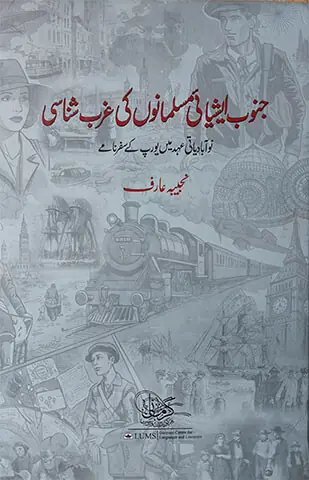
Occidentalism is often viewed as the East’s critique on the West, or, at least, how the East views the West. But in Urdu we do not have much material on gharb shanaasi, or Occidentalism. Dr Najeeba Arif’s just-published book Janoob Asiai Musalmaanon Ki Gharb Shanasi (South Asian Muslims’ Occidentalism) is the first-ever full-length research study in Urdu that analyses Occidentalism. Using travel accounts of Europe written in the colonial era as source material, the book also takes into account the motives behind the South Asian travellers’ journeys across the seas as well as the impact these journeys had on their views on the West. Sub-titled Nau Aabadiyaati Ehad Mein Europe Ke Safar Naame, or Europe’s travelogues in the colonial era, and published by Gurmani Centre, LUMS, in collaboration with Sang-i-Meel, the book is a thorough research work with the writer’s own point of view, which is supported by ample evidence mostly taken from the original travel accounts, both published and unpublished, in Urdu and Persian.
As Najeeba Arif mentions in her intro, the book is an endeavour to trace if or not the East’s intellectuals have tried to analyse the West from their own point of view and in their own ways, with elaborations on the Western culture and civilisation, just as the Westerners have recorded their observations and views on the East in their travelogues, autobiographies, letters memoirs and diaries. Then she opens up a whole new world to the readers, in her usual unassuming way, without making any tall claims to be the first researcher to have carried out such a study in Urdu, albeit she fully qualifies to claim the distinction.
Expounding the terms South Asia and maghrib (the West), she says the West here does not mean a specific geographical or political entity but the term applies to an entire civilisation and a point of view. As for limiting the study to the Muslims, she says that firstly till 18th and 19th centuries, barring a few exceptions, the Hindus did not take a trip across the seas because of their religious beliefs and the travellers who recorded their journey in writing in that era were mostly Muslims.
Secondly, the reason for limiting this study to the Muslims is, as put by the author, to evaluate a narrative, pushed forward by some Western political and journalistic quarters, that sees Muslims as averse to modernistic ideas and modern education. The assumed view about Muslims says that they are against all the good aspects of the Western culture, are bigoted, intolerant, enemy of the scientific knowledge and view the West as enemy. This view, says Najeeba Arif, has somehow been a part of the Western psyche since long and was made a part of the latter-day global narrative as a part of strategy. With a possible post-cold war scenario in mind, Bernard Lewis had reintroduced it, probably with a nod from the establishment. But in more recent times, Samuel Hiuntington’s theory of the clash of the civilisations strengthened that narrative and the purpose behind was, perhaps, to make the general public keep on believing in this distorted reality. But Edward Said has exposed this hollow Western propaganda in his book Covering the Islam: How the Media and the Experts Determine How We See the Rest of the World (1981), says the author.
The works so far carried out on Occidentalism in the West, she adds, have one assumption in common: the people of the East have a negative perception of the West. Even the research works carried out at the Western universities are one-sided, as they try to condone the widespread bias against Muslims. But the fact is, she says on the basis of her research, contrary to the premeditated negative concepts, South Asian writers have amply appreciated the positive sides of the West and its culture. To prove her thesis, Najeeba Arif dived deeply into archives and libraries during her stay in the UK for her post-doctoral study and discovered some rare and unpublished travelogues and historical accounts, not to mention the libraries in Pakistan. This work deserves all the kudos for its depth, erudition and ample references — from Urdu, English and Persian sources — all presented with an academic detachment and empirical objectivity that is becoming rarer by the day.
Najeeba Arif is a well-known scholar and heads Pakistan Academy of Letters.
Published in Dawn, August 10th, 2026