We were fast asleep in the early hours of March 9, 1951 when my mother woke us up. It must have been around 4am because it was almost light outside. She said to kiss Abba because he was going away. I felt his breath on my cheek. Then I could hear my mother shouting and some sort of disturbance but I was only half awake and went back to sleep.
That day, or the next, I saw the headlines of newspapers that talked about a conspiracy being unearthed or something. There were names of people I didn’t know but my father’s name was among the conspirators.
My mother, clearly agitated, was reading the news out loud. She told us later how she had demanded to see a warrant when they came for my father. She knew her rights and she wasn’t going to let them take my father without a warrant for his arrest. It’s almost laughable in today’s context — your house can be raided and ransacked without explanation or identification — but at that time there was a semblance of law and an expectation that the law would be observed.
My parents’ immediate concern was a bottle of brandy in the house, so they poured it down the toilet before letting in the law. But my father had had an inkling they would come to arrest him; the elections were imminent, and he had written some very tough editorials. When my mother asked him what it was all about, he said it was an election stunt. He had no idea then that there were much more serious charges being levelled.
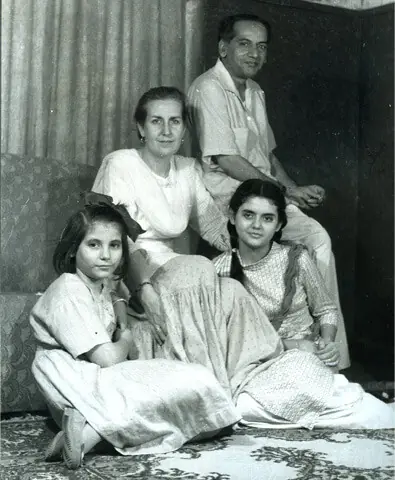
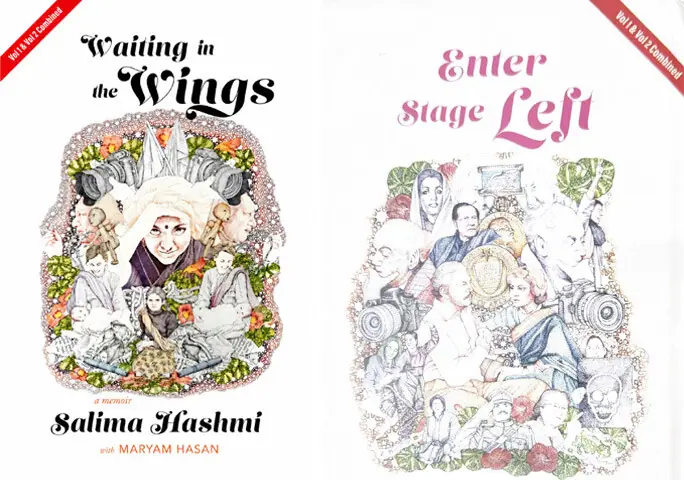
A renowned artist, curator, art historian and activist in her own right, Salima Hashmi is still perhaps best known as the elder daughter of the poet and litterateur Faiz Ahmed Faiz and his British wife Alys. In her two-volume memoirs, published recently by Vanguard Books, she recounts her life growing up under the shadow of one of Pakistan’s most famous couples and her own journey beyond them. Eos presents, with permission, excerpts from the memoirs that detail Faiz’s arrest and imprisonment in the famous Rawalpindi Conspiracy Case of 1951 and how the family coped with it…
Someone eventually turned up with a warrant and, after he was gone and the search had ended, there was absolute silence in the house for a very long time. It was as though he had disappeared off the face of the earth. Ammi’s queries and phone calls went unanswered. The Civil Lines police station denied any knowledge of him or his whereabouts.
At the time, Abba was the only person taken from civil society; the other alleged conspirators were from the army and air force. But he was later joined by three others, [writer and Communist Party secretary general] Sajjad Zaheer, Begum Nasim — the wife of Maj Gen Akbar Khan — and [Communist Party central executive member] Muhammad Hussain Ata who was arrested a month later.
My mother tried her best to find out where he was with the help of [publisher] Mian Iftikharuddin and [journalist] Mazhar Ali Khan at The Pakistan Times. Then the phone calls started. A voice on the other end would try to intimidate my mother, saying they were torturing my father and that it would be better if she confessed to what she knew, otherwise it wouldn’t go well for him.
This was quite the wrong tactic to take with someone like my mother, of course, because she would shout at them and call them whatever few curse words she knew in Urdu. Once or twice when I answered the phone, they said, ‘We put your father on ice’ and ‘We’ll take his eyes out’, and I was very frightened. I cried, and my mother tried to make me tell what I’d heard but I wouldn’t say.
A SILENCED HOUSE
My aunt Bali [Faiz’s step-sister Iqbal] moved in with us; my mother was very fond of her and needed support. We lived upstairs and we would look down and see a plainclothes man, someone from the CID [Crime Investigation Department], standing outside the gate and sometimes outside the door downstairs, basically keeping a watch on whoever was coming and going. Of course, this discouraged anybody from coming to see us. Bali would give them a tongue-lashing whenever she passed through the front door or sarcastically ask if they were counting the bricks in the walls of the house.
Those were very uncertain times and much of it was a blur. We had a car, but Ammi didn’t know how to drive. I went to school as a very scared child. My sister [Moniza Hashmi, Mizu] didn’t really know what was going on. I was about eight and a half and she was only four years old. She just wept and hung on to Ammi, not wanting to leave her side.
It was strange for us. Our home had always seemed like the centre of activity, with a constant flow of journalists or writers or people from politics, tea being made and discussions taking place. And suddenly there was silence. As a child, the silence was very noticeable. It was as if we had some disease that people were afraid to catch. When I think of it now, our history has been full of such experiences that affected hundreds, if not thousands, of families like ours. All of a sudden it becomes a test of loyalty, of friendship.
THOSE WHO STOOD BY US
Of course, throughout there were also people like [educationist and patron of the arts] Begum Majeed Malik, steadfast and supportive. She felt it was part of her role to cultivate my mother and spoke to her in beautiful Urdu, encouraging her to hone her skills. She was also an amazing raconteur, one of the finest I have ever encountered.
One learnt everything under the sun in her company, whether it was the latest theories in education, or the recipes for complicated Mughlai cuisine or medications to cure you of kidney pain or diabetes, or how to cut a proper gharara — which she would demonstrate during a conversation by taking hold of a napkin and then folding it and showing you exactly how it would be cut and tailored. She could reel off from memory the poetry of any number of poets.
Begum Amina Majeed Malik, Baji to her friends, was the epitome of a cultured woman of the 19th century, except she was very much of the 20th century. She set up the PECHS School in Karachi to demonstrate her theory that a good education should be an amalgam of the best that the West could offer, seeped through and interwoven with the best of the East. She was a Renaissance woman in a much wider sense of the word than we understand.
She had a certain imperious way about her, where she could summon up the highest authority in the land with great informality and a great sense of purpose. No one felt able to refuse her requests, because they were always delivered with an inimitable courtesy and grace, even though it was clear she would brook no argument or contradiction.
She was a fount of memories and anecdotes, from stories about the lofty circles she moved in, to the often heart-rending accounts of ordinary people she came across. She and her husband were patrons of the arts. [Artist Abdur Rahman] Chughtai’s career owed much to their early support. They had dozens of his paintings in the house. She confided in me regretfully, but very cynically, that many of them had been borrowed back by Chughtai for an exhibition and never returned. His name was never again mentioned with the same respect he’d been given earlier.
Once you stepped over her threshold, regardless of whatever other plans you might have, it was understood that her management took over. The cook would be summoned, and a meal would be ordered, and you were simply railroaded into staying on. It was very old world but that’s how she was.
She did that with my sister, with my cousins Salma and Mariam. The children of her friends became her children and, like a mother hen, she would be inquisitive and solicitous about each of our lives. Later, even [my husband] Shoaib [Hashmi] was accorded the status and courtesy of humaray damaad (our son-in-law). It may not always have been apparent, but she was immensely sensitive to the needs of others. Baji was a phenomenon in Karachi.
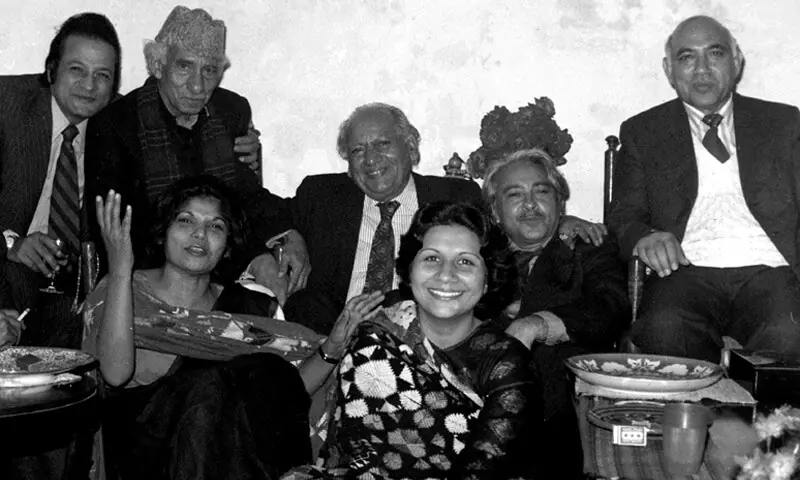
I certainly learned at a very young age what courage is because there were those people we may or may not have been very close to but who made it their business to come and be there and brave the silence at 41 Empress Road.
THE COURAGE OF STRANGERS
An old classmate of my father’s was a regular, Sher Muhammad Hameed who had shared a room with him in the Government College hostel. He lived in a village and whenever he came to Lahore he would make his way to our house — always with some sort of offering, perhaps rice or atta [flour], sometimes daal [lentils].
He would stay to talk with my mother, giving her support and encouragement. Someone who used to work in my father’s press, a very humble man, would come and, from what must have been his small salary, bring something for my mother or sweets for us.
There was another person, Uncle Haneef, who became a very frequent and regular visitor to the house, to show solidarity I suppose. I’d never seen him before and I didn’t remember him ever visiting the house or, if he had, he had never stood out.
He was a bit like a maulvi [cleric] with a beard, but he was a businessman, and I think reasonably well-off because he always came laden with fruit and the sort of goodies we couldn’t afford anymore. I think he also felt that my mother and the two girls and our aunt needed cheering up with some sort of distraction, so he would take us with his family on picnics and outings.
Later, I learnt that he was one of my father’s very wild friends — the drinking, gregarious type — until 1947 happened. He lived in Shahalmi in the Old City, and his street had housed mostly Sikh families. Once the riots started, he realised the Sikh families were in danger. He sent messages to them to send their women into his haveli, which they did. Their men all perished and, at great risk, Uncle Haneef escorted the women in trucks to the refugee camps. According to my mother, Haneef never touched a drop after that.
One remembers these people because they weren’t high-profile, but nevertheless, utterly important to our well-being. So many abandoned us, even relatives — apart from immediate relatives like my mother’s sister, [paternal grandmother] Bebeji, my aunt Bali and Uncle Inayat, my father’s elder brother Uncle Tufail and his family. With hindsight, it was a time in which life became crystal clear.
A SINGLE MOTHER
My mother of course took great pains to tell us our father had done nothing wrong because she was terribly afraid we would be targeted by our friends or by our schoolmates. So, she sat us down periodically to emphasise that he was a good man. He wasn’t a criminal and he’d been put in jail because he told the truth. So, in my mind, the truth became something for which you would inevitably suffer.
I remember [Ammi] being so proud that Paul Robeson, the great singer, was on the list of internationally acclaimed people who had signed petitions for my father’s release. She closely followed the trial of the Rosenbergs [Julius and Ethel, American couple executed for spying for the Soviet Union]. Bali was a constant presence in our home at the time and, one morning, she was discussing with my mother something in the news about the death sentence being passed. Bali asked my mother, ‘Bhabhi, woh rishteydaar thhe? [Were they your relatives?]’ because my mother was so upset, she must have been weeping.
It was from such moments that I picked up how one connects to people far away and the pivot was always my mother during different stages in my life. Through her, one was always connected to a wider world.
There was also this constant fear of what had happened to Abba, because we didn’t know where he was and there was absolute silence on that score. Until one day, Auntie Chris [Alys’ sister] called my mother and apparently a letter had been smuggled out from my father through some source or other. It must have been almost two months after he’d gone; I remember my mother telling me he was safe and fine. But this had to be a secret, and we must never ever let anybody know because Auntie Chris would get into trouble.
A few days later, I was invited to a birthday party by a schoolmate.
I was too shy as a child to enjoy going to birthday parties at anyone else’s house and wept if I was made to go. It was no different this time, but my mother thought it would be good for me to get out and be with other children. So, I went reluctantly and, once there, I was taken to a room in which there were just these men sitting around a table.
They started asking me questions about my father, ‘Where is he?’ and ‘Where has he gone?’ I could feel myself trembling, but I was determined to be what I thought was ‘brave’, which was quite uncharacteristic for me, as I was generally tongue-tied. So, I said, ‘My father is fine.’ They asked how I knew that.
‘Because we’ve got a letter.’
My saying that was like dropping a bomb. I suddenly realised I had said the wrong thing and let out the secret, so I tried to backtrack. ‘My mother says she’s got a letter, but I know she hasn’t, she’s making it up.’ They were still giving me very piercing looks and asking where the letter had come from. ‘I don’t know. She’s just making it up, so I won’t cry.’ I babbled on, unsure whether I was being believed or not.
I wanted to be defiant, but it wasn’t in my nature, and I wasn’t very good at it. Finally, I just clammed up. They tried asking me more questions, but I stood there dumbly and, eventually, they let me go.
I didn’t join in the games at the birthday party. When I came home and my mother asked me if I’d enjoyed myself, I told her about the men in the room. She was furious and called the family and gave them hell over the phone, ‘This is what you’ve done to my child, you invite her over with this excuse and question her about her father!’ or words to that effect. I remember her shouting over the phone and then hugging me afterwards and telling me not to be afraid.
I think the experience was a bit of a turning point for me. I’d never thought of myself as being capable of defying adults because I was always compliant and submissive. But after that happened, I more or less decided to keep my own counsel in future and not share anything with anybody.
I also felt more confident holding my own in a room full of people asking me questions and not being frightened, in the sense that I could be stubborn, and I didn’t have to answer if I didn’t want to.
MEETING ABBA AGAIN
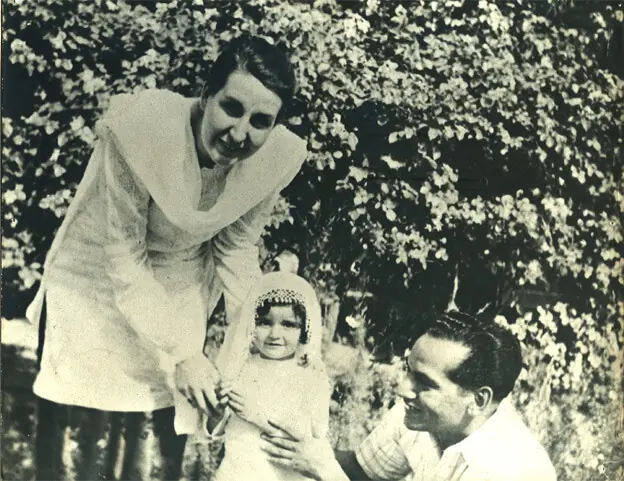
Out of the blue one day, we heard we were going to see my father in Lyallpur [now Faisalabad]. A cousin, the son of my phuppi [paternal aunt] who had died, was a lecturer at Lyallpur Government College. Saeed was very fond of me because we shared a love of reading. He died very young but during the time I knew him he sent me books. Some of my finest collections of books were sent by Saeed bhai.
He picked us up in a tonga from Lyallpur station and took us to the jail. We were put in a small room, and my mother sat with her back to a window which looked out on to the jail yard. Mizu and I sat opposite her. And there, through that window, I saw my father strolling towards the warden’s room, smoking a cigarette. He was holding a tin of his favourite cigarettes — 555 — and had on dark glasses and he was wearing his familiar white kurta and pyjama— his Aligarh ka pyjama.
I said, ‘Ammi, Abba’s coming.’ She didn’t turn around but asked in a very stricken voice, ‘How is he?’ and I said, ‘He looks okay.’
She was afraid, I think, that he had been tortured or physically harmed, but he was the way he always was, with his very casual air and, after a few moments, the door opened and he entered the room. I don’t remember much after that except my mother didn’t take her own dark glasses off. They talked and we hugged and we kissed and I just remember a few snatches of conversation.
Abba said to my mother, ‘I didn’t have a paper and pencil so I couldn’t write the poems that came. I wrote some of the best poems in my head and I didn’t have any means of writing them down and I’ve been trying to memorise them.’
Then she asked him about his food, and he said, ‘I have someone who cooks for me. He’s a life-term prisoner, and he tells me stories because I have nobody to talk to. I’ve been in solitary confinement but, when he comes to deliver the food, I make him tell me stories. I eat slowly, so he has to sit there and tell me these wonderful stories while I’m eating. Then he goes away and I’m alone again.’
So, it was three months’ solitary confinement in Lyallpur jail. Later, I heard he had been taken to Lahore jail first, then Sargodha and, finally, ended up in Lyallpur jail.
I went back to that jail in 2011 and looked for the cell, but the jail had been sort of redone. I looked for the window through which I had seen him walk towards us, but it looked different from my own memory of the yard. Some visual details diffuse over time, yet I will never forget the look of relief on my mother’s face when she set eyes on him.
ALYS THE FORT
During this time, of course, the economics of the household had to change. My mother sold the car to pay for the lawyer, Nawazish Ali, a distant relative. But that money soon ran out and there was nothing left to pay a lawyer to represent my father. In the beginning, Mian Iftikharuddin decided to send for one of the top barristers from England, Denis Pritt QC, and he was willing to pay his fee.
I remember my mother discussing it with Mian Iftikharuddin, or perhaps his wife. Pritt had said that no defence could be presented because the trial was going to be held in camera, and they weren’t going to be tried under the Penal Code. They were being tried under the special act passed specifically for this trial, the Rawalpindi Conspiracy Case Act, which meant that any evidence presented could not be made public, nor could any report be made of what was going on. Pritt said it was impossible to defend anyone under this law because it was loaded against those that were being tried, and he couldn’t take up the case. He returned to England.
The state had appointed Huseyn Shaheed Suhrawardy [later prime minister of Pakistan] as defence counsel, who then took up the cases of several of the people who couldn’t afford lawyers, my father among them. Then Uncle Tufail died suddenly from a heart attack while on his way to see my father.
This was in the first few weeks of the trial, and my father was only allowed out for the funeral. It was a great loss to the family because we looked up to Uncle Tufail; he was supposed to protect my father, and he was also, in a sense, a kind of protector of my mother. Now he was gone, and he left behind a widow and four little girls; one a little bit older than me but the rest all very young.
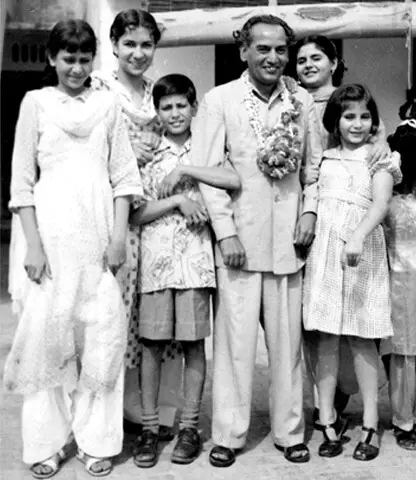
It just felt like one blow after another. My mother’s brother in-law [M.D. Taseer, Salman Taseer’s father] died, my mother’s sister had recently been widowed, her husband was in jail, but through all this, I remember my mother’s fortitude and courage and after that I always looked up to her as someone who was never going to be intimidated. Never going to be fazed by whatever happened around her.
She’d been offered a job at Pakistan Times, and she would cycle to work. We would joke about it because her salary was 420 rupees so she would say, ‘I am 420’, which of course is char sau bees (a term for a cheat or fraudster).
She and my aunt Bali would sit down and figure out the monthly budget. This was when she took me out of Queen Mary’s school, and we were sent to Kinnaird Mission High School. The principal was an Englishwoman who looked upon my mother as a fellow Englishwoman in distress and didn’t understand why Abba was in jail but, I suppose, was too polite to comment that he must have done something very bad. We used to walk to school, quite a long walk, and the servant, our ‘bearer’, walked beside us wheeling his bicycle and then we would ride on the bike.
Once this gentleman came alongside us and asked the bearer, ‘Aren’t these Faiz’s children?’ And when he said, yes, the man remarked, ‘It’s disgraceful that Faiz’s daughters are walking to school.’ When I told my mother this, she got so angry and said, ‘You should have told him, okay, you pay for our tonga!’
Excerpted with permission from Waiting in the Wings and Enter Stage Left by Salima Hashmi with Maryam Hasan, published together by Vanguard Books
The author is an internationally renowned artist, curator, art historian and activist. She is currently professor emerita at Beaconhouse National University in Lahore, where she was the founding dean of the School of Art and Design
Published in Dawn, EOS, August 9th, 2026