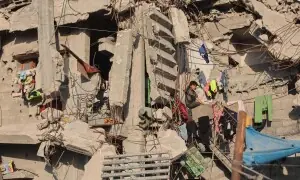


ONLY an unreasonably optimistic worldview could persuade anyone to view last week’s announcements about the Gaza Strip as a ‘breakthrough’. Hamas might have agreed to put away its weapons, but that’s contingent on Israel’s withdrawal from the occupied territory. Its armed forces control more than 70 per cent of the Strip, and says it won’t budge until Hamas ‘completely’ disarms. At best, this is a recipe merely for prolonging the status quo that followed last year’s so-called ceasefire, which has been violated more or less daily by the Israel Defence Forces, with nary an objection from Donald Trump’s ridiculous Board of Peace (BoP). One can just about imagine a scenario in which the graduated disarmament of not just Hamas but also Israeli-sponsored factions in the territory is accompanied by a reciprocal IDF pullout.
But anyone cognisant of realities would find it hard to imagine any meaningful concessions from the Israeli state ahead of the October elections — even afterwards, regardless of whether Benjamin Netanyahu retains the prime ministerial post he has held far too frequently. There has lately been exaggerated commentary about the US president’s capacity to restrain Netanyahu’s worst impulses. This variety of nonsense is belied by recent history. All of the White House incumbent’s predecessors this century resisted Netanyahu’s unrelenting efforts to spark a military confrontation with Iran. It took a stupendous ignoramus to plunge in with haste and to regret it at leisure — amid his various other pastimes, from golf to architectural glitter.
The negotiations he recently cited as an explanation for not launching his threatened fire and fury against his latest adversary appear to be taking place only between Iran and Oman. Whether they lead to the reopening of the Strait of Hormuz will depend on extraneous factors over which only the US has control. The minimum requirement would be for the American blockade to be lifted, but it would hardly be unreasonable for Iran to also demand the cessation of attacks on its infrastructure. As in the case of Gaza, it’s natural to hope for the best without losing sight of contrary likelihoods.
Devoid of diplomatic skills, weak on geopolitical knowhow, and ignoring the recent precedents in Iraq and Afghanistan, the Trump administration this year embroiled the US in yet another war without an exit strategy. ‘Peace with honour’ used to be the motto in the Vietnam era, but the eventual defeat was accompanied only by ignominy. Perhaps the only consolation that can be drawn more than 50 years later is that the periodic bouts of invariably misguided military aggression can be interpreted as the fatuous fireworks of a fading empire.
The pogroms are a daily affair.
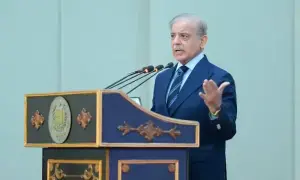
The death throes might linger for a while, though, and there might be worse to come. Public opinion across much of the world, including in the West, no longer holds the US or its auxiliaries in much esteem. But ruling elites are a different matter. Notwithstanding Trump’s contempt, the EU by and large remains beholden to the Western emperor. So do many of the regimes in West and South Asia. One of them, for instance, has credited the BoP’s “significant achievement” to Trump’s “courageous leadership”, adding as an afterthought the hope that it would result in ‘realisation of the right to self-determination of the people of Palestine’.
The phrase ‘self-determination’ sounds almost archaic in the Palestinian context, particularly amid an unending genocide in Gaza and ‘ethnic cleansing’ in the West Bank. The pogroms are a daily affair, and they are only stepped up in the face of any resistance. The Palestinian Authority has long served as a kind of Vichy regime for the Zionist occupation, and rarely goes beyond the occasional platitude in response to everyday atrocities. Any resistance prompts the illegal settlers to step up their malignance. When BBC’s Lucy Williamson recently interrogated a settler called Yehuda Shimon on why one Jewish death (in an unusual instance of rebellion) should be avenged by taking hundreds or thousands of Palestinian lives (as he advocated), Shimon responded: “No, millions. One Jewish life, it’s 10 million… .”
We are witnessing the aftermath of that kind of attitude in Gaza. Even beyond public opinion among the states most complicit in Israel’s genocide, though, there are occasional indications of the turning tide. A German appeals court this week acquitted a woman convicted for Instagram posts that compared Israeli actions to Nazi conduct. Since Nazi ideology was being denigrated rather than promoted, the court ruled, the comments fell under the category of protected speech. It would be a welcome change if British courts took a cue from that, given their inclination to not just convict pro-Palestinian activists as terrorists, but to condemn their advocates as well.
Published in Dawn, August 5th, 2026