‘Preservation over excavation leaves Mohenjo Daro questions unanswered’


• Recent fieldwork significantly revises researchers’ understanding of early urban development at the heritage site
• Finds previously identified ‘bund’ was in fact a substantial mud brick city perimeter wall constructed during early Harappan period
KARACHI: The Sindh Exploration and Archaeological Society (SEAS) in collaboration with the Department of Antiquities, Government of Sindh held a technical briefing about the recently concluded fieldwork season at the world heritage site of Mohenjo Daro at the National Museum of Pakistan here on Wednesday.
Speaking on the occasion, archaeologist and historian Dr Kaleemullah Lashari said that many questions around Mohenjo Daro remain unanswered to this day because after the original excavations there, back in the early and mid-1900s, the focus was on safeguarding the relics and antiquities along with the excavation site, without any plans for further excavation.
“Prominent American Archaeologist Professor Dr George F. Dales, who conducted critical excavations at Mohenjo Daro in 1964 and co-authored major hydrological theories regarding the decline of the Indus Valley Civilisation, also could not return to pursue further research because of the 1965 India-Pakistan war. Other foreign delegates also could not come then for the same reason, which affected the inquiry on Mohenjo Daro,” he said.
It was only recently that the 2025-2026 Documentation and Conservation Programme at Mohenjo Daro was implemented over three seasons (summer 2025, winter 2025-2026 and summer 2026) through a collective effort involving the Directorate of Archaeology and Museums, the Government of Sindh, SEAS and international researchers.
The project integrated archaeological research, conservation, museum improvement, scientific analysis and digital documentation to enhance understanding and long-term preservation of Mohenjo Daro.
A presentation of key archaeological findings by archaeologist, museologist and conservationist Dr Asma Ibrahim took us through the work carried out by SEAS so far.
“We have not yet started on the conservation of the structures of Mohenjo Daro but the conservation of the objects, which we have already excavated, lying in the stores of Mohenjo Daro Museum,” she said.
The museum component focused on assessing the display and reserve collections, conserving selected copper and faience artefacts, improving storage and packaging, desalinating vulnerable faience objects and conducting scientific analyses of selected artefacts using non-destructive techniques, including scanning electron microscope analysis.
“Second was excavation,” Dr Ibrahim said.
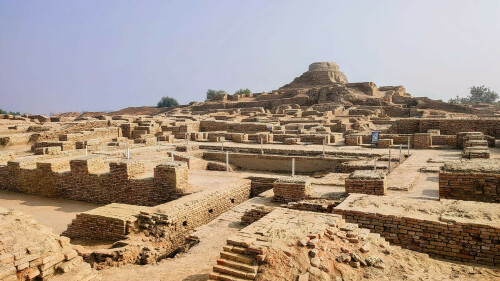
Senior Archaeologist from the University of Wisconsin, Madison, USA, Dr Jonathan Mark Kenoyer said that an earlier map showing what Mohenjo Daro was proposed to be done by Mortimer Wheeler in the 1930s is totally wrong as it shows an imaginary city made with very little information.
“Unfortunately, it is the map which every textbook published in Pakistan, India, America and everywhere else also has,” he said.
“Dr Michael Jansen and his team came in the 1980s and began remapping the site. Focusing on the surface levels, they remapped every detail, every area and they proposed a new understanding of the Mound as it was also clear that the streets in the old map did not connect. In fact, the city is made of many different mounds, mohallas [neighbourhoods] in different areas of the city,” said Dr Mark.
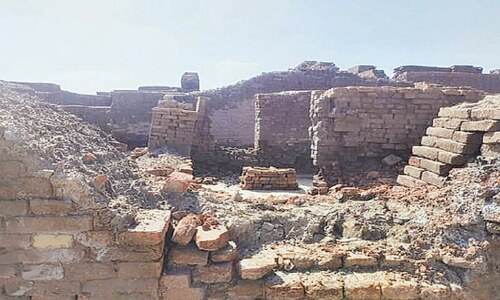
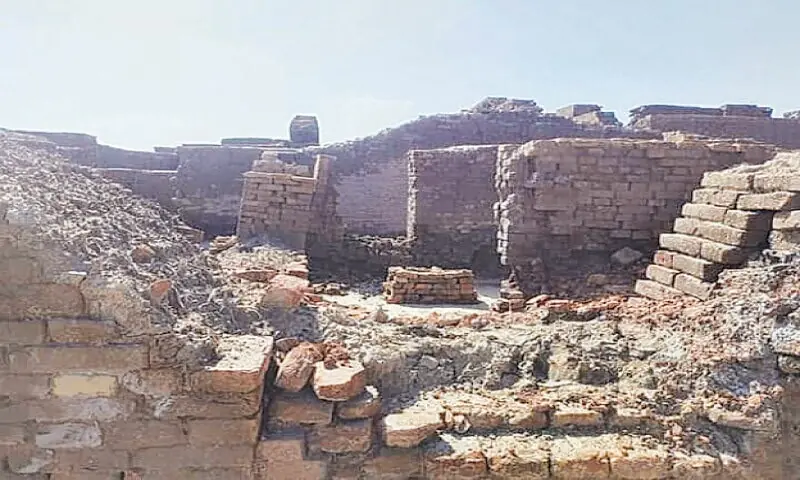
Of course the recent fieldwork has brought up new information. The archaeological investigations concentrated on the western edge of the stupa (citadel) mound to clarify its construction history. Through excavation, coring and reassessment of Sir Mortimer Wheeler’s 1950 trenches, the team demonstrated that the previously identified ‘bund’ is in fact a substantial mud brick perimeter city wall extending along the western edge of the mound. The multiple construction phases indicate that the wall originated during the early Harappan period, significantly revising the understanding of Mohenjo Daro’s early urban development.
Radiocarbon dating of charcoal recovered from the excavated contexts and mud brick cores produced dates ranging between approximately 2708-2576 calibrated Before Common Era (BCE) for the earliest wall construction and 2460-2280 cal BCE for later street levels. Together with the recovery of Kot Diji phase pottery, these findings provide the first firm chronological evidence that the city’s defensive perimeter wall was constructed during the early Harappan period.
The project also introduced innovative conservation and interpretation initiatives, including the production of replica mud bricks and a demonstration section of the ancient city wall to aid public interpretation. Comprehensive drone mapping, 3D documentation, geological studies of mud brick production, metallurgical analyses of copper artefacts and systematic artefacts documentation further strengthened the scientific record and conservation planning for the site.
Lucas Wirick, a student of Archaeology at the University of Wisconsin, archaeologist and surveyor with the Sindh Department of Archaeology Danish A. Sheikh, Assistant Director Excavation Antiquities and Archaeology, Government of Sindh, also spoke at length on conservation updates, research methodology and future plans for Mohenjo Daro, which include a replica for visitors in order to protect the original.
Published in Dawn, July 30th, 2026