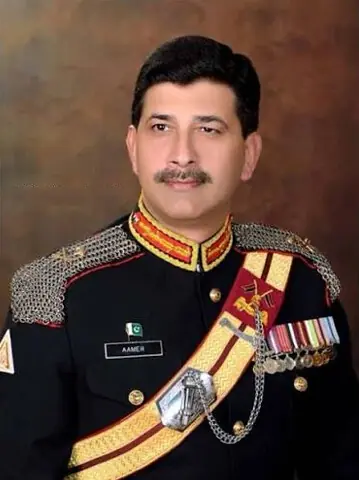
ISLAMABAD: The government on Friday moved another step towards completing the restructuring of its higher military command, initiated under last year’s 27th Constitutional Amendment, by appointing Gen Syed Aamer Raza as the country’s first Commander of the National Strategic Command, a newly created four-star office that will oversee the operational integration of Pakistan’s strategic forces.
Prime Minister Shehbaz Sharif promoted Gen Raza from the rank of lieutenant general and simultaneously appointed him to the new position.
“The prime minister congratulated General Aamer Raza, HI(M), SBt on his promotion and appointment, wishing him the best for undertaking this important responsibility,” the Prime Minister’s Office said.
The office of Commander NSC was created through the 27th Constitutional Amendment enacted in November last year, which fundamentally altered Pakistan’s higher defence architecture by abolishing the office of the Chairman Joint Chiefs of Staff Committee and creating the new position of Chief of Defence Forces, held concurrently by the Chief of Army Staff.
Field Marshal Asim Munir became the country’s first Chief of Defence Forces following the constitutional changes.
Under the amended Army Act, the Commander NSC is appointed by the prime minister on the recommendation of the Chief of Defence Forces from among serving army generals and serves a three-year term.
The office functions as the unified operational headquarters for the strategic forces by bringing together the Army, Navy and Air Force strategic commands under a single command structure. However, the National Command Authority, chaired by the prime minister, continues to retain ultimate authority over nuclear policy and employment.
With the constitutional architecture now largely operationalised, attention is increasingly turning towards amendments to the National Command Authority Act, 2010, which in its current form still reflects the pre-amendment military hierarchy.
Although no draft legislation has yet entered the public domain, officials familiar with the process privately indicate that work on the amendments is under way and is primarily intended to bring the statute in line with the new military offices rather than altering the civilian-led character of the nuclear command and control system.
The expected amendments would replace references to the abolished Chairman Joint Chiefs of Staff Committee with the Chief of Defence Forces, who is likely to become deputy chairman of the National Command Authority, while formally recognising the four-star Commander NSC as the operational commander of the strategic forces.
The Development Control Committee would also undergo corresponding changes in leadership.
However, officials maintain that the broader institutional framework would remain unchanged, with the prime minister continuing as chairman of the National Command Authority, the Strategic Plans Division retaining its role as secretariat, and the authority to employ nuclear weapons remaining vested in the National Command Authority rather than any individual office.
Gen Raza’s appointment is also expected to trigger the long-awaited promotions and transfer cycle within the army’s senior leadership.
With the highest four-star appointment now completed, officials expect a reshuffle of principal staff officers and corps commanders in the coming weeks.
Before his elevation, Gen Raza had been serving as Chief of General Staff, the army’s principal operational appointment, where he oversaw the implementation of organisational changes necessitated by the 27th Amendment and the restructuring that followed last year’s conflict with India, including the establishment of the Army Rocket Force Command.
A cavalry officer from OTS and commissioned into the 6th Lancers in 1988, he has commanded an armoured regiment, an armoured brigade, an infantry brigade in South Waziristan, an infantry division and Lahore’s IV Corps.
He also headed Heavy Industries Taxila, besides serving as Director General Weapons and Equipment and Chief of Staff at II Corps.
At the time of his promotion, Gen Raza ranked eighth on the Army’s seniority list of lieutenant generals.
His elevation superseded Lt Gen Inam Haider Malik, Lt Gen Fayyaz Hussain Shah, Lt Gen Nauman Zakaria, Lt Gen Muhammad Zafar Iqbal, Lt Gen Ahsan Gulrez and Lt Gen Shahid Imtiaz, while the senior-most officer, Lt Gen Asim Malik, who serves concurrently as Director General of the Inter-Services Intelligence and National Security Adviser, continues on an extended tenure.
Published in Dawn, July 25th, 2026