Some animals slip away without much notice. Others leave a hole so wide it starts to feel like a page torn from the country’s story.
The rhinoceros belongs to the second group. Standing in Pakistan today, it is hard to picture a rhino shouldering through reed forests along the Indus, feeding near Mohenjo Daro or fleeing before a Mughal emperor on the Peshawar frontier. And yet the old records keep insisting: it was here.
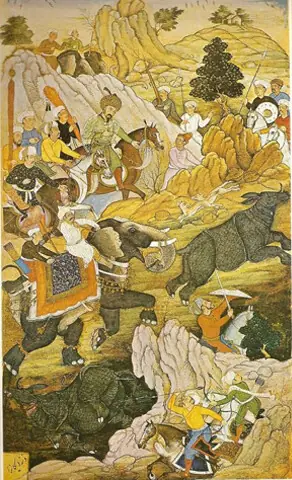
The painting of Zaheeruddin Muhammad Babur hunting a rhinoceros is usually read as royal theatre, but it opens on to a landscape we have forgotten. History remembers him as the founder of the Mughal Empire — a warrior-poet out of Fergana, a man of gardens, grief and appetite — and less often as one of the finest observers of the country in early modern South Asia. In his memoirs Baburnama, he catalogues rivers, passes, fruits, birds and animals with a naturalist’s attention, and his rhinoceros is no traveller’s rumour. He met it, in territory that is now Pakistan.
In February 1519, Babur crossed into the ground between the Indus and the Punjab plains and recorded a hunt on the “Sawati” side, at a place the locals called Karg-khana, the house of the rhinoceros.
Seals, manuscripts, one Mughal miniature and a handful of travellers’ notes are all that remain of a species that once ranged the Indus…
The cover was thick. A female came out with her calf, arrows flew and the calf was killed. A hard passage to sit with now, but a valuable one: the rhino had a range, a local name and a presence large enough for a place to be named after it.
Days later he turned to the Salt Range, the old Koh-i-Jud, moving through Bhera, Khushab, Chiniot and the River Jhelum to Kallar Kahar, with its lake and spring. This green country, perhaps the Soon (also rendered Soan) Valley in Khushab, is where historians have long placed the famous miniature painting. Wherever the painter stood, the rhino belonged to the memory of the northwest’s rivers and grasslands.
Babur met the rhinoceros again near Peshawar in December 1526, when the animal was flushed from a thicket. Babur’s son and successor Humayun and the younger men, who had never seen one, were delighted and the chase ran for miles before the animal fell. At one point, Babur wonders how a rhino and an elephant might fare against each other — the idle curiosity of an empire still learning to read its new ground.
IBN BATTUTA ON THE INDUS
Babur was not the first to write about the animal. Almost two centuries earlier, the famous traveller Ibn Battuta had seen it beside the Indus. Born in Tangier in 1304, Battuta left home young for the Hajj and travelled for nearly 30 years, from North Africa to China, and his Rihla remains one of the great travel books of the mediaeval world.
When Ibn Battuta reached Sindh in 1333, the Indus was nothing like the harnessed river of today. It was restless and many-branched, forever making and unmaking wetlands, reed forests and grazing land.
Near Janani, placed by local tradition in the old Larkana-Warah-Badah country within reach of Mohenjo Daro, he came upon a rhinoceros on the riverbank. Ibn Battuta’s sketch is sharp: black and heavy-bodied, with an outsized head — smaller than an elephant, yet more frightening when it charged. He passes along the old saying that the beast was “head and no torso.”
A party pushed into a reed forest after fording the river; a rhino appeared without warning, goring a horseman’s mount, throwing the rider and vanishing into the cover, wrote Ibn Battuta. Later, he watched another grazing and, elsewhere, while riding with the Sultan of Delhi, he saw rhinos driven from a reed jungle and killed. The killing mattered less than the setting: reeds, thickets, wet ground — an Indus lush enough to carry one of Asia’s largest land animals.
THE EVIDENCE IN STONE
Here, the old seals of the Indus Valley begin to talk. Mohenjo Daro and Harappa left us the famous “unicorn”, along with zebu bulls, elephants, buffaloes, tigers and rhinoceroses. On some, the rhino stands complete with its armoured folds and single horn. The carving is no flight of fancy; it is a memory pressed into steatite, evidence that the Bronze-Age Indus held tall grass, floodplains, marsh and forest.
When the seals are set in a row, a timeline emerges: the rhino was not only present in the imagination but, probably, also the surroundings of the Bronze-Age Indus. It was there in the reed forests of Sindh in the 14th century, and was still clinging on in the 16th century around Peshawar, Swabi and the approaches to the Khyber, as later travellers would confirm.
THE LAST SIGHTING
The last clear sighting on paper comes from Seydi Ali Reis, an Ottoman admiral born around 1498 who served Suleiman the Magnificent. Swept into the sea war with the Portuguese, his fleet was driven on to the Subcontinent’s western coast, and he came home overland through Gujarat, Sindh, Delhi, Lahore and Peshawar.
In 1556, having crossed the Khyber Pass, Reis reported two rhinoceroses. While the Khyber of today is known for bare stone and dust, and as a corridor for armies, Reis’ note points to something greener: riverine patches and scrub and wooded pockets able to feed animals that now survive only far to the east, in India and Nepal.
These three make a thin archive: no numbers, no census, no date for the final animal, only something heavier — the rhino held on in these lands until at least the middle of the 16th century and, after Reis, disappeared from the written world.
An animal does not die the day the last traveller stops writing about it, and a few may have lingered unseen in far reed beds for generations. But by the close of the century, the rhino was plainly in its last shadows, worn down by hunting, the plough, the draining of wetlands, the shifting river, growing towns, and the endless movement of men and horses.
The loss runs deeper than the animal. What went with it was the sort of country that could hold one: grasslands and wallows, mud and reeds, seasonal floods, a measure of safety. The rhino’s exit is the receipt for a whole landscape taken apart.
A GHOST IN THE REEDS
The greater one-horned rhinoceros is thriving again in parts of India and Nepal. In Pakistan, it is a ghost — surviving in seals, manuscripts, place-names, one painting and a handful of traveller’s notes.
Even that should change how we see the Indus, which was never only a canal grid or a barrage on a map. It was a living corridor, once wide enough for elephants, buffaloes, tigers, swamp deer and rhinoceroses.
Recovering that memory is a form of literacy: a country that forgets its lost animals loses the measure of its own damage. The old miniature, then, is more than a Mughal-era artwork. Behind the emperor and the wounded beast stands another Pakistan — wetter, wilder, deeper in grass.
The rhino is gone, but the gap it left still has weight, standing in the reeds like a dark, armoured question: if a creature that size could vanish from the land and nearly from memory, what else are we mislaying now without noticing?
The writer is a researcher with a focus on history and anthropology. He is also the founder of the Clifton Urban Forest, Karachi. X: @masoodlohar
Published in Dawn, EOS, July 26th, 2026