0
0

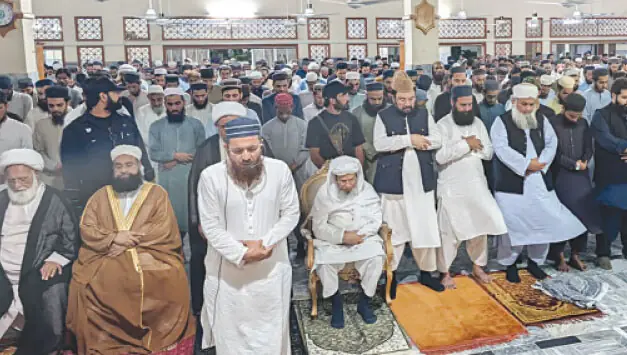
ISLAMABAD: In a significant move to eradicate inter-sect strife in the country, clerics belonging to all four mainstream schools of thought offered prayers together at what was once considered one of the country’s most hardline seminaries.
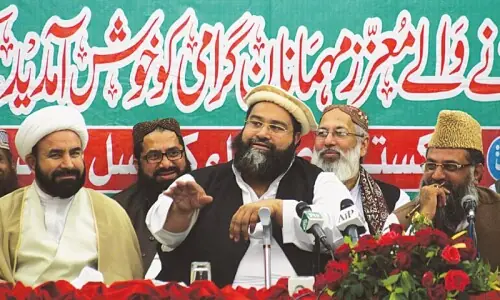
Briefing the media here on Monday, Pakistan Ulema Council chairman Hafiz Muhammad Tahir Ashrafi said, “Offering prayers together symbolises growing tolerance in society, especially among religious circles”.
Ashrafi also serves as Prime Minister’s Coordinator for the National Paigham-i-Aman Committee (NPAC), a group of senior clerics representing the country’s four mainstream schools of thought Shia, Barelvi, Deobandi and Ahle Hadith.
The group members, led by Ashrafi, recently visited Jamiatur Rasheed in Karachi and offered collective prayers there.
The move is being seen as a significant milestone in the national campaign against extremism, terrorism and sectarian violence, as clerics and spiritual leaders offered Maghrib prayers behind the designated imam of Jamiatur Rasheed.
“This is an unprecedented demonstration of religious harmony and national unity by the National Paigham-i-Aman Committee, bringing together eminent ulema and mashaikh, representatives of major religious seminaries, and leaders from different faith communities,” Ashrafi said.
He added that the congregation was one of the first of its kind in Pakistan’s history, where scholars representing all schools of Islamic thought assembled at a leading religious institution to offer collective prayers.
Those who offered the prayers included Allama Arif Wahidi, Allama Muhammad Hussain Akbar, Mufti Abdul Rahim, Allama Syed Ziaullah Shah Bukhari, Mufti Muhammad Karim Khan, Dr Asif Mir, Mufti Yousaf Kashmiri, Allama Tauqir Abbas, Allama Asad Zaidi, Hafiz Maqbool Ahmed, and representatives of various federations of religious seminaries.
Responding to media queries, Ashrafi said there was no inherent discord among the people of Pakistan. However, he said, some miscreants created divisions by dragging society into chaos, while a few religious leaders also backed such elements.
“The goal of all responsible ulema in Pakistan is to see Muslims offering prayers together, just as they do in the Two Holy Mosques, standing behind one imam,” he said, adding that one of the committee’s key achievements had been the peaceful and harmonious observance of Muharram.
He said the NPAC remained committed to implementing the objectives of Paigham-i-Pakistan by countering extremism, terrorism and sectarian violence while promoting unity, tolerance, mutual respect and national cohesion across the country.
The committee has held meetings and gatherings in several cities, visiting not only Muslim places of worship but also those belonging to Sikhs, Hindus and Christians.
Established in September 2024, the NPAC comprises clerics, religious leaders from non-Muslim communities and senior government officials to counter extremism, hate speech, terrorism and sectarianism in the country. It is a subcommittee of the National Committee on Narrative Building (NCNB), which includes the information ministers of all four provinces, Gilgit-Baltistan and Azad Jammu and Kashmir, as well as the federal information minister.
The NCNB also includes representatives of the military, intelligence agencies, the ministries of foreign affairs and information technology, and the chairman of the Pakistan Telecommunication Authority.
According to an official notification, the committee is tasked with overseeing the “information operation, formulation, dissemination, propagation and evaluation of the national narrative against the spread of terrorism and extremism through media, communication and cyber networks” to facilitate the implementation of the Revised National Action Plan 2021.
Published in Dawn, July 21st, 2026