Chenab water level likely to surge following ongoing rains in Indian-occupied Kashmir, Punjab
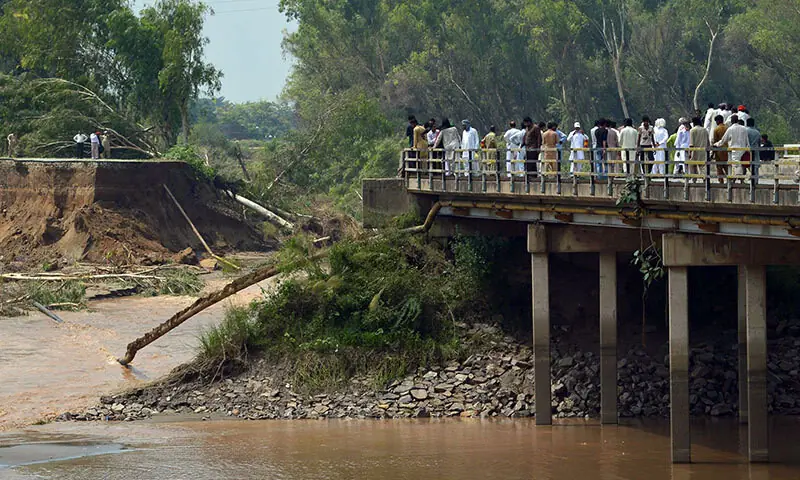
LAHORE: The water level in the Chenab River is likely to surge significantly over the next couple of days following ongoing rains in catchment areas of Indian-occupied Kashmir and fresh spells of heavy rain in parts of Punjab.
“At the moment, the Chenab River is flowing in medium flood. Its flow may surge and enter the high-flood category following forecasts of heavy rain over the next three to four days in both held Kashmir and Punjab,” a senior official of the Punjab Irrigation Department told Dawn on Monday.
“The situation may turn critical if there are heavy rains, as predicted, in the catchment areas of held Kashmir and Punjab,” he added.
Meanwhile, the Pakistan Meteorological Department’s Flood Forecasting Division (FFD) issued a forecast of high flood levels in major rivers, including the Chenab, and nullahs due to heavy rains expected until July 24.
According to the FFD’s Monday flood bulletin, the flows of all major rivers were likely to increase significantly by July 24 due to a prevailing westerly wave coupled with a strong monsoon incursion from the Arabian Sea and the Bay of Bengal over the catchments of all major rivers.
“High flood levels are expected in River Chenab at Marala, River Jhelum upstream of Mangla and associated nullahs of the Jhelum and Chenab (Dora, Dotta, Dowara, Bhimber, Halsi, Aik and Palkhu) and Ravi (Bein, Bassanter, Deg and Sakki). High flows are also expected in River Kabul and its associated tributaries,” the FFD warned.
It also forecast flash flooding in the hill torrents of DG Khan, streams of Khyber Pakhtunkhwa and northern Balochistan, and urban flooding in Rawalpindi, Jhelum, Gujranwala, Sargodha, Khushab, Sialkot, Gujrat, Narowal, Lahore, Okara, Sahiwal, Bahawalnagar and Faisalabad.
The FFD also mentioned the current situation regarding water flows at various gauging stations.
It observed that the River Indus was flowing at “low and below-low levels” at various stations, including Tarbela, Kalabagh, Chashma, Taunsa, Guddu Sukkur and Kotri.
“The Jhelum is flowing in low to medium flood at Mangla and Rasul, followed by the Chenab flowing in medium to high flood at Marala, Khanki and Qadirabad. The Ravi and Sutlej rivers are flowing in below-low flood,” it added.
Meanwhile, the daily water report issued by the Water and Power Development Authority stated that inflows and outflows in the River Indus at Tarbela were recorded at 232,500 cusecs and 210,000 cusecs, respectively. The inflows and outflows in the Jhelum at Mangla were recorded at 57,400 cusecs and 10,000 cusecs, respectively.