SHC maintains life imprisonment of two appellants in drug trafficking case

KARACHI: The Sindh High Court has upheld life imprisonment handed down by the trial court to two men in a drug peddling case.
A two-judge regular bench of SHC comprising Chief Justice Zafar Ahmed Rajput and Justice Jan Ali Junejo noted that appellants Shakeel Ahmed and Attaullah were jointly travelling in the vehicle carrying seven kilograms of methamphetamine (‘ice’) and surrounding circumstances have clearly established joint possession and common intention on the part of both appellants.
However, it also noted that the case of co-accused Khalid Nawaz was entirely on different footing as he was not present at the crime site when the alleged recovery was made and exonerated him.
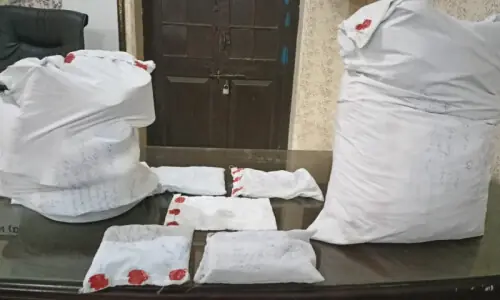
The Special Court for Control of Narcotic Substances (CNS) had sentenced Ahmed, Attaullah and Nawaz to life in prison in April 2025 for transporting seven kilograms of ‘ice’ concealed in a bedsheet in the trunk of a car on Feb 8, 2022 in a Kharadar locality.
The prosecution said that during investigation, appellant Nawaz was also implicated in the case for being owner of the vehicle in question and alleged facilitator of transportation of narcotics.
Thereafter, the convicts had challenged the verdict of the trial court and after hearing both sides as well as examining the record and proceedings of the case, the bench maintained the life term of two and set aside the sentence of the third appellant.
The bench in its order said that the prosecution case against two appellants rested upon the recovery of the drug from the vehicle in their possession at the relevant time.
It also noted that testimonies of two key prosecution witnesses remained consistent on all material particulars and could not be shaken during lengthy cross-examination while the evidence of police officials cannot be discarded merely on the ground of their official status if the same inspired confidence and was otherwise trustworthy.
The bench further observed that the recovered substance was subsequently examined by the chemical examiner and was found to be ‘ice’ thereby fully corroborating the prosecution version.
“Although certain omissions appear in the road certificate and acknowledgment column, yet the prosecution has examined the malkhana in-charge as well as the official who transmitted the samples to the chemical laboratory. The chemical examiner received the sealed samples and reported that the seals were intact. No suggestion of tampering, substitution or manipulation of the samples was established during trial,” it added.
It said that the alleged procedural irregularities pointed out by the defence did not appear to have caused any prejudice and the same were not of such magnitude to destroy the entire prosecution case particularly when the report of the chemical examiner remained unchallenged.
The bench also observed that both appellants were jointly travelling in the vehicle carrying seven kilograms of ice and the quantity involved was enormous and not consistent with personal consumption.
It further noted that the surrounding circumstances have clearly established joint conscious possession and common intention on the part of both appellants and the recovery was affected from a private vehicle under the direct control and possession of such appellants.
However, it maintained that the case of appellant Khalid stood on an entirely different footing since admittedly he was not present at the place of occurrence when alleged recovery was made.
The bench also observed that the spy information received by the Anti-Narcotics Force did not mention his name and prosecution witnesses had also candidly admitted that his implication was primarily based on his ownership of the vehicle.
It further said no independent evidence was collected to establish that the co-accused had knowledge of or connection with transportation of recovered narcotics and mere ownership of the vehicle without proof of conscious possession, knowledge or facilitation, was insufficient to sustain conviction under the relevant law.
Published in Dawn, July 19th, 2026