



 0
0

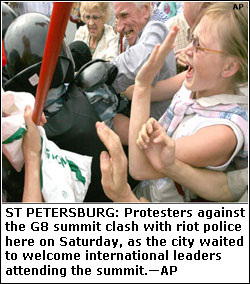 ST PETERSBURG, July 15: Middle East conflict muscled its way onto the Group of Eight agenda on Saturday, setting the United States against those who say the Jewish state has been too violent.
US President George Bush has called on Israel to avoid civilian casualties but has refused to tell it to halt its bombardment of Lebanon, which G8 partner France and the European Union have called an excessive response to Hezbollah militant attacks.
“This is a very serious situation and no one should pretend otherwise. This is a situation we have to calm down and we have to calm down quickly,” said a spokesman for British Prime Minister Tony Blair.
“We understand that there were provocations against Israel, but we believe the use of force by Israel was disproportionate,” said European Commission President Jose Manuel Barroso.
The rising death toll from Israel’s four-day offensive has overshadowed the formal agenda of the meeting of the world’s leading industrialised nations.
Russia, first-time host, had wanted to focus on security of energy supplies. But the leaders of Japan, Russia, Britain, Germany, Canada, Italy, France and the United States will instead discuss divisions over the Middle East, Iran and trade.
At a joint news conference with Russian President Vladimir Putin, Mr Bush firmly blamed Middle East violence on Hezbollah guerillas. The Kremlin leader agreed but asked for a ‘balanced’ response from Israeli forces.
Mr Bush’s national security adviser, Stephen Hadley, told reporters the Hezbollah attacks had ‘threatened to plunge the region into violence’.
RUSSIA AND US: Diplomats have begun work on a statement on the Middle East crisis but strains were quickly visible among the leaders.
France called on the G8 to agree that violence would not resolve the situation, a formulation at odds with Mr Bush’s strong support for Israel. Italian Prime Minister Romano Prodi cast doubt on whether a common G8 position could be agreed.
“The president (Jacques Chirac) is expecting everybody to unite around the goal of de-escalating the situation,” French presidential spokesman Jerome Bonnafont told reporters.
The summit began on Saturday with dinner for the leaders at the glittering Constantine palace just outside Russia’s second city. Formal sessions are on Sunday and Monday.
Earlier, Mr Bush and Mr Putin put on a show of harmony by resurrecting an old proposal for averting nuclear terrorism and endorsing a plan to halt the spread of atomic arms.
On Iran the summit appeared certain to struggle for a common position with Russia opposing for now any talk of U.N. sanctions.
Mr Bush said he had common ground with Mr Putin on Iran, though the Kremlin leader sidestepped a question on sanctions.
Some hope persists world leaders will send a signal of willingness to abandon fiercely-held negotiating positions, thereby ending a deadlock on global trade talks.
“We are ready to make an effort to get a deal if the others can also make that effort,”
EU Commission President Jose Manuel Barroso told reporters.—Reuters




























