Khamenei lies in state as Iran begins week-long ‘farewell’


 0
0

• Millions of mourners expected to converge on Tehran
• Processions to pass through holy cities before burial in Mashhad on July 9
• President Pezeshkian says large turnout will signal unity and defiance against terrorism
TEHRAN: The body of Ayatollah Ali Khamenei lay in state in a vast hall in Tehran on Friday as millions of mourners are expected to converge on the city over the coming days to pay their final respects to former supreme leader, assassinated at the age of 86 by US and Israeli bombs.
Iran is staging a week of mass funeral processions for Khamenei, whose 37-year rule was brought to an end in February by the first air strike of the war.
The proceedings will mark one of the largest public funerals in modern history, its scale and size expected to surpass the 1989 funeral of former Iranian Supreme Leader Ayatollah Ruhollah Khomeini, which drew about 10 million mourners.
Iran’s current supreme leader and son of Khamenei, Mojtaba Khamenei, will not be attending the funeral. This is due to security reasons following Israel’s latest threat to assassinate him.
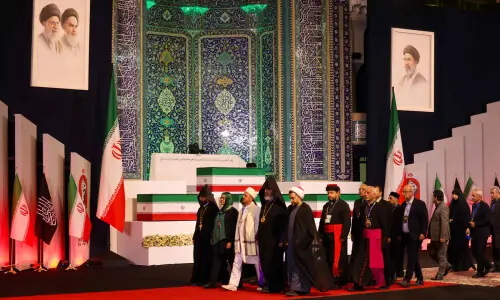
Photos showed mourners carrying Khamenei’s coffin, emblazoned with Iran’s tricolour flag, into the Grand Mosalla, one of the Islamic republic’s most important ceremonial venues.
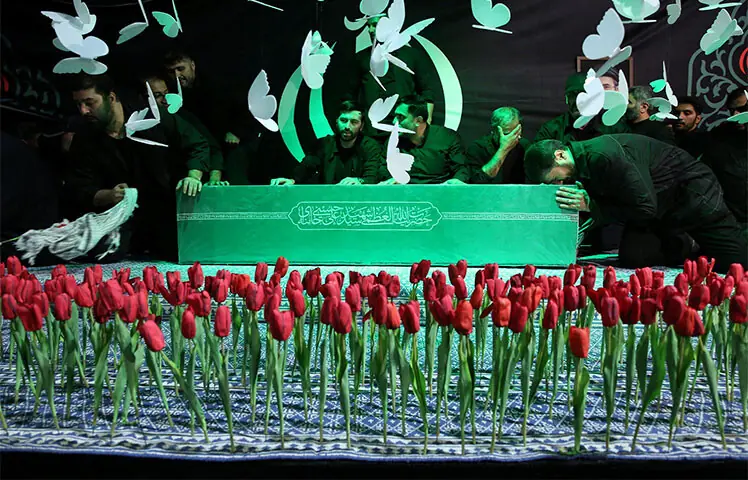
Others show crowds at a pre-funeral ceremony clad in black, as the coffin was set down against a backdrop of red flowers and white butterflies hanging in the air.
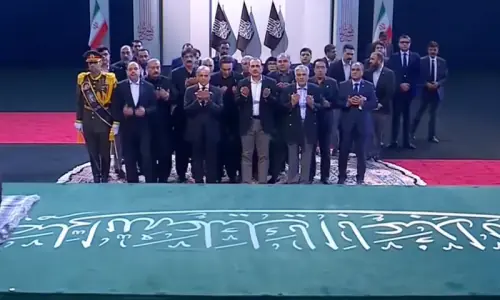
Ahmad Vahidi, head of the Revolutionary Guards, the ideological arm of the military, made his first appearance since the start of the war in February, paying his respects at the coffin.
He will lie in state for three days at the colossal Grand Mosalla, which has been draped in banners featuring images and quotes of Khamenei.
Holy cities
The funeral ceremonies for the supreme leader will pass through a series of locations — from the seat of power in Tehran to the holy cities of Qom, Karbala, Najaf and finally Mashhad — that reflect the religious, political and ideological pillars of the Islamic republic.
His funeral, initially delayed at the height of the Middle East war, is taking place as Iran and the US uphold a fragile ceasefire after signing the Islamabad Memorandum of Understanding to halt the conflict.
The US and Israel initiated a war against Iran with the initial strikes assassinating the supreme leader and his family members — his daughter, grandchild, son-in-law and daughter-in-law. Other senior Iranian military commanders were also assassinated during the strikes, including Ali Shamkhani, an adviser to Iran’s supreme leader.
His public funeral will begin on Saturday, with his body lying in state at the colossal complex in central Tehran that hosts major Friday prayers, official ceremonies and religious gatherings.
Following the ceremonies in Tehran, Khamenei’s body will be taken to the Iraqi holy cities of Najaf and Karbala before his burial on July 9 at the shrine of Imam Reza in the northeastern Iranian city of Mashhad, his birthplace.
His coffin was unveiled late on Thursday to a throng of sobbing supporters, swaying and beating their heads in time to a sung lament as flowers were thrown from the bier into the crowd.
On Friday, the coffin and those of family members killed with him was laid in state in the great prayer hall built to honour his predecessor, Ayatollah Khomeini.
After the coffins arrived on Friday, borne high across the upraised hands of a waiting crowd, they were laid in the prayer hall on a white, stepped dais before a high, intricately tiled, arched recess, flanked by national and black mourning flags.
Iranian President Masoud Pezeshkian said a massive public turnout at the funeral of late supreme leader Khamenei would serve as a “decisive” response to terrorism, violence and bullying, while demonstrating national unity.
Published in Dawn, July 4th, 2026