During a panel discussion at this year’s ThinkFest in Lahore, I declared that these days people engage with politics the way they do with a cola brand. After the discussion, a handful of young folk approached me to ask exactly what I had meant by this. I was simply referencing a part of the book The Fragile Absolute by the Slovenian philosopher Slavoj Žižek.
He uses the Coca-Cola versus Pepsi analogy to describe modern ideology. Žižek writes that the very idea of consumer choice is a farce because, even though Coke and Pepsi are chemically almost identical, people express identities through choosing one over the other. According to Žižek, our voting choices are made in a similar manner and are therefore superficial.
Choosing a political party or leader today is not so different from picking a bottle of cola off a supermarket shelf. Most people do not buy a soft drink based on a breakdown of its chemical ingredients, and the exact same logic applies to how we vote. Voters do not dive into a party’s manifesto. Instead, they buy into a brand identity. When you examine the mechanics of a modern election campaign, the parallel between a supermarket aisle and a ballot paper becomes clear.
The American marketing theorist David Aaker posits that product branding seeks to make emotional and psychological values transcend the physical asset itself. He uses the example of Nike trainers as a way to demonstrate that consumers do not buy them because they are fascinated by the specific rubber compound used in the sole. They buy them for the feeling of athletic aspiration encapsulated in Nike’s famous slogan: “Just Do It.”
In his book Marketing of a President, the American professor of marketing Bruce I. Newman writes that politicians are packaged in the same manner. Since public policy details are often far too complex for the average voter to consume, campaigns deploy the exact same mass-market consumer packaging, image-crafting and archetypal branding strategies used by multinational corporations.
Branding, symbolism and ‘consumer’ data have transformed electoral politics into a consumer marketplace where a heavily curated image triumphs over substance
This nature of packaging relies heavily on visual aesthetics. Researchers Richard Lau and David Redlawsk define things such as iconic logos and symbols as “cognitive heuristics”. These are attention-grabbing visual cues that allow our brains to bypass dense policy analysis and instantly signal our alignment with a specific political party or leader. According to researchers Anastacia Kurylo and Arlene Dumile, this was seen in the US with the stylised 2008 Barack Obama “Hope” poster, and the pro-Trump red “MAGA” (Make America Great Again) caps, both of which served as highly visible badges of belonging.
Similarly, in the UK, Tony Blair and his strategists rebranded their movement as “New Labour” in 1997. They dropped traditional socialist imagery, adopted a sleek red rose logo, and used Britpop music to package the party like a modern corporate enterprise.
Such manoeuvres are part of a broader historical evolution in how both consumer products and politics have been sold to the public. Until the 1940s, commercial advertising focused more on the functional utility of a product and its direct benefits to the consumer. In the same way, political parties historically operated by explaining the concrete policies they planned to introduce to address the electorate’s issues.
But advertising began to change in the 1950s. For example, Marlboro cigarettes were struggling as a product that was marketed explicitly to women based on functional traits such as a clean filter that would not smudge lipstick. As a result, its advertising agency got rid of Marlboro’s functionality, replacing it with imagery. It introduced the rugged cowboy archetype to sell an image of untamed masculinity and freedom. It worked. Soon, products gave way to brands, and brands delivered an emotion and an identity with which consumers could connect and adopt as if they were ideologies.
Noticing this, in 1952, the Republican Party in the US hired advertising executive Rosser Reeves to manage the image of the party’s presidential candidate, Dwight Eisenhower. According to Newman, Reeves treated Eisenhower like a consumer product through short, punchy TV and radio ads, and pleasing jingles. Reeves successfully transformed a stern former military figure (the product) into a warm “living room candidate” (the brand).
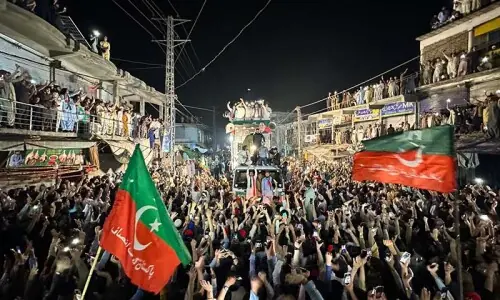
In countries such as Pakistan and India, or in regions where varying literacy rates make reading complex manifestos challenging for a large portion of the electorate, parties are assigned visual symbols. The parties have transformed these into corporate-style identities.
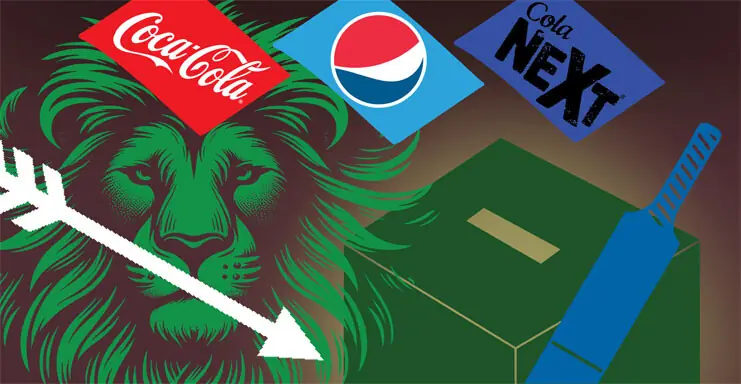
The Pakistan Tehreek-i-Insaf (PTI) built its political brand around Imran Khan’s personal legacy as a ‘dashing and handsome’ cricketer, utilising its electoral symbol, the cricket bat, to project a trendy lifestyle brand promising tabdeeli [change] to a tech-savvy youth.
The Pakistan Muslim League-Nawaz (PML-N) anchors its brand around the tiger symbol, to project rustic strength, making its supporters connect with the image of a hardworking ‘lion’. The Pakistan Peoples Party (PPP) uses the arrow symbol to signify an agile force that always accurately hits its targets. The running theme across all three symbols is masculinity: metrosexual (PTI), rustic (PML-N) and agile (PPP).
Just as corporate brands track your data to serve you an advertisement for the exact pair of shoes you supposedly like, modern political campaigns use the same playbook. In his book The Victory Lab, the American journalist Sasha Issenberg posits that, through advanced data analytics, political players segment the electorate into specific consumer profiles.
A voter receives ads tailored to issues they are interested in. According to the researcher Peter Robinson, through this data-driven lens, the modern politician becomes a chameleon, perfectly tailored to fit the consumer’s immediate desires. However, the move from substance to packaging has greatly dumbed down politics. By treating voters like supermarket consumers, the political system has steadily emptied out genuine debate, giving rise to what former Australian federal minister Lindsay Tanner termed a “political sideshow”.
When branding becomes the primary vehicle for political engagement, the first casualty is nuance. Complex societal problems cannot be solved in a three-word slogan or a stylish video clip. Since deep policy analysis does not fit neatly into a corporate brand identity, it is discarded entirely. This is quite common in advertising as well, which actively encourages an anti-intellectual disposition.
Politicians have begun to focus more on what is referred to as “the aesthetic of action”, which prioritises looking busy over solving national issues. This has also seen the rise of hyper-personalisation, or what communication scholars call “human branding”. In contemporary media, it is far easier to sell a charismatic, larger-than-life individual than a well-thought-out party plan.
So, then, the next time you venture into a polling booth, remember you basically have three choices: Coke, Pepsi or a ‘challenger brand,’ Cola Next. Same ingredients, different images.
Published in Dawn, EOS, July 5th, 2026