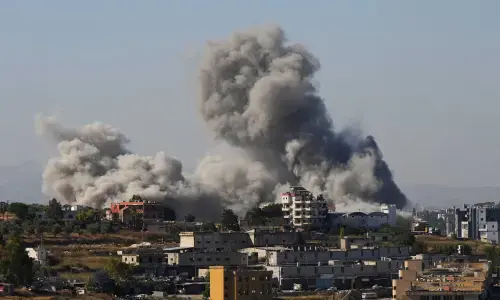
THERE is no shortage of gruesome wars across history initiated by tyrants and oppressors against the weak and the defenceless. The mayhem we have witnessed in Iran, Lebanon and Gaza is the latest in this long series of blood-soaked events.
One of the most poignant and sorrowful episodes where absolute righteousness clashed with absolute evil is what millions across the world are commemorating today: the event of Ashura, where the family members of the Holy Prophet (PBUH) were slaughtered or taken prisoner in the burning desert of Karbala in 61AH.
Though this is not the space for geopolitics, there seems to be a link between that watershed event of 14 centuries ago, and today’s unjust wars. Before the start of the Iran war in February, the president of the US reportedly said he was “curious” why Tehran had not “capitulated” despite the massive build-up of military muscle around the Islamic Republic.
While opinions may vary about Iran’s ruling system, as a nation, the Iranians are well-acquainted with Karbala, and Imam Husain’s eternal stand based on courage and conviction. Arguably, that is why they refused to yield to a power many times more formidable than them, materially speaking. Though it is true that Iranians are intensely nationalistic, something more than nationalism — something metaphysical — was at play as they resisted a superpower.
But one is sure the American leader is unaware of this landmark chapter of Islamic history, or any chapter of Islamic history for that matter, and its impact on nations and civilisations.
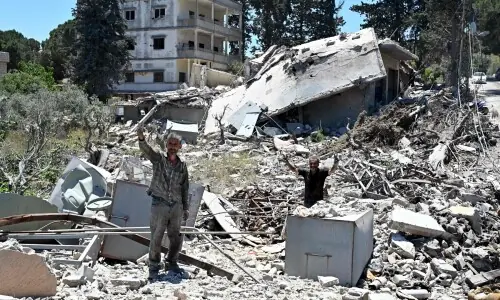
Similarly, the brave people of Lebanon have resisted the Israeli onslaught, despite losing their children and homes. They, too, are familiar with the lessons of Ashura and Karbala.
One recalls seeing a video clip after the 2006 war of a Lebanese man walking through the rubble of his neighbourhood, pointing out the destruction caused by Zionist forces. Having lost nearly everything, he remained dignified and poised, closing the video by sending salutations on Imam Husain. Moreover, Hamas leader in Gaza Yahya Sinwar had also cited Karbala as an inspiration before he was murdered by Israel, reportedly saying that “We have to move forward … or let it be a new Karbala”.
There’s a link between today’s wars and the events at Karbala.
This is what happens when people understand the true lessons of Karbala: nothing — not even the most unspeakable violence — can break their resolve and make them step back from principles. This is the impact of what Imam Husain has achieved: the ability to awaken people centuries after his epic stand.
These are only a few living examples of the courage and wisdom Imam Husain inspires in all who hear and read of his valiant stand. Confronted by an imperial power of his time, he refused to bow before an oppressive, bloodthirsty system that was the antithesis of all that his noble grandfather the Holy Prophet, and his illustrious father Hazrat Ali, stood for and preached. He was not interested in worldly power or material gain; far from it.
The son of Hazrat Fatima Zehra wanted to arrest the decline in Muslim society, as the rulers of Damascus sought to return to the ways of old — of jahiliyya and Arab pride — trying to uproot the egalitarian and spiritual message of Islam. The Imam resisted the ruling powers of his time, even if it required the ultimate sacrifice from himself and his loved ones.
The truth is that despite the passage of 14 centuries, power remains just as ruthless. The bloodstained bags of Iranian schoolchildren in Minab, the lifeless bodies of Gaza’s toddlers, and the tiny coffins of Lebanon’s children are proof of this.
In Karbala, the merciless Syrian-Kufi forces murdered the Imam’s six-month-old son Ali Asghar with a massive arrow, while many other children were martyred in similarly cruel ways. Then the oppressors used swords and spears to target children; today’s tyrants use precision bombs and AI kill lists to murder the innocent. Very little, it seems, has changed. The lamentations of the mothers of Karbala today echo in Tehran, Beirut and Palestine.
Across the vast expanse of time and space, Imam Husain continues to inspire. For individuals facing personal difficulties, to whole nations defending themselves from powerful enemies, the Imam is indeed misbah ul huda — the lamp of guidance, as the hadith states. Weeping and reflecting over the ordeals faced by Imam Husain and his family and companions creates a spiritual link with the Imam; when one recalls the difficulties faced by him, our own hardships seem trivial.
Anyone who has been blessed by the Almighty to have travelled to Karbala to pay their respects at Imam Husain’s tomb can bear witness to the fact that there is an inexplicable energy emanating from this holy city. Beyond Shia and Sunni, beyond Muslim and non-Muslim, beyond race and tribe, Husain inspires all.
The writer is a member of staff.
Published in Dawn, June 26th, 2026