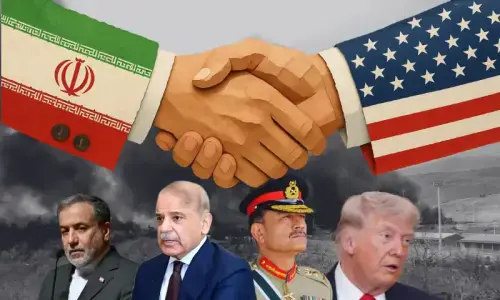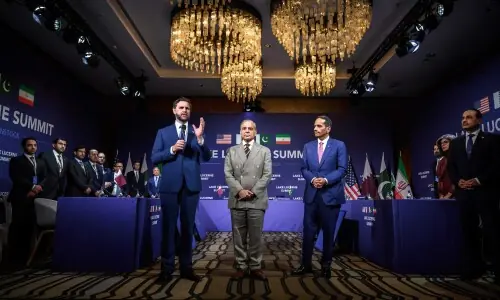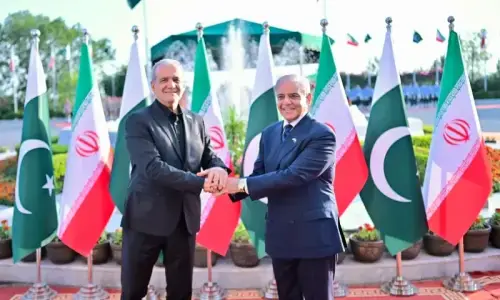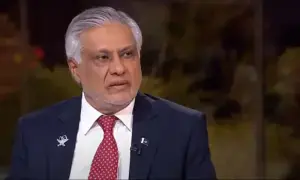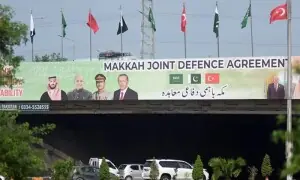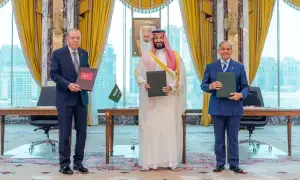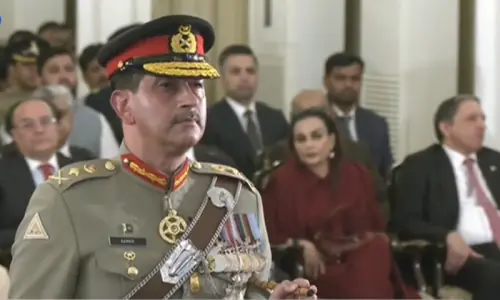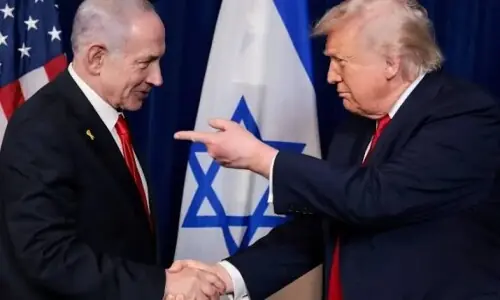


PAKISTAN has been in the international limelight for its successful mediation efforts in bringing the US and Iran back to the negotiating table. The weekend summit between the two warring sides at the Bürgenstock Resort on Lake Lucerne, jointly hosted by Pakistan and Qatar, produced a breakthrough that raised hopes of cementing a permanent peace deal. Pakistan’s civil and military leadership were rightly commended for their efforts. Bringing the two sides to agree on the Memorandum of Understanding, which provided the framework for lasting peace and an end to the war, was certainly a painstaking process that spanned several months. It is indeed a proud moment for the country.
However, this foreign policy success should not be used to divert attention from some critical problems at home. Success in foreign policy cannot yield long-term dividends in the absence of economic and political stability — and, unfortunately, the country lacks both. The prime minister and deputy prime minister are spending more time on foreign trips than on domestic governance. There is no concept of sharing responsibility, as both top officials are mostly together, and the army chief accompanies them as well. It’s quite unprecedented.
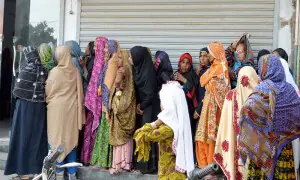
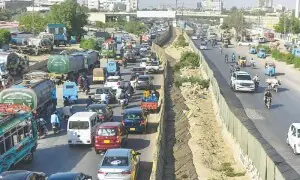
Their absence during the budget session was particularly noticeable. The lacklustre debate in parliament on the critical finance bill reflects a troubling lack of interest in economic issues. An economy that is still not completely out of the ICU, remains dependent on external financial support and has 41 per cent of its population living below the poverty line cannot sustain its diplomatic prominence for long. There are several critical economic issues that need to be resolved on a priority basis, and the main question is whether the government is fully prepared to address the spillover effects of the war in Iran on our economy. The current budget is nothing more than a patchwork that cannot take the country out of the morass.
Success abroad won’t yield long-term dividends without economic and political stability at home.
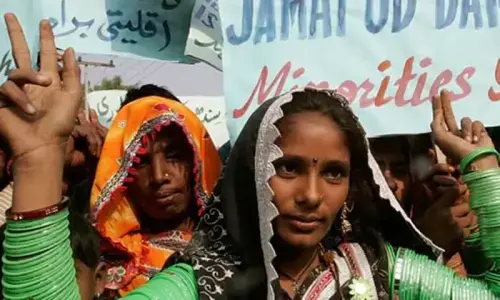
More troubling still is the rising political instability at home — even as our leaders have been busy trying to end one of the most consequential conflicts in recent history, with significant global implications. For almost two weeks, widespread violent protests paralysed most of Azad Kashmir, yet no serious effort has been made to address them. Instead, the action committee leading the protests has been outlawed, and its leaders have been declared foreign agents. The present hybrid regime appears to rely solely on coercion.
Such an attitude, in a region this sensitive, carries serious implications for Pakistan’s Kashmir policy — all of it is unfolding on the eve of elections there. The defence minister compounded the damage by questioning the identity of the residents of the worst-hit districts. Such chauvinistic views can only deepen the anger. What is unfolding is a revolt against the corrupt political order that the state has long been protecting. A media ban on coverage of the protests cannot solve the problem — but that, it seems, is what the government is good at. The unrest adds to the political instability already gripping KP and Balochistan, which has seen arbitrary arrests and convictions of political activists on terrorism charges. While Pakistan celebrated the breakthrough at the Bürgenstock peace negotiations, its democratic and human rights situation remained deeply questionable.
There has been a marked surge in militant attacks in Balochistan in recent years — our biggest national security challenge and one that harsh state actions can only intensify. Even the freedom of assembly has been curbed. Instead of pursuing a political solution, the state has resorted to a kinetic approach, which only pushes more people into the arms of separatist forces.
Meanwhile, last week, an anti-terrorism court convicted and sentenced several PTI leaders — including Dr Yasmin Rashid — to 10 years’ imprisonment in yet another case linked to the May 9, 2023, violence. The 80-year-old former Punjab minister, herself a cancer survivor, has already been languishing in jail for three years and has been convicted on multiple charges under anti-terrorism laws.
More than 100 PTI leaders and activists have so far been convicted by anti-terrorism and military courts in cases arising from the May 9 protests. Among them are opposition leaders in the National Assembly and Senate, including Omar Ayub and several other parliamentarians. There is no legal recourse against such arbitrary actions: the 26th and 27th Constitutional Amendments have stripped the judiciary of what little independence it had left. Former prime minister Imran Khan, incarcerated for the past three years and implicated in more than 100 cases, has been denied a fair trial. For several months now, he has not been allowed to meet his family members or lawyers, despite court orders.
Last year, parliament passed the Anti-Terrorism (Amendment) Bill, allowing detention without charges for up to three months. Journalists are repeatedly targeted under the Prevention of Electronic Crimes Act for reports deemed critical by the authorities. Earlier this year, human rights lawyers Imaan Mazari-Hazir and Hadi Ali Chattha were convicted by an Islamabad district court and handed cumulative 17-year prison sentences under Peca for ‘cyberterrorism’ and spreading ‘anti-state’ narratives. All of this signifies the lengthening shadow of authoritarianism. There is not even a semblance of freedom of expression anymore.
The country’s strength lies in its political and economic stability, not in fleeting moments of diplomatic success. Pakistan’s projection on the international stage as a peacemaker must now be redirected towards national reconciliation and economic development. The strength of the state rests on the confidence of its people, which cannot be built in an atmosphere of repression and the denial of democratic rights.
Curbs on the press may offer a false sense of stability, but that deception cannot last long. A hammer-handed approach will only worsen the situation, forcing people towards extremism — a lesson of history that those at the helm easily forget. This is not the first time the country has been in the international limelight, yet that attention has never been enough to deliver lasting political and economic stability.
The writer is a writer and journalist.
X: @hidhussain
Published in Dawn, June 24th, 2026