Iran, Oman assert ‘sovereignty’ over Hormuz, mull fees

• Joint statement mentions study of payment to be charged for services provided in administration of energy route
• Dar backs idea of ‘toll-free strait’ for at least 60 days, says Switzerland talks ‘nearly derailed’ because of Israeli actions in Lebanon
MUSCAT/ISLAMABAD: Despite widespread opposition to any change in the status of the Strait of Hormuz, Iran and Oman said they would study the fees to be charged for services provided in administering the vital energy route, as they asserted “sovereignty” over the waterway.
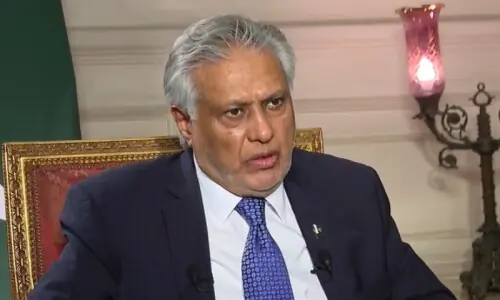
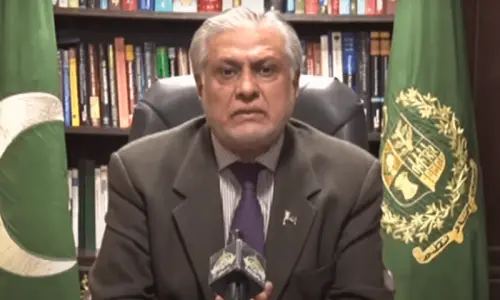
The announcement came as Foreign Minister Ishaq Dar told Al Arabiya in an interview that Pakistan supported a toll-free Hormuz that did not involve permits or any service fees.
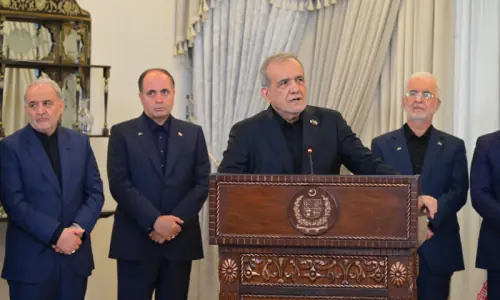
In a joint statement on Tuesday, Iran and Oman emphasised their “sovereign rights over their territorial waters”, but Muscat’s foreign minister said on X that both sides were committed to “toll-free safe passage”. They “agreed to maintain their dialogue on this issue through a joint working group between the two foreign ministries”, the statement quoted by AFP said.
The working group was aimed at reaching “agreement on the future administration of navigation in the Strait of Hormuz and the services that will be provided in this regard and the costs associated with them in accordance with international standards”, they said.
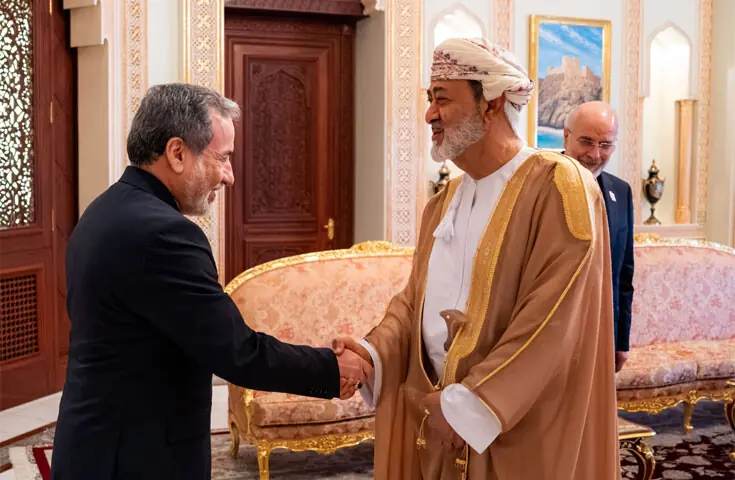
The statement followed meetings in Muscat between top officials from the two nations. Iran’s Foreign Minister Abbas Araghchi and chief negotiator Bagher Ghalibaf met Oman’s Sultan Haitham bin Tariq and Foreign Minister Badr Albusaidi.
Last week, Iran’s foreign ministry said the country would impose what it called maritime service fees for crossing the strait. Mr Ghalibaf said the fees will come into effect after a 60-day period without charges that is stipulated in a memorandum of understanding signed with the United States.
The MoU states that Iran and Oman will discuss its “future administration and maritime services” alongside other Gulf countries.
Optimism for final agreement
In the interview, FM Ishaq Dar spoke about Pakistan’s efforts to broker peace between the US and Iran, the status of negotiations between the two countries, and the Hormuz and nuclear issues being discussed by the two rivals.
Speaking about the MoU signed by the two countries, he said the world was already beginning to see the dividends of peace in the form of reduced energy prices and resumption of traffic in Hormuz. He maintained that the Strait of Hormuz should be restored to pre-conflict status, which “means no fee and no toll at all”. He also recalled his March visit to China, where he said both China and Pakistan agreed, as per a five-point plan, that there should be free movement in the strait.
“No permits, no toll, no additional charge, whatever you name it; it should be free movement and sea lanes should be freely moving [on] both sides,” Mr Dar said. “This is the global understanding,” he said, observing that for “at least 60 days, there will be free movement” within the waterway.
Shifting his attention to the talks in Burgenstock in Switzerland, he called the summit “phase two” of the negotiation process. “There are three technical groups. One is to deal with the nuclear issue, the second is about sanctions and frozen assets and third is Lebanon,” Mr Dar said.
“This new document (MoU) has been divided into two phases,” he said, explaining that the first phase had been completed and signed and urged that no one should doubt the “intentions of the signing parties”. “We have no doubt that they are sincere and want to move forward,” FM Dar said.
“For certain items, they have 30 days to conclude, but the bulk and overall conclusion of the final deal timeline is 60 days, and this can be mutually extendable,” the FM said. He, however, expressed hope that the final agreement will yield positive results. “We have to be sincere to the cause; Pakistan has no personal vested interests, and we did the entire exercise with complete sincerity…” FM Dar said.
When asked about Iran’s uranium stockpile, the minister said that at the time of Islamabad Talks, Iran had expressed flexibility on the issue. “It was at that time a question of US demand that they wanted to take it away. Iran was not willing…but [..] it can be downblended from the claimed 60 per cent,” FM Dar said.
Talking about Lebanon, the foreign minister observed that the issue had “erupted time and again” during the course of the peace process and added that the Switzerland talks were nearly “derailed” due to Israel’s attacks in Lebanon.
Published in Dawn, June 24th, 2026